


Introduction
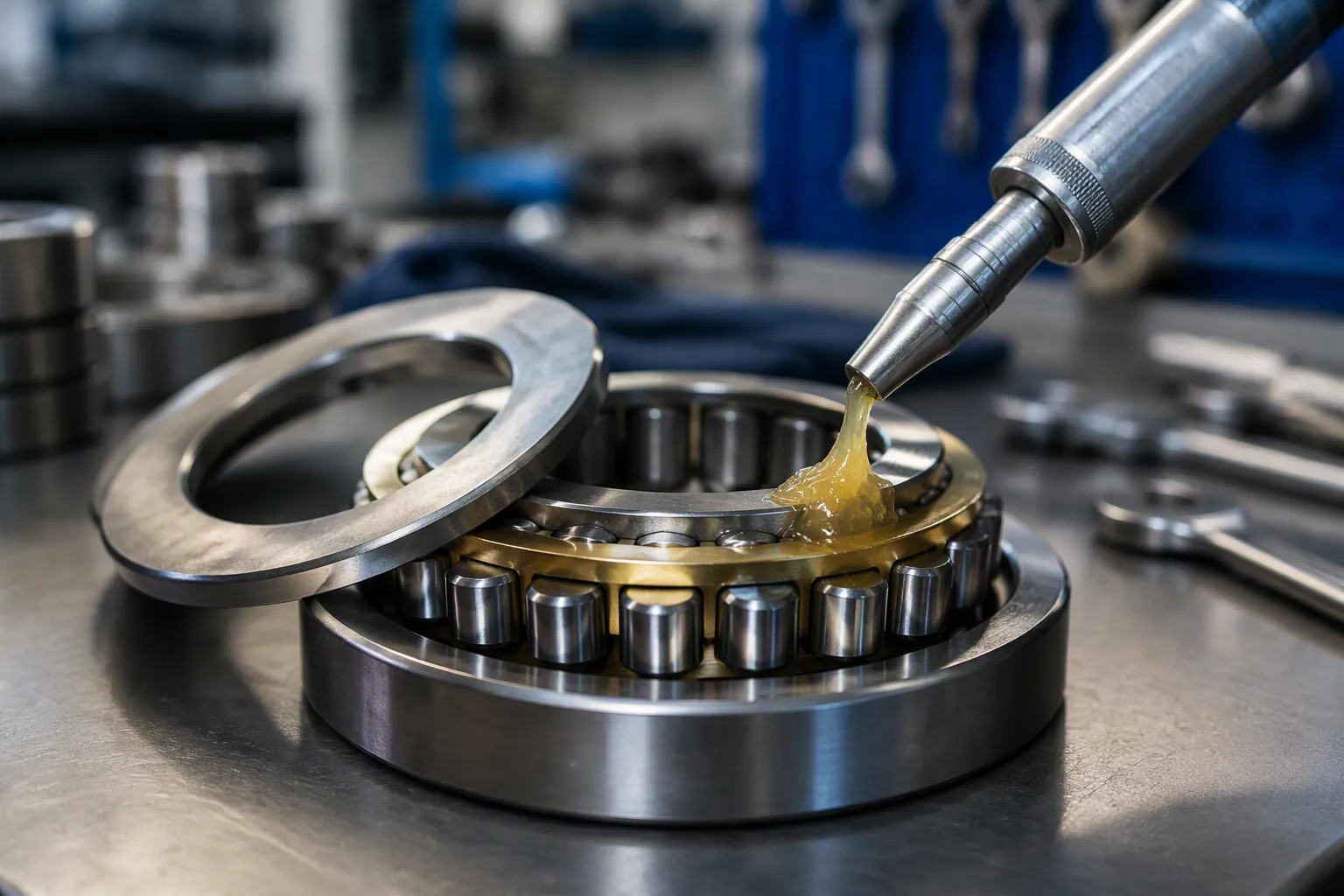
Selecting the correct grease for a thrust roller bearing is essential for achieving reliable performance, extending bearing service life, and minimizing maintenance requirements. Unlike radial bearings, thrust roller bearings are primarily designed to accommodate axial loads, which places unique demands on the lubricant film between the rolling elements and raceways.
There is no single grease that is suitable for every thrust roller bearing application. The optimum grease selection depends on several operating parameters, including:
Applied axial load
Bearing speed
Operating temperature
Lubrication method
Environmental conditions
Relubrication interval
Manufacturer recommendations
In many industrial applications, an extreme pressure (EP) grease is a suitable choice because it provides enhanced protection under heavy loading conditions. For general operating conditions, lithium complex grease is often an effective and economical solution. However, applications involving very high speeds, extreme temperatures, or special environmental requirements may require advanced synthetic lubricants.
The correct approach is not to select grease based only on bearing type, but to match grease performance characteristics with the actual operating conditions.
Select grease according to bearing load, speed, temperature, and operating environment.
Use EP grease when bearings are subjected to high axial loads or shock loading.
Lithium complex grease is a reliable choice for many standard industrial applications.
Synthetic grease is recommended for extreme temperature ranges or high-speed operation.
Always verify grease compatibility, relubrication intervals, and operating limits according to bearing manufacturer specifications.
General Grease Recommendation for Thrust Roller Bearings
High-Pressure Grease for Heavy Axial Loads
Thrust roller bearings operate under concentrated axial loading, requiring a lubricant capable of maintaining a stable protective film between rolling contacts. High-pressure or extreme-pressure (EP) greases are commonly recommended for applications where heavy loads or intermittent shock loads occur.
EP additives chemically react with metal surfaces under high contact pressure, forming a protective layer that reduces the risk of adhesive wear and surface damage. This protection is particularly important in heavily loaded applications where the lubricant film thickness may temporarily decrease.
Typical applications include:
Heavy-duty gear systems
Industrial machinery
Crushers and mills
Construction equipment
Steel-processing equipment
However, EP performance alone should not determine grease selection. Excessive additive levels or unsuitable grease chemistry may affect bearing materials, seals, or lubrication intervals. Compatibility with the bearing manufacturer’s recommendations should always be confirmed.
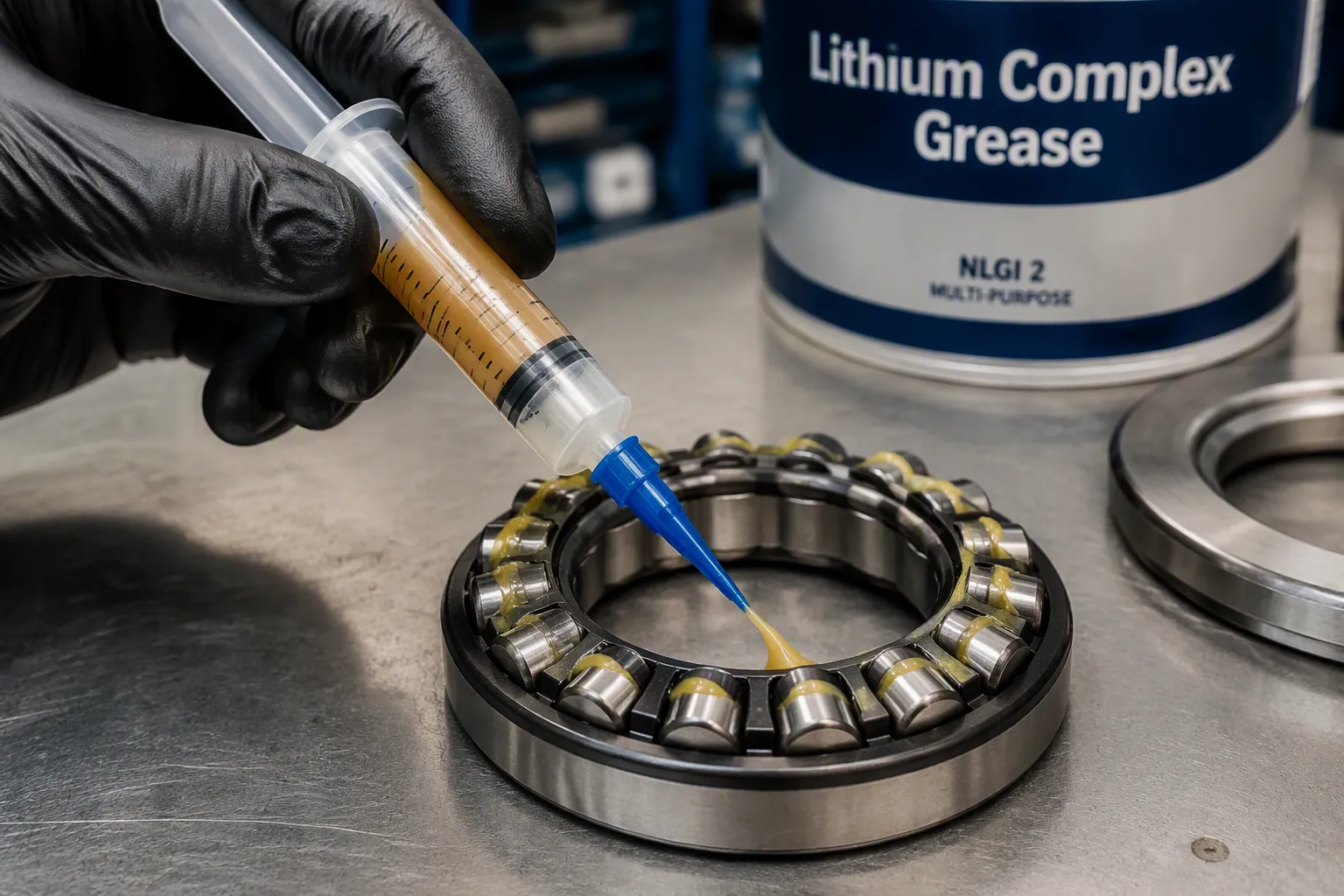
Lithium Complex Grease as a General-Purpose Solution
For many industrial thrust roller bearing applications, lithium complex grease provides an excellent balance between performance, availability, and cost.
Compared with conventional lithium grease, lithium complex grease generally offers:
Property | Conventional Lithium Grease | Lithium Complex Grease |
|---|---|---|
Load-carrying capability | Moderate | Higher |
Temperature resistance | Moderate | Improved |
Mechanical stability | Good | Excellent |
Water resistance | Good | Very good |
Industrial suitability | General applications | Medium to heavy-duty applications |
Lithium complex grease provides good mechanical stability, oxidation resistance, and resistance to softening during operation. These properties make it suitable for bearings exposed to vibration, moderate loads, and continuous operation.
Typical applications include:
Electric motors
Pumps
Conveyors
Fans
General industrial machinery
The advantage of lithium complex grease is its operating margin. When applied within appropriate load and temperature limits, it maintains grease consistency and lubrication performance over extended service periods.
When Synthetic Grease Should Be Considered
Some thrust roller bearing applications exceed the operating limits of conventional mineral oil-based greases. High rotational speeds generate additional frictional heat, while extreme temperatures can accelerate oxidation and lubricant degradation.
Synthetic greases based on polyalphaolefin (PAO), ester, silicone, or PFPE base oils provide improved performance under demanding conditions.
Synthetic grease may be required when:
Bearing temperatures are continuously elevated
Start-up temperatures are very low
High-speed operation increases churning losses
Extended lubrication intervals are required
Equipment reliability is critical
For example, PAO-based synthetic greases provide excellent viscosity stability over a wide temperature range and are commonly used in high-temperature electric motors, generators, and continuously operating industrial equipment.
Specialized spindle applications may require low-friction synthetic greases designed for very high DN values. In these cases, grease quantity, bearing design, and operating speed must be carefully considered because excessive grease filling can significantly increase operating temperature.
Engineering Principle
The correct grease selection strategy can be summarized as follows:
Standard operating conditions → Lithium complex grease
Heavy axial loads or shock loads → EP grease
Extreme temperature or high-speed applications → Synthetic grease
The best lubricant is not necessarily the most expensive product, but the one whose properties match the bearing’s actual operating requirements.
Matching Grease to Load, Speed, and Temperature
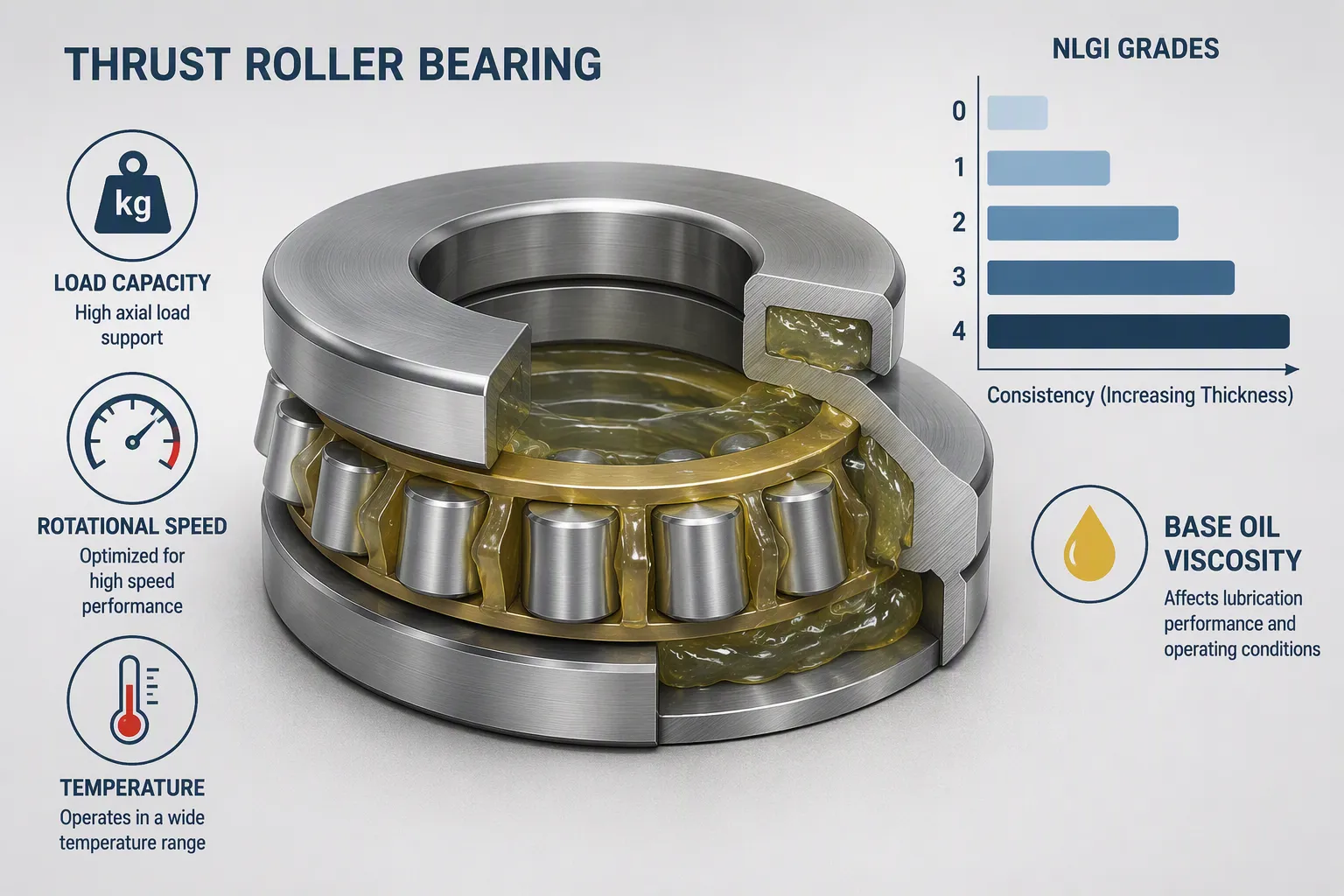
You must evaluate three operating factors before choosing grease for your Thrust Roller Bearing. Load determines how much pressure the grease film must withstand. Speed affects how quickly the grease gets churned and worked inside the bearing. Temperature influences the grease’s ability to maintain proper viscosity and structure.
The consequences of getting this wrong are severe. Using a grease with incorrect viscosity creates a mismatch with your bearing’s operational speed and load. A high-speed grease under heavy loads will suffer film failure. That failure leads to increased friction, overheating, and rapid bearing wear. The base oil viscosity determines the thickness of the lubricating film. When that film becomes too thin for the applied load, metal surfaces touch and damage begins.
Temperature plays a critical role in your selection. Different base oils operate within distinct temperature windows:
PAO synthetic grease: –40°C to 150°C
Ester grease: –20°C to 180°C
Silicone grease: –50°C to 200°C
PFPE grease: –70°C to 250°C+
High-temperature greases rely on synthetic oils and stable thickeners such as PTFE or polyurea. These combinations resist oxidation and prevent oil separation when temperatures climb. For applications that stay within moderate ranges, mineral oil grease provides adequate protection at lower cost.
You should also consider the speed factor, often expressed as DN. Higher speed factors demand greases with better shear stability. Products like Mobiltemp SHC 100 handle high pressure and high-speed conditions effectively. This grease maintains its structure under centrifugal forces that would throw thinner greases out of the bearing.
Understanding NLGI Grades and Base Oil Viscosity
The National Lubricating Grease Institute (NLGI) assigns grades based on grease consistency. Lower numbers indicate softer grease that flows more easily. Higher numbers mean stiffer grease that resists displacement. Your operating temperature and speed factor should guide your grade selection.
At lower temperatures ranging from –30°F to 100°F, you should choose NLGI 1 or 2. These softer grades allow easier starting and better flow during cold operation. Moderate temperatures between 0°F and 150°F call for NLGI 2 or 3. High-temperature environments from 100°F to 275°F also require NLGI 2 or 3, with higher grades suited for elevated speed factors.
For low ambient temperatures, NLGI 1 grease performs best. Its softer consistency lets it flow into contact zones even when equipment sits idle in cold conditions. For very high-speed conditions, the recommended NLGI grade is #3. This applies to thrust roller bearings as a bearing type, as the guidance is general across bearing categories.
For very high-speed conditions, the recommended NLGI grade is #3.
Base oil viscosity deserves equal attention. The oil component, not the thickener, provides the actual lubricating film. You need oil thick enough to separate surfaces under load yet thin enough to flow at operating temperature. Mineral oils with extreme pressure additives offer good rust protection for general industrial use. Synthetic base oils maintain more consistent viscosity across wider temperature ranges.
When you match NLGI grade and base oil viscosity to your actual conditions, you prevent premature failure. A grease that suits your load, speed, and temperature will maintain its structure, resist oxidation, and keep your bearing protected between maintenance intervals.
Comparing Grease Types for Different Needs
Lithium-Based Greases for Most Applications
Lithium-based greases serve as the workhorse for most bearing applications. Their excellent versatility makes them the most commonly used lubricant for ball and roller bearings. You will find them suitable for a wide range of machinery, from automotive components to industrial equipment. They remain stable under varying conditions, which simplifies your grease selection process.
Advantage | What It Means for You |
|---|---|
Versatility | Works across many bearing types and operating conditions |
Availability | Widely stocked by suppliers, making procurement easy |
Cost | Moderate price point compared to specialty synthetics |
Water resistance deserves your attention when choosing a grease. Standard lithium grease offers good water resistance for most environments. Lithium complex grease performs slightly better in wet conditions. However, you should note that lithium complex grease’s water washout and rust protection can lag behind calcium sulfonate in persistently wet or salty environments.
Lithium complex grease’s water washout and rust protection can lag behind calcium sulfonate in persistently wet or salty environments.
For a Thrust Roller Bearing operating in a typical factory setting, lithium complex grease provides dependable protection. It handles moderate loads, resists water exposure, and maintains its structure through vibration. You gain reliable performance without paying premium prices for synthetic alternatives.
Synthetic Greases for Extreme Conditions
When your application pushes past conventional limits, synthetic greases deliver the protection you need. These products use engineered base oils that withstand temperature extremes and high speeds far better than mineral oils.
Mobiltemp SHC 100 grease exemplifies this category. Its polyalphaolefin (PAO) base fluid operates across a remarkable temperature range. The organo-clay thickener provides excellent resistance to thermal and oxidative degradation. You can rely on this grease for high-speed bearings and thrust bearings running continuously at elevated temperatures.
For precision CNC spindles, Kluber NBU 15 stands as the specialized choice. This ultra-filtered grease meets the demanding requirements of high-speed spindle bearings. You must follow proper packing procedures to achieve optimal results:
Grease fill should be 15% of the open area for angular contact bearings
Roller bearings require only 10% fill to prevent overheating
Over-packing causes temperature spikes and premature failure
Users report that Kluber NBU 15 performs adequately once break-in cycles complete. One machinist running tapered roller bearings at 8000 rpm saw temperatures stabilize around 91–93°C after several thermal cycling runs. The grease maintained protection within the bearing’s maximum operating temperature of 120°C.
Your choice between lithium and synthetic grease depends on your operating reality. Standard conditions favor cost-effective lithium products. Extreme speeds, temperatures, or precision requirements justify the higher investment in synthetics. Match the grease chemistry to your actual demands, and your Thrust Roller Bearing will deliver reliable service.
Your choice of grease for a thrust roller bearing requires careful evaluation. You must consider load, speed, temperature, and the operating environment. High pressure grease handles demanding axial loads most effectively. Lithium complex grease serves well under general operating conditions. For precision CNC spindles, you need specialized products like Kluber NBU 15. This grease performs at very high speeds while maintaining low friction characteristics. Always consult your manufacturer specifications for exact grease requirements. Follow proper relubrication intervals to protect your investment. These steps extend bearing service life and prevent unexpected downtime. Your equipment runs reliably when you match grease to actual conditions. A methodical approach yields the best results.
FAQ
How often should you relubricate a thrust roller bearing?
For maximum reliability, reduce your regreasing interval to about half the standard time. This practice ensures fresh grease reaches all contact surfaces before the old supply degrades. Monitor bearing temperature regularly. Rising temperatures often signal that lubrication has broken down and needs attention.
Can you mix different grease types?
You should avoid mixing different grease types. Incompatible thickeners can separate, causing the grease to lose its structure and fail prematurely. If you must switch products, clean the bearing housing thoroughly first. Then apply the new grease completely. This prevents chemical reactions between different formulations.
How much grease should you apply?
Over-packing causes temperature spikes and premature failure. For roller bearings, fill only 10 percent of the open area. Angular contact bearings need 15 percent fill. These levels prevent overheating while maintaining adequate lubrication. Follow manufacturer specifications for your specific bearing design.
What signs indicate grease failure?
Watch for rising bearing temperatures, increased noise, or visible grease leakage. These symptoms suggest the grease has degraded or washed out. Check the grease color and consistency during routine maintenance. Dark, stiff, or separated grease needs immediate replacement. Early detection prevents costly bearing damage.
See Also
Using FAKKT-GC874K Synthetic Grease To Improve Automotive Reliability
What You Must Know About Grease For Harmonic Drive Reducers
The Effect Of Colloidal Stability On Grease Performance
Key Traits That Make High-Performance Industrial Grease Exceptional
Solving Modern Automotive Challenges With FAKKT Grease Solutions