


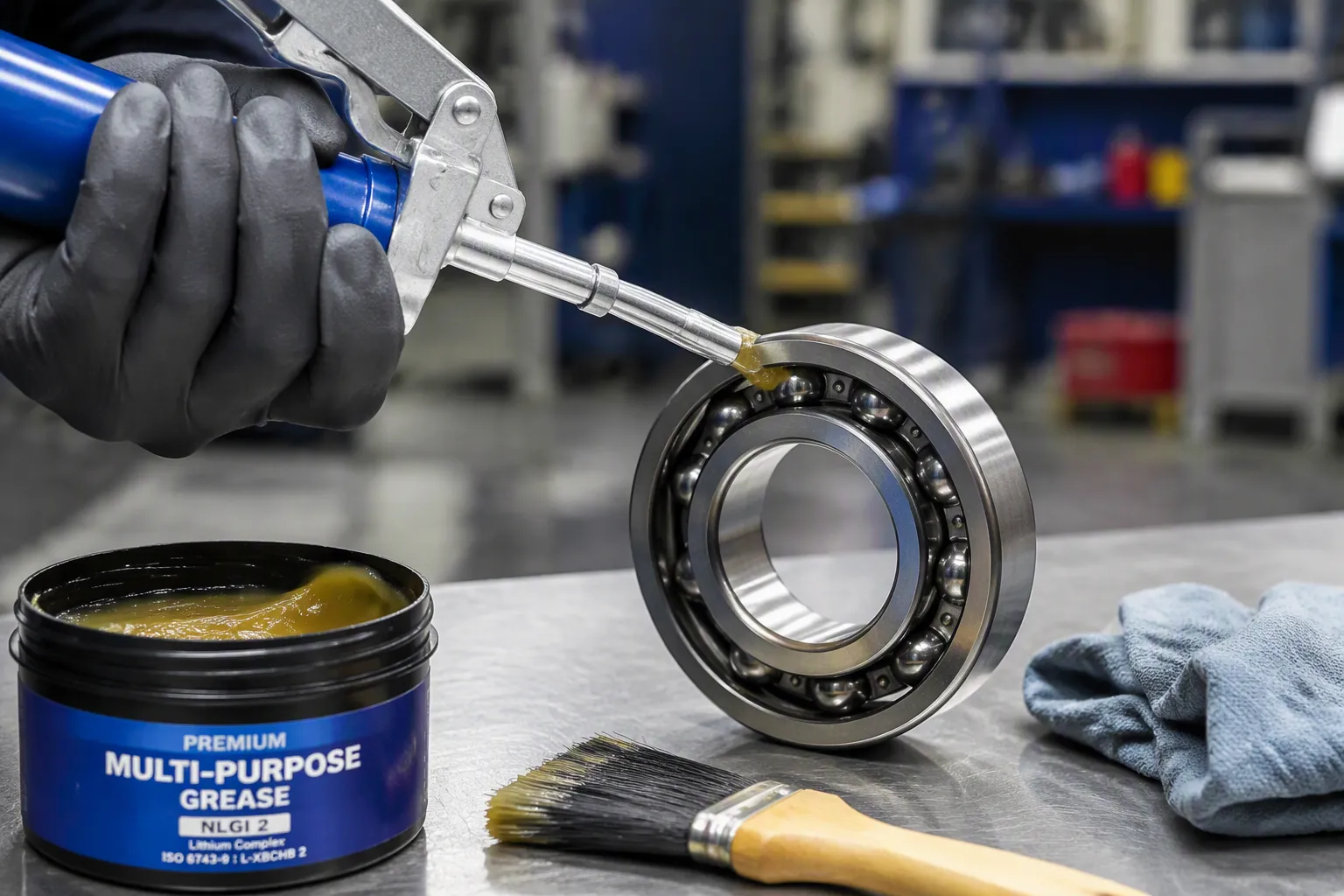
Bearing failure costs manufacturers thousands in downtime and replacement parts. Improper lubrication causes approximately 80% of all premature bearing failures, according to data from the American Bearing Manufacturers Association (ABMA). Standard deep-groove bearings tolerate sloppy greasing practices. An Angular Contact Ball Bearing (ACBB) demands precision. Its asymmetric raceway design directs combined radial and axial loads along a specific contact angle, concentrating stress across a narrow elliptical contact zone per Hertzian contact mechanics. Grease must reach this exact contact zone to form a load-bearing film.
You probably wonder, “How much grease is enough?” You also ask, “What is the correct method?” Getting this wrong leads to overheating, churning, and early failure. Getting it right keeps your equipment running smoothly.
Following these guidelines maximizes your bearing’s service life. Your machinery will run reliably for years. Your maintenance costs will drop significantly. You will perform this task with professional confidence.
Key Takeaways
Use grease formulated for high-temperature stability and extreme pressure (EP) additives for angular contact bearings, per SKF and NSK engineering specifications.
Fill the bearing cavity to 30–50% of its free volume for general industrial speeds; reduce to 20–30% for high-speed spindle applications, in alignment with ABMA Standard 9 and ISO 281:2007 best practices.
Apply grease with a needle nozzle directly to the loaded side of the bearing for effective lubrication of the Hertzian contact zone.
Avoid over-greasing: excess grease causes churning, heat buildup, and premature bearing failure — a top cause of spindle downtime documented by Schaeffler Technologies.
Sealed bearings are factory-filled to 20–24% of free volume and designed for life-long lubrication; re-greasing compromises seal integrity and is generally not recommended by SKF.
Selecting Grease for Angular Contact Ball Bearings
Key Grease Properties and Additives
Your Angular Contact Ball Bearing operates under concentrated stress. The contact zone between each ball and raceway forms an elliptical area under Hertz contact theory, where surface pressures can exceed 2 GPa in heavily loaded applications. Standard general-purpose grease cannot handle this pressure. You need a lubricant with appropriately matched base oil viscosity to form a cohesive film that separates metal surfaces during operation.
Base oil viscosity must be matched to operating speed and temperature, as specified in ISO 281:2007. For most industrial ACBB applications, ISO VG 32 to VG 68 base oils are recommended; high-speed machine tool spindles typically use ISO VG 15 to VG 32 for reduced churning drag. The viscosity index (VI) matters too — synthetic PAO base oils with high VI maintain film thickness across temperature swings far better than mineral oils, per SKF lubrication engineering guidelines.
Extreme pressure additives matter just as much. These EP additives (typically sulfur-phosphorus chemistry) significantly increase the grease’s load-bearing capacity by forming a sacrificial protective layer on bearing surfaces. This layer prevents metal-to-metal contact during shock loads and peak load operation. Greases containing EP additives offer superior protection for angular contact bearings, which carry combined radial and axial loads that concentrate stress on the raceway shoulders. NSK’s ABC of Bearings handbook specifically recommends EP-enhanced lithium complex or polyurea greases for ACBBs operating under heavy or variable loads.
Load-carrying additives help to improve wear protection under high load conditions. Polyurea-thickened greases are particularly well-suited for high-speed ACBB applications due to their excellent oxidation resistance and mechanical shear stability, making them a standard choice for electric motor and machine tool spindle bearings.
Household Substitutes to Avoid
You might wonder about household substitutes. Do not use them. They lack the engineered formulation required for proper bearing lubrication. Field experience from industrial maintenance teams consistently documents rapid failure when these substitutes are used:
表格
Substance | Impact on Bearing Lifespan | Field Evidence |
|---|---|---|
WD-40 | Acts as a temporary lubricant that quickly evaporates (1–4 weeks), leaving bearing surfaces dry and stripped of original grease. This causes increased friction, wear, and reduced lifespan. | A Midwest metal stamping plant reported a 75% reduction in motor bearing life after maintenance staff used WD-40 as a stop-gap lubricant on conveyor line bearings. |
Petroleum jelly (Vaseline) | Too thick to penetrate bearing contact surfaces; instead it collects dust and debris, leading to contamination, abrasive wear, and accelerated failure. | Food processing facility data shows bearing life dropped by 60% when petroleum jelly was substituted for NSF-approved food-grade grease on washdown conveyor hinges. |
These substitutes fail because they lack film strength and protective additives. Your bearing will fail rapidly. You will face costly repairs and downtime.
Tools for Precise Application
Applying grease correctly requires the right equipment. A manual grease gun works well for most maintenance tasks. A pneumatic grease gun suits high-volume operations. Both need a needle nozzle attachment with an 18–20 gauge tip, per SKF recommended practice for precision bearing lubrication.
The needle nozzle delivers grease precisely. It reaches into small cavities between balls and cage. This precision matters for angular contact designs, where the contact zone is offset from the bearing centerline. The nozzle directs grease exactly where it belongs. You avoid wasting lubricant on outer surfaces that do not participate in load transfer.
Choose a grease gun with a flexible hose. This feature lets you access tight spaces around mounted bearings. A rigid nozzle forces awkward angles. You might miss critical lubrication points. For high-volume maintenance, calibrated grease guns that deliver a fixed volume per stroke eliminate guesswork and ensure consistent fill volumes.
Clean your tools before each use. Dirt and old grease contaminate fresh lubricant. Contaminated grease damages bearing surfaces. It introduces abrasive particles that score raceways, initiating spalling and premature fatigue failure per ISO 15243 bearing failure classification.
Store your grease gun properly. Keep it covered when not in use. This prevents dust accumulation. Your equipment stays ready for the next lubrication task.
Step-by-Step Greasing Procedure
Greasing Open Bearings
Open bearings give you full access to the internal components. This design makes them ideal for re-greasing. Follow these steps to achieve professional results with your Angular Contact Ball Bearing, aligned with SKF standard maintenance procedures:
Clean the work area and bearing exterior. Dirt poses a serious threat. Any contaminant that enters the bearing will score the raceways. Wipe the outer surfaces with a lint-free cloth. Ensure your grease gun nozzle stays clean throughout the process.
Verify grease compatibility. Check whether the new grease matches any residual lubricant inside the bearing. Mixing incompatible greases causes the thickeners to break down. This degradation ruins the lubricating properties. When in doubt, flush the old grease completely with a compatible solvent before applying fresh lubricant. Lithium complex and polyurea greases are generally incompatible; always confirm with the manufacturer if switching chemistries.
Calculate the correct grease amount. The bearing cavity should hold only 30–50% of its free volume for general industrial speeds. For high-speed applications (speed factor A > 500,000 mm/min), reduce fill to 20–30% per SKF super-precision bearing guidelines.
Calculation Example: 7210AC Angular Contact Ball Bearing
Bearing dimensions: bore d = 50 mm, outer diameter D = 90 mm, width B = 20 mm
Approximate free volume inside bearing: ~12.7 cm³
Recommended initial fill (40% of free volume for general speed): 0.4 × 12.7 = 5.1 cm³
For side relubrication per SKF formula: Gₚ = 0.005 × D × B = 0.005 × 90 × 20 = 0.9 grams per relube
For relubrication through outer ring holes: Gₚ = 0.002 × D × B = 0.002 × 90 × 20 = 0.36 grams per relube
This space allows the grease to move and expand during operation. Overfilling leaves no room for this movement. Underfilling starves the rolling elements. Both scenarios lead to premature failure.
Apply the grease with precision. Wear clean gloves for manual application. Work the grease evenly around the bearing elements. Aim the grease gun nozzle between the balls and the cage, on the loaded side of the bearing. This position delivers lubricant directly to the critical contact zone where the balls press against the raceway shoulder.
Rotate the bearing slowly during application. This action distributes the grease uniformly across all rolling elements and races. You achieve a consistent coating without gaps or excess buildup. Continue rotating until you see grease emerge evenly around the entire circumference.
Run-in the bearing at low speed. SKF strongly recommends a 10–30 minute run-in period at 20–30% of operating speed after re-greasing. This allows excess grease to be displaced and the remaining lubricant to distribute evenly. Skipping this step risks temperature spikes that can cause premature grease degradation.
Establish a re-lubrication schedule. Operating hours determine the frequency. High-speed applications demand attention every 1,000 operational hours. Lower-speed setups may extend intervals to 5,000 hours. Per NSK guidelines, reduce the relubrication interval by half for every 15°C rise in operating temperature above 70°C. Mark your calendar and stick to the schedule.
Monitor performance after greasing. Check the lubricant condition every 3–6 months. Record the bearing temperature during operation. Keep temperatures below 70°C as a general baseline to protect bearing components. Higher temperatures indicate problems with grease quantity or type.
Greasing Sealed and Shielded Bearings
Sealed and shielded bearings present a different challenge. Manufacturers pre-lubricate these units at the factory. SKF seals its super-precision ACBBs with high-grade low-viscosity grease filling 20–24% of the free internal volume, optimized for the bearing’s entire service life. Re-greasing these bearings is rarely necessary or recommended.
The shield or seal blocks access to the internal components. You cannot reach the rolling elements without removing this barrier. Attempting to pry off a shield risks permanent damage. The metal shield bends easily. The seal loses its protective properties.
Specialized injectors exist that pierce the seal. These tools deliver grease through a small hole. However, this approach compromises the seal’s integrity. Contaminants can enter through the puncture point. Moisture finds its way inside. The bearing’s protection diminishes significantly.
Replacement often represents the safer option. A new sealed bearing costs less than the downtime caused by a failed re-greasing attempt. The factory lubrication provides optimal performance. You avoid the risks associated with seal damage.
Consider the application requirements before deciding. If the bearing operates in a clean environment with moderate loads, replacement makes sense. If you absolutely must re-grease, use the specialized injector. Accept that the bearing will require more frequent monitoring afterward.
Pro Tip for Mounting: When mounting any bearing onto a shaft, apply a thin layer of grease to the raceway first. This practice prevents scratching during seating. The initial lubrication protects the surfaces before operation begins. This simple step extends the life of your Angular Contact Ball Bearing significantly.
Determining Correct Grease Quantity
The 30–50% Fill Rule
The grease cavity inside your Angular Contact Ball Bearing needs a specific fill level. You should fill it to 30–50% of its free volume for general industrial applications. This measurement is the fill factor. It determines how well your bearing performs.
The free volume means the empty space inside the bearing after you install it. This space includes gaps between balls, cage pockets, and raceway channels. You need to estimate this volume before applying grease. Most bearing catalogs list this dimension, or you can approximate it using geometric calculations.
Why does this range matter so much? The grease needs room to move during operation. As the bearing spins, centrifugal force pushes grease outward. The rolling elements redistribute the lubricant across the raceways. A 30–50 percent fill gives the grease space to circulate properly.
Fill level must be adjusted for operating speed, per NSK official lubrication guidelines:
≤ 50% of limiting speed: Fill 1/2 to 2/3 of free space (50–67%)
> 50% of limiting speed: Fill 1/3 to 1/2 of free space (33–50%)
High-speed super-precision spindles: Fill < 30% of free space, per SKF S70/S719 series specifications
Research on high-speed sealed angular-contact ball bearings confirms this principle. Controlled experiments published in Proceedings of the 6th International Conference on Mechatronics, Materials, Biotechnology and Environment compared different grease quantities under various operating conditions. The results showed an optimal fill level for minimizing operating temperature. The relationship between grease quantity and temperature is not linear. Both insufficient and excessive amounts lead to suboptimal thermal behavior. A specific optimal point exists, determined through empirical testing.
You might think more grease means better lubrication. This assumption fails in practice. The 30–50 percent rule balances two competing needs. You need enough grease to separate metal surfaces. You also need empty space for heat dissipation and grease movement.
Risks of Over-Greasing
Over-greasing creates a problem called churning. The rolling elements must push through excess grease with every rotation. This action consumes energy. It generates friction between grease molecules. That friction converts mechanical energy into heat.
Real-World Case Study: CNC Machine Tool Spindle A precision machine shop in Ohio reported repeated spindle overheating on a vertical machining center. Inspection by Atlanta Precision Spindles found that the 7014C angular contact bearing set had been over-greased during a maintenance overhaul — filled to approximately 65% of free volume. Operating temperature had risen from a baseline 65°C to 82°C, and spindle accuracy had degraded by 0.008 mm due to thermal expansion. After draining excess grease and performing a proper run-in cycle, operating temperature dropped back to 67°C within 2 hours, and spindle accuracy was restored.
The heat problem compounds quickly. Excess grease cannot dissipate heat effectively. It acts as an insulator rather than a coolant. Bearing temperatures rise well above normal operating ranges. High temperatures degrade the grease’s base oil. The oil oxidizes and thickens. Lubricating properties deteriorate. The bearing eventually fails from thermal damage.
Churning also increases torque. Your Angular Contact Ball Bearing requires more force to rotate. Motors draw more current. Energy costs rise. Mechanical components experience additional stress. This strain affects the entire machine, not just the bearing.
Under-greasing causes different problems. Without enough grease, the bearing suffers from starvation. Rolling elements run dry against raceways. Metal-to-metal contact occurs. This contact generates rapid wear. Scoring and pitting appear on bearing surfaces. Premature failure follows quickly.
The 30–50 percent rule protects you from both failure modes. It provides sufficient lubrication for normal operation. It leaves room for grease expansion as temperatures rise. It allows excess grease to escape through seals without building pressure.
You should measure grease carefully during application. Use a calibrated grease gun when possible. Track how many pumps you deliver. Each pump delivers a known volume. Compare this volume against your calculated fill factor. This approach prevents guesswork and ensures consistent results.
Temperature monitoring helps you verify correct fill levels. Record bearing operating temperatures after greasing. Compare readings against baseline data. A sudden temperature increase often indicates over-greasing. A gradual rise may signal inadequate lubrication. Adjust your fill factor accordingly.
Mounting and Design Considerations
Orientation and Grease Flow
The contact angle of your Angular Contact Ball Bearing determines everything about grease placement. Angular contact bearings have raceways displaced axially relative to each other, creating a contact angle (typically 15° for C-type, 25° for AC-type per SKF designation standards). This angle creates a specific load path through the bearing. This path defines where the rolling elements press hardest against the raceway shoulder — the loaded shoulder. You must direct grease to this loaded side. The bearing then draws lubricant naturally into the contact zone during rotation.
Consider how the bearing sits in your machine. The load direction rarely points straight through the shaft. It arrives at an angle matching the bearing’s contact angle. You need to identify this loaded region before applying grease. Look at the housing design and shaft orientation. These clues reveal where the load concentrates.
Apply grease to the unloaded side and you waste most of it. The rolling elements push lubricant away from the contact zone. Starvation occurs exactly where you need protection most. The raceway wears rapidly. Premature failure follows despite your lubrication effort.
Direct Lubrication Techniques
High-speed applications demand a different approach. Direct grease lubrication through the outer ring offers superior results. Many bearing housings include a lubrication hole for this purpose. You inject grease straight into the bearing cavity through this port. The lubricant reaches the rolling elements without traveling across external surfaces.
This technique provides efficient cooling during operation. Fresh grease continuously replaces depleted lubricant. You reduce maintenance intervals significantly. The bearing runs cooler and cleaner.
Your nozzle angle matters during direct lubrication. Aim the nozzle to match the bearing’s internal geometry. The grease must flow into the cage pockets rather than bounce off the cage surface. Cage pocket depth also influences grease distribution. Deeper pockets hold more lubricant near the rolling elements. Shallower pockets require more frequent application.
Study your specific bearing design before choosing an application method. Each bearing model has unique internal clearances and cage configurations. Adapt your technique accordingly. The extra attention ensures every drop of grease reaches its intended destination. Your careful approach prevents costly bearing failures and extends equipment life.
FAQ
Can I mix different grease brands or types?
No. Mixing incompatible greases breaks down the thickeners. This ruins the lubricating properties. Always flush the old grease completely before adding a different type.
How often should I re-grease an angular contact ball bearing?
High-speed applications need grease every 1,000 operating hours. Lower-speed setups can extend intervals to 5,000 hours. Monitor bearing temperature and adjust the schedule as needed.
What happens if I over-grease the bearing?
Excess grease causes churning. The rolling elements push through thick grease, generating excess heat. Temperatures rise and damage both the lubricant and the bearing. Follow the 30-50% fill rule.
Can I re-grease a sealed or shielded bearing?
Manufacturers pre-lubricate these bearings for their full service life. Re-greasing requires piercing the seal, which invites contamination. Replacement is normally the safer and more reliable option.
See Also
New Technical Bulletin Shows FAKKT-GC874K Grease Boosts Car Reliability
What You Should Know About Grease For Harmonic Drive Reducers
How FAKKT Grease Solutions Overcome Modern Automotive Challenges Today
The Impact Of Colloidal Stability On Grease Performance Explained
Key Qualities That Make High-Performance Industrial Grease Exceptional