


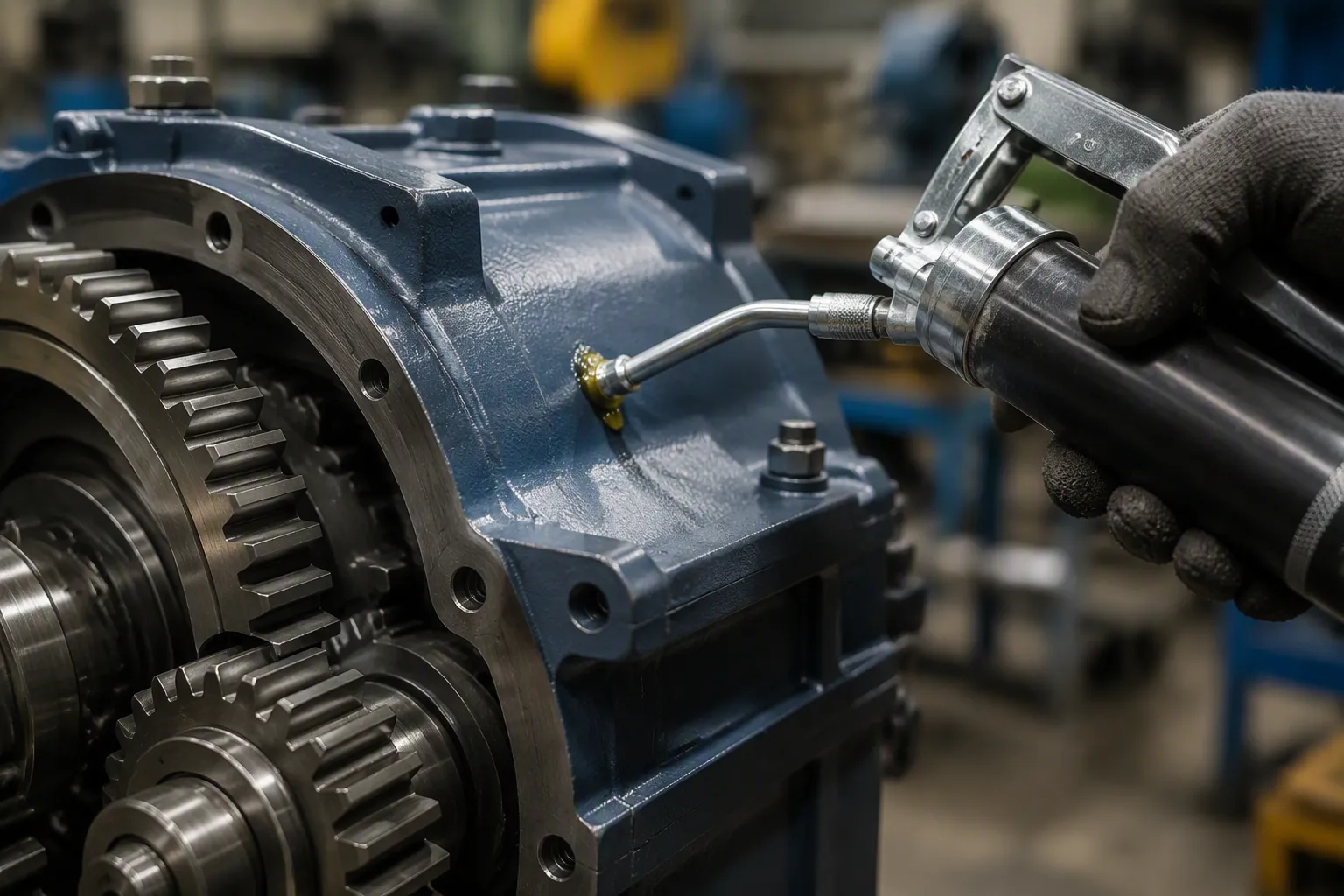
Before you select a Grease for Heavy-duty Planetary Gearbox, you must answer one question: can the system shed heat passively? Grease traps heat inside the gear mesh. Oil circulates and carries heat away. This makes lubrication a thermal decision, not a preference.
Three thresholds are non-negotiable. Pitch line velocity must stay below 1 m/s. Sump temperature must remain under 80°C. The duty cycle must be intermittent, allowing cool-down periods. If any threshold fails, oil wins.
Poor lubrication causes 14% of planetary gearbox failures. The financial impact is severe:
Cost Metric | Reported Value |
|---|---|
Average unplanned gearbox failure | $250K–$500K |
Unplanned gearbox replacement | $150K–$500K |
Average cost per unplanned failure (steel mills) | $350K+ |
This article guides you through a decision tree. First, verify grease viability. Then, match the grease properties to your load.
Key Takeaways
Grease is a thermal decision. Use it only if your gearbox runs slow, stays cool, and stops often.
Three rules must hold: speed under 1 m/s, temperature under 80°C, and duty cycle with breaks.
Pick a grease with thick oil (ISO VG 320-680), a lithium complex thickener, and NLGI 1 or 2 grade.
A regular re-greasing schedule costs little but prevents expensive failures worth hundreds of thousands of dollars.
Thermal Limits: When Grease for Heavy-duty Planetary Gearbox Works
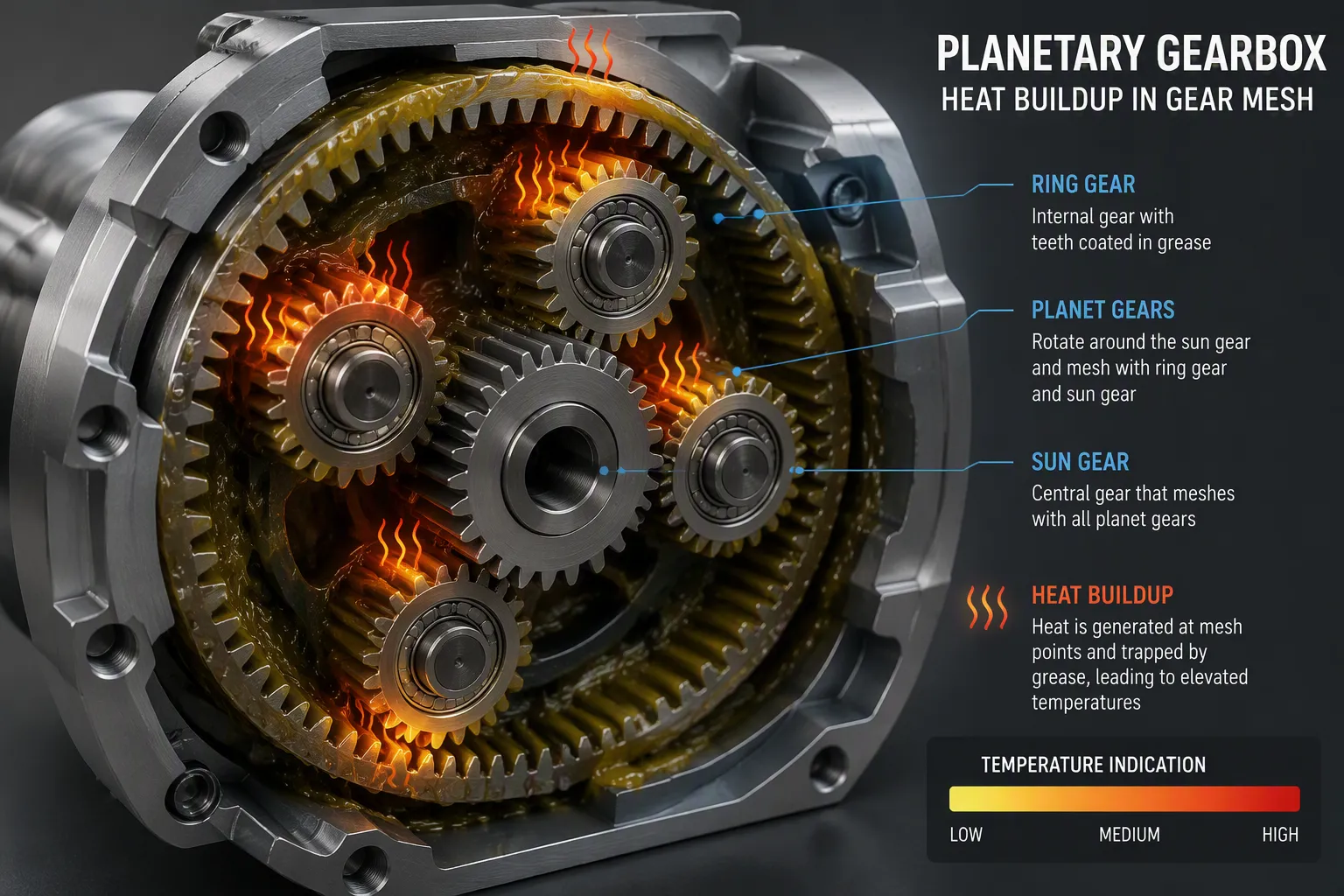
Heat Trapping vs. Heat Dissipation
The core difference between grease and oil comes down to heat movement. Oil circulates through the gearbox. It absorbs heat at the mesh point and carries it to the housing walls. There, the heat dissipates into the surrounding air. Grease does not circulate. It stays in place. This means the heat generated by meshing teeth stays trapped inside the gear mesh area. That trapped heat changes the thermal balance of the system. It forces the gearbox to operate at a higher baseline temperature than an oil-lubricated unit would.
You encounter a measurable consequence when you substitute grease for oil. Direct comparative measurements show that operating temperature rises by 15 to 20 degrees Celsius in the same gearbox housing. The measurement comes from direct comparison of the same gearbox design. Why does this happen? Grease has a higher base viscosity than oil. It also contains a thickener matrix. These properties increase fluid friction between meshing teeth. More friction means more heat. And that heat stays trapped at the source.
Planetary gearboxes make this problem worse. Multiple planet gears mesh simultaneously. They all generate heat at the same time. And they do this inside a compact housing with limited surface area for heat dissipation. The housing wall is the only path for heat to escape. Oil would circulate and spread this heat across the entire housing wall. Grease cannot do that. It remains stationary. It traps thermal energy right where the heat is generated. This creates a localized hot spot that drives up the overall operating temperature.
You must understand this fundamental trade-off. Grease provides convenience. It stays in place and requires no circulation system. But it trades away thermal performance. Every time you choose a Grease for Heavy-duty Planetary Gearbox application, you accept this thermal penalty. The question is whether your system can absorb that penalty without damage.
Why Oil Wins When Heat Load Rises
The evidence is clear. Grease lubrication is unsuitable for high load and continuous operation in enclosed gear systems. The cooling effect of grease is inferior to that of lubricating oil. Under sustained high load, the inadequate cooling leads to a measurable rise in operating temperature. This is not a marginal difference. It is a fundamental limitation of the lubricant type.
Think about what happens inside a heavily loaded planetary gearbox. The final stage carries the highest torque. The gear teeth press together with enormous force. This pressure generates significant heat at the contact point. With oil, the circulating fluid absorbs this heat and moves it away from the mesh. With grease, the heat accumulates at the mesh point. The temperature climbs. There is no relief until the gearbox stops and cools down. That is why intermittent duty is essential for grease survival.
The decision between grease and oil is not a preference. It is a thermal management decision. You must evaluate your duty cycle honestly. If the gearbox runs continuously under high load, grease will not provide adequate cooling. The temperature will rise beyond safe limits. Base oil will oxidize. Thickener will break down. The grease will lose its lubricating properties. Metal-to-metal contact follows. Then you face gear failure and costly downtime.
Manufacturers often recommend lithium soap grease with NLGI grade 1 or 2 for grease-lubricated planetary units. But this recommendation comes with a condition. It only applies within the thermal envelope. You must keep pitch line velocity below 1 m/s, sump temperature below 80°C, and the duty cycle intermittent. These limits are not suggestions. They are hard boundaries. If any of these conditions fail, even the best grease cannot protect your gearbox. Selecting a Grease for Heavy-duty Planetary Gearbox means first confirming your system operates within these limits.
The thermal limits define whether grease is even an option. Do not skip this step. Verify the operating envelope first. Then you can move to selecting the specific grease properties that match your load.
Operating Envelope: 3 Critical Thresholds
Pitch Line Velocity: The 1 m/s Speed Limit
Pitch line velocity measures the speed of the gear tooth contact point. It does not measure shaft RPM. These two values differ significantly. A small pinion rotating at 100 RPM has a much lower pitch line velocity than a large gear at the same speed. You must calculate pitch line velocity from the pitch diameter and rotational speed of the gear.
The 1 m/s limit exists because grease cannot replenish fast enough beyond this speed. At higher velocities, the grease channels away from the mesh point. The tooth surfaces run dry. Metal-to-metal contact follows. This limit applies to the fastest gear in the planetary set, typically the sun gear or the final stage planet gears.
You can estimate pitch line velocity with this formula: pitch line velocity = π × pitch diameter × rotational speed. Use consistent units. Measure pitch diameter in meters and rotational speed in revolutions per second. The result gives you the speed of the tooth contact point in meters per second.
Sump Temperature and Duty Cycle: The 80°C and Intermittent Rule
Sump temperature must stay below 80°C. This threshold protects the grease structure. Above this temperature, oxidation accelerates rapidly. The rate of oxidation in grease depends mainly on temperature. When oxidation occurs, acidic products build up. These acids attack the thickener, causing softening, oil bleeding, and leakage. Eventually, the grease carbonizes, hardens, or forms crust.
Typical specification target for continuously hot applications: Oxidation stability pressure increase below 5 kPa after 100 h at 99°C (ASTM D942).
The oxidation rate follows a predictable pattern:
Temperature Range | Oxidation Rate Factor (per 10°C rise) |
|---|---|
Above 70°C | 1.5 |
Above 150°C | 2.0 |
Above 70°C, the oxidation rate multiplies by 1.5 for every 10°C increase. Above 150°C, it doubles. This means a Grease for Heavy-duty Planetary Gearbox operating at 90°C oxidizes significantly faster than one at 70°C.
Intermittent duty provides the cooling window grease needs. Each cycle must include a shutdown period long enough for the gearbox to return near ambient temperature. Continuous operation traps heat with no escape path. The sump temperature climbs past 80°C, and the grease degrades. You must verify your duty cycle honestly before selecting a Grease for Heavy-duty Planetary Gearbox.
Grease Selection Matrix: Matching Components to Load
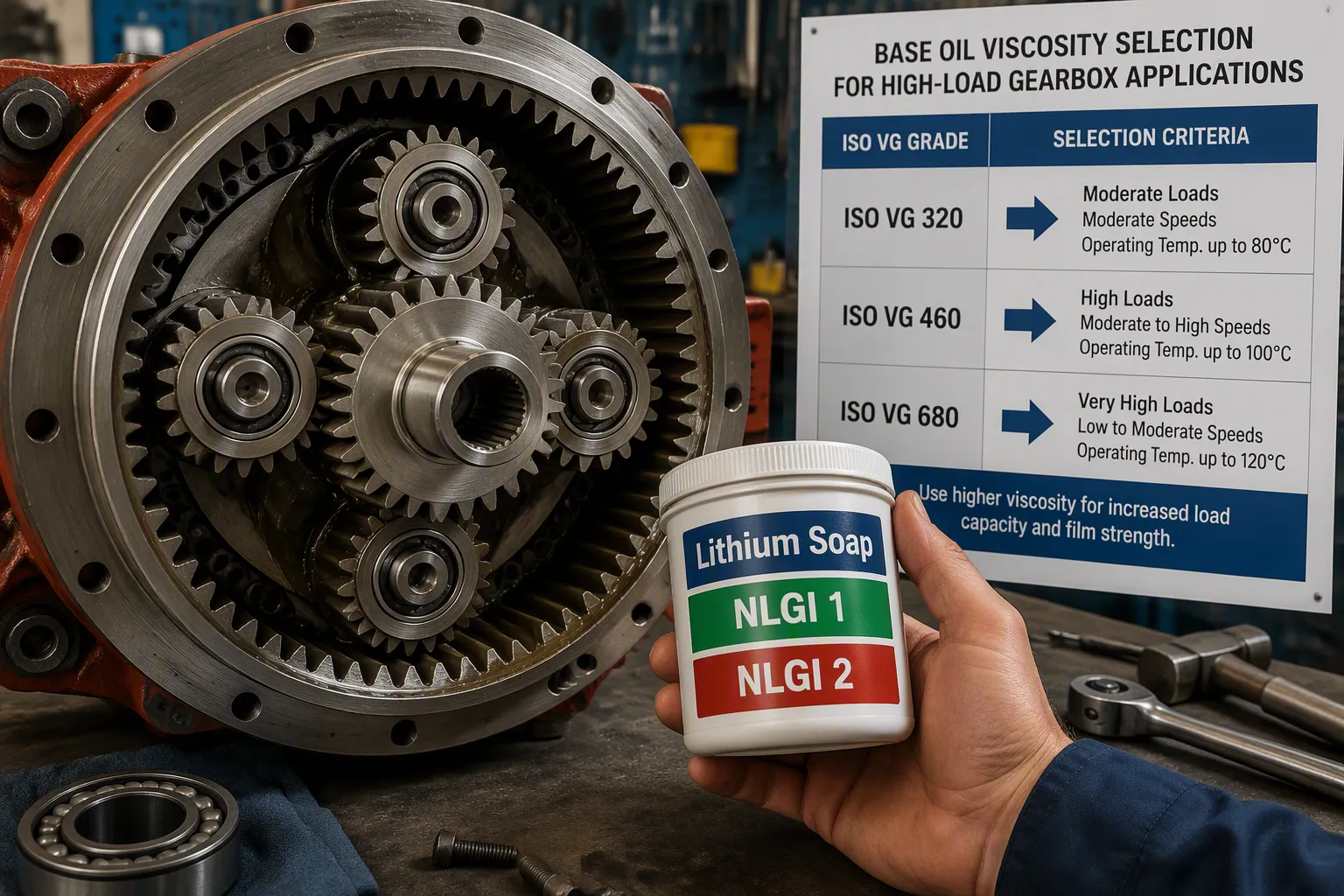
Once you confirm the thermal envelope, you shift focus to the grease properties. Two factors determine success: base oil viscosity and thickener type. These two elements dictate whether the grease protects the gear teeth under heavy loads.
Base Oil Viscosity and Viscosity Index
The base oil viscosity controls the oil film thickness between meshing teeth. Heavy-duty planetary gearboxes operate at low speeds with high torque. The final stage carries the highest load in the planetary reducer. You need a thick oil film to separate the metal surfaces. The recommended viscosity range for this application is ISO VG 320 to 680. This range covers low-speed, high-torque equipment like crushers, kilns, and heavy mills.
The viscosity index (VI) measures how much the oil thins as temperature rises. A high VI value means the oil holds its thickness better at high temperatures. This matters in a planetary gearbox. Multiple planet gears mesh simultaneously. They generate substantial heat. That heat causes the lubricant’s viscosity to drop. The film thickness between gear teeth shrinks. Metal-to-metal contact becomes more likely. A high VI grease counteracts this effect. The viscosity index improvers help maintain optimal film thickness across temperature ranges. You get better protection even near the 80°C sump temperature limit.
You should select a synthetic base oil with a high VI. Synthetic oils naturally have higher VI values than mineral oils. They also resist oxidation better. This combination works well for heavy-duty planetary gearboxes where thermal stress is constant.
Thickener Type and NLGI Grade
The thickener acts as a sponge that holds the base oil in place. Lithium soap grease is the industry standard for planetary gearboxes. The two common grades are NLGI 1 and NLGI 2. NLGI 1 is softer and flows into the gear mesh more easily. NLGI 2 is stiffer and stays in place better. Your choice depends on the gearbox design and application method.
You must distinguish between standard lithium grease and lithium complex grease. Standard lithium grease handles moderate loads. Lithium complex grease handles heavy loads and extreme pressures. Manufacturers formulate lithium complex grease with extreme pressure additives. These additives reduce wear under heavy loads. For a Grease for Heavy-duty Planetary Gearbox, you need the lithium complex type. The heavy loads in the planetary set demand higher load-carrying capability.
Products like Mobilgrease 28 (available in NLGI 1 and 2) and Mobil XHP 222 are examples of gear application greases. These products have field experience. However, you must always defer to the OEM’s recommendation. The manufacturer knows the specific requirements of your gearbox design.
You should also avoid white lithium grease. This product works for light-duty transmissions. It does not provide sufficient load-carrying capacity for heavy-duty planetary gearboxes. The extreme pressure additives are missing. The base oil viscosity is often too low. White lithium grease will fail under the heavy loads in a planetary reducer.
The correct thickener type and NLGI grade, combined with the right base oil viscosity, create a grease that protects your gearbox. You match the grease to the load. The final stage of the planetary reducer sets the requirement. Use the ISO VG 320 to 680 range. Choose lithium complex thickener with NLGI 1 or 2. Verify the OEM recommendation. Then you select a Grease for Heavy-duty Planetary Gearbox with confidence.
Geometry, Maintenance, and Total Cost
Channeling and Replenishment in Planetary Sets
Planetary gear geometry creates multiple mesh points inside one compact housing. The sun gear, planet gears, and ring gear all contact each other simultaneously. This design puts high stress on the grease film at several locations at once.
Grease does not flow like oil. It stays in place. Under heavy load, the grease pushes aside from the contact area. This is called channeling. The grease moves away from the gear teeth. The surfaces become dry. Metal-to-metal contact follows. This causes wear and generates more heat.
You must plan for periodic replenishment. A scheduled re-greasing program pushes fresh grease into the mesh points. This replaces the channeled grease. It restores the protective film between gear teeth. The frequency of re-greasing depends on your duty cycle and operating temperature. Check the gearbox regularly. Look for signs of channeling. Inspect for dry spots on the gear teeth. Early detection prevents failure.
Cost of Failure vs. Cost of Re-Greasing
The cost of a grease-related failure is enormous. You saw the numbers earlier in this article. An unplanned gearbox failure costs between $250,000 and $500,000. A gearbox replacement runs $150,000 to $500,000. These figures include downtime, replacement parts, and labor. In steel mills, the average cost per unplanned failure exceeds $350,000.
Now compare that to the cost of grease. Mineral grease costs $2 to $4 per kilogram. Synthetic grease costs $6 to $12 per kilogram. Synthetic grease costs 2 to 3 times more per kilogram. But it lasts 3 to 5 times longer than mineral grease in demanding applications. The higher initial cost offsets over the gearbox lifetime. You get better protection and longer intervals between re-greasing.
The cost of a scheduled re-greasing program is negligible compared to a failure. A few hundred dollars in grease and a regular maintenance schedule protect a gearbox worth tens of thousands of dollars. The labor cost for re-greasing is small. The downtime for maintenance is planned and brief. A failure shuts down production for days. A re-greasing stop takes minutes.
Proper lubrication is the single most cost-effective way to extend the service life of a heavy-duty planetary gearbox. You invest in high-quality grease. You follow a consistent re-greasing schedule. You avoid catastrophic failures.
Run this checklist before you choose. Is pitch line velocity below 1 m/s? Is sump temperature under 80°C? Is the duty cycle intermittent? Answer yes to all three. Then grease remains viable.
Select a Grease for Heavy-duty Planetary Gearbox with ISO VG 320-680 base oil, high viscosity index, lithium complex thickener, and NLGI 1 or 2 grade. The thermal envelope drives every other decision.
Condition-based lubrication programs deliver measurable returns:
Scenario | Bearing Replacements | Direct Savings | Program Cost | Net Return | ROI |
|---|---|---|---|---|---|
Previous year (calendar-based) | 90 | – | – | – | – |
After one year (condition-based) | 24 | $95,700 | $18,000 | ≈ $77,700 |
Choosing the right grease is a proactive reliability strategy. The grease cost stays negligible compared to downtime expenses.
FAQ
How do I calculate pitch line velocity for my gearbox?
You multiply π by the pitch diameter and rotational speed. Use meters for diameter and revolutions per second for speed. The result gives you meters per second. Compare that value against the 1 m/s limit before choosing grease.
Is synthetic grease worth the higher price?
Yes. Synthetic grease costs $6 to $12 per kilogram. Mineral grease costs $2 to $4 per kilogram. Synthetic grease lasts 3 to 5 times longer in demanding applications. The longer service life offsets the higher initial cost.
How often should I re-grease my planetary gearbox?
Your duty cycle and operating temperature determine the interval. Inspect the gear teeth regularly for dry spots or channeling. When you see signs of grease displacement, apply fresh grease immediately. A scheduled program prevents metal-to-metal contact.
What happens if my sump temperature exceeds 80°C?
Oxidation accelerates rapidly above this threshold. The rate multiplies by 1.5 for every 10°C rise above 70°C. Acidic products attack the thickener. The grease softens, bleeds oil, and eventually hardens into crust. Gear failure follows without intervention.
Can I mix different grease types in my gearbox?
No. Different thickeners and base oils do not mix well. The combination can break down the thickener structure. You lose load-carrying capacity and protection. Always drain and clean the housing before switching to a different grease product.
See Also
Key Traits Defining Outstanding Industrial Grease Performance
Essential Facts About Harmonic Drive Reducer Grease
Boosting Car Dependability Using FAKKT-GC874K Synthetic Grease