


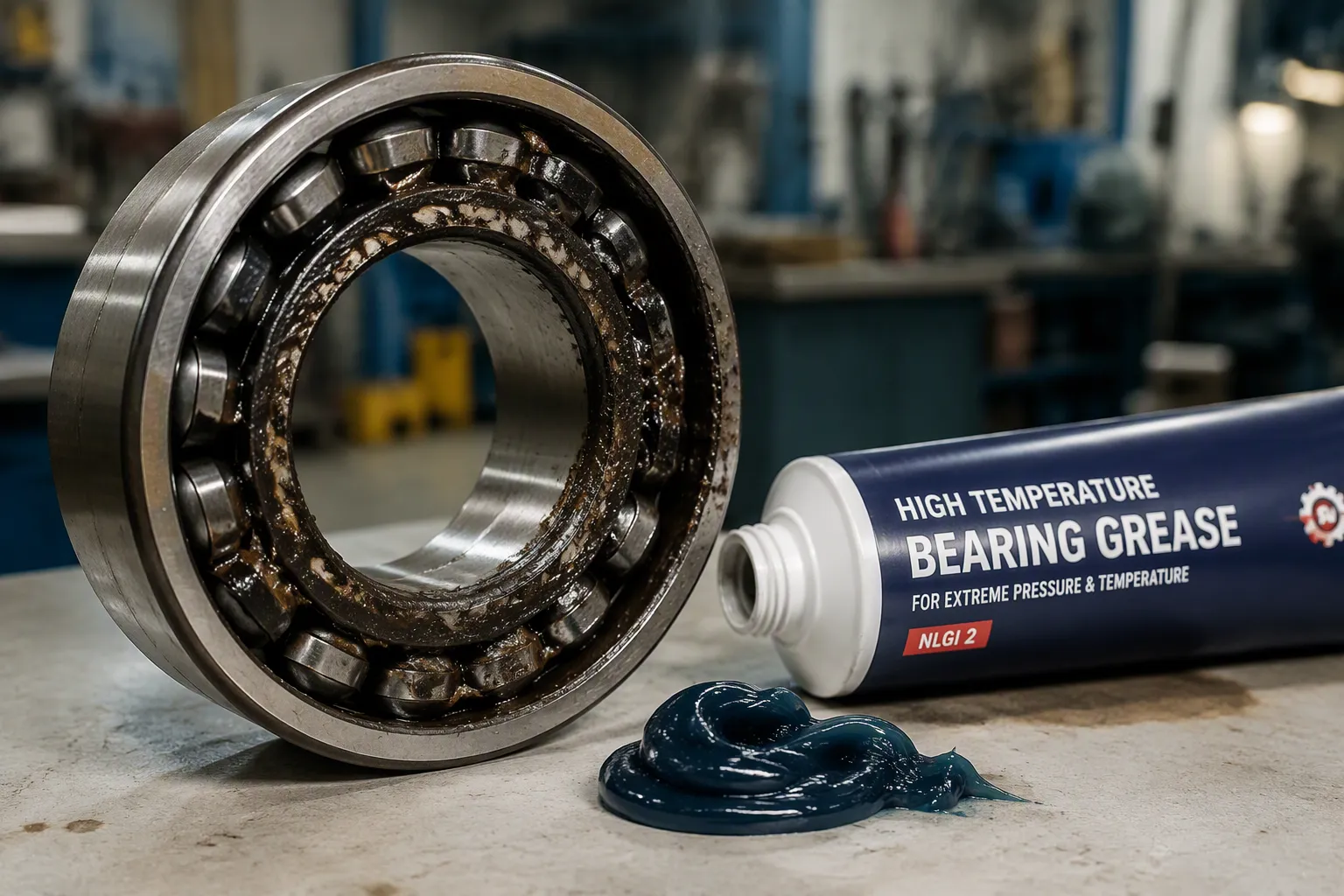
Picture this: you’re running a busy bakery, and the conveyor belt motor suddenly seizes mid-shift. The oven heat has silently destroyed your bearing grease, turning it into hard, crusty residue. Now your production line stops, and you lose thousands of dollars in revenue.
Standard greases cannot survive sustained high temperatures. Heat accelerates oxidation, evaporates essential oils, and breaks down thickeners. The result? Metal grinds against metal until bearings fail completely.
You can prevent this. Switching to a specialized high-temperature grease and adopting proper lubrication practices keeps your equipment running reliably. This article explains the science of thermal grease failure, the real costs of ignoring it, and practical steps to select and apply the right product for your operation.
Key Takeaways
High heat destroys standard grease through oxidation and evaporation. Switch to synthetic oils when temperatures exceed 150°C.
Grease failure costs more than parts—lost production can reach $260,000 per hour. Proper lubrication prevents this.
Choose a grease with a stable thickener and synthetic base oil matched to your operating temperature range.
Apply grease correctly: clean old residue, use proper fill volume, and halve re-lubrication intervals for every 15°C above 70°C.
Why High Heat Destroys Bearing Grease
When temperatures climb past 150°C (302°F), conventional bearing grease begins a rapid downward spiral. You might think the grease simply melts, but the real story involves complex chemical reactions that permanently destroy its structure. Understanding these mechanisms helps you recognize why standard products fail and why specialized alternatives matter.
Oxidation and Oil Evaporation
Heat triggers a chain reaction called oxidation. Free radicals form in the base oil molecules, then react with oxygen to create peroxide radicals. These unstable compounds break down into organic acids, aldehydes, and ketones. Eventually, these byproducts polymerize into varnish and sludge—sticky, rubber-like deposits that coat bearing surfaces and block proper lubrication.
The speed of this destruction follows a predictable pattern. For every 10°C rise in temperature, the oxidation rate doubles. This relationship, described by the Arrhenius equation, means grease life drops by half for each 10°C increase in the high-temperature zone above 160°C. At 180°C, your grease oxidizes four times faster than at 160°C.
Simultaneously, lighter oil components evaporate from the grease matrix. Think of a sponge losing its moisture—the thickener remains, but it becomes dry, hard, and brittle. Without the lubricating oil film, metal surfaces contact directly, generating even more heat and accelerating the failure cycle.
Thickener Breakdown and Additive Depletion
The thickener provides the grease’s structure, but not all thickeners handle heat equally. Simple lithium soap melts around 180–200°C, while lithium complex and polyurea thickeners withstand 260–280°C. Calcium sulfonate offers a high thermal ceiling, though exact figures vary by formulation. When soap-based thickeners soften or melt, the grease loses its consistency and leaks away from the bearing.
Additives also suffer in high-temperature environments. Anti-wear compounds and antioxidants deplete rapidly because decomposition reactions occur twice as fast for every 10°C increase. Once these protective chemicals vanish, metal surfaces lose their defense against scoring and wear. Your grease performance drops dramatically, leaving bearings vulnerable to premature failure.
The combination of oxidation, evaporation, thickener breakdown, and additive loss creates a cascade effect. Each mechanism accelerates the others, turning a minor temperature issue into catastrophic equipment damage.
Consequences of Grease Failure in High Heat
When your bearing grease fails under heat, the damage follows a predictable path. You might not notice the problem at first, but each stage compounds the next until catastrophic failure occurs.
From Friction to Catastrophic Bearing Failure
The destruction unfolds in four distinct phases:
Churning phase: Fresh grease sits between rolling elements, creating resistance during startup. The grease eventually pushes into unswept areas like seals and cage shoulders.
Bleeding phase: The grease slowly releases oil to the raceways through a feed-and-loss mechanism. Side flow and oxidation deplete the lubricant, leading to starvation in sealed bearings.
End of grease life: Reservoirs empty or deteriorate beyond usefulness. Without relubrication, the oil film breaks down completely.
Bearing damage and failure: Metal contacts metal directly, causing scoring, spalling, and eventual seizure.
Several failure modes accelerate this timeline. Exudation occurs when oil separates from the thickener, causing hardening and lubrication loss. Excess grease, long periods without relubrication, and centrifugal forces at high speeds all contribute. Softening and bleed-out happen when operating temperatures approach the grease’s dropping point—around 350–380°F for standard lithium grease—causing the semi-solid structure to flow away. Oxidative degradation forms acidic byproducts and deposits that block lubricant flow paths.
Both failure modes remain invisible during routine inspection. By the time you notice elevated temperatures or increased noise, significant wear has already occurred.
The True Cost of Downtime and Repairs
The financial impact extends far beyond replacement parts. Consider this breakdown:
Cost Category | Estimated Range |
|---|---|
Direct bearing cost | $50 – $5,000+ (parts only) |
Labor (removal + reinstall) | $200 – $5,000+ |
Associated component damage | $0 – $50,000+ |
Lost production | $10,000 – $2,000,000+ (per hour) |
Emergency parts / expediting | $500 – $50,000+ |
A mid-size automotive stamping plant illustrates the reality. With downtime costing $75,000 per hour, an 8-hour stoppage from bearing failure totaled $601,700. Direct repairs accounted for only $1,700—just 0.3% of the total. Production losses consumed the remaining 99.7%.
The most widely cited average cost of lost production per hour across all manufacturing sectors is $260,000 per hour, as reported by the Aberdeen Group and corroborated by Siemens and multiple 2025–2026 studies.
In automotive applications, the stakes rise even higher. Wheel bearing grease failure creates dangerous driving conditions, not merely inconvenience. A seized wheel bearing at highway speed can cause loss of control, putting lives at risk alongside your repair budget.
Selecting the Right High-Temperature Grease
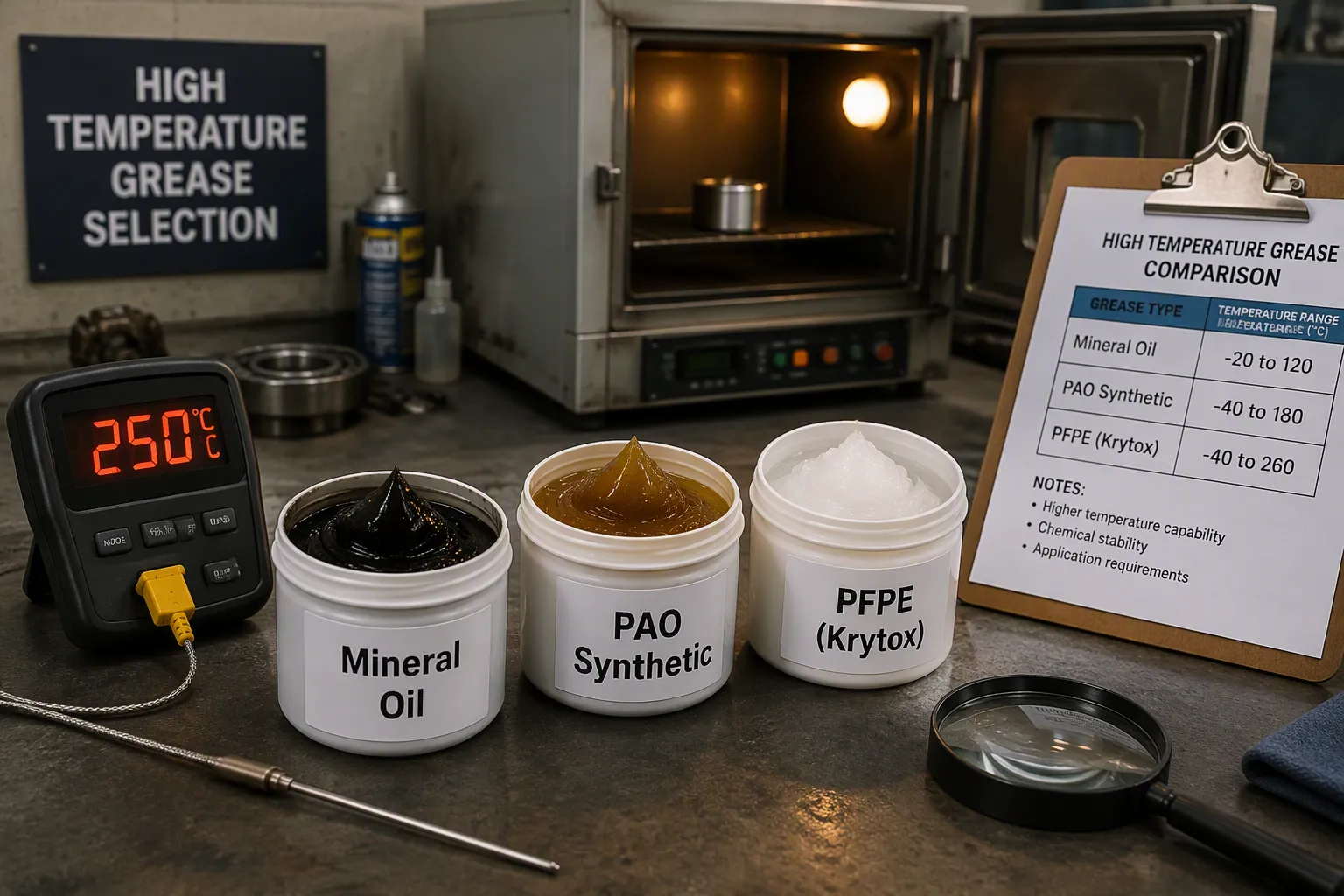
Choosing the correct bearing grease for hot environments requires more than picking the most expensive option. You need to understand three critical specifications: base oil, thickener, and temperature ratings. Each component determines how well your grease survives sustained heat.
Key Specs: Base Oil, Thickener, and Temperature Ratings
The base oil forms 80–90% of your grease and carries the actual lubricating film. Mineral oils degrade quickly above 100°C because their molecular structure contains weak points like sulfur and aromatic compounds. Synthetic oils offer a better solution. Polyalphaolefin (PAO) oils are “built” rather than extracted, creating uniform, fully saturated molecules that resist oxidation far longer. According to the Polyalphaolefins FAQ, each 10°C rise in temperature halves oxidative stability. At high temperatures, PAO’s inherently stable structure becomes a decisive advantage, extending grease life under sustained heat.
For extreme conditions, perfluoropolyether (PFPE) oils push the limits further. Products like Krytox GPL 207 operate up to ~288°C, while Krytox XHT-BD handles ~288°C and above, reaching up to ~360°C continuously. This performance comes at a steep price—roughly $30,000 for five gallons. You must weigh whether your application truly demands this level of thermal endurance.
The thickener provides grease’s structure, and its heat tolerance varies dramatically. Simple lithium soap melts around 175–200°C, while lithium complex and polyurea withstand 250°C or more. PTFE thickeners paired with PFPE oils excel above 200–230°C, making them ideal for paint shops and bakeries where no tarring and low odor matter. Polyurea thickeners suit high-speed applications like electric motors, offering low-noise operation and oxidation stability up to ~200–220°C.
Product | Type | Temperature Range |
|---|---|---|
Krytox GPL 206 | PFPE/PTFE | up to ~260°C |
Krytox GPL 207 | PFPE/PTFE | up to ~288°C |
Molykote 41 | Silicone | up to ~288°C |
Molykote HP-300 | PFPE/PTFE | −65…+250°C |
Complex calcium sulfonate | −20…+150°C continuous |
The Society of Tribologists and Lubrication Engineers confirms that PAO’s strengths include “high thermal and oxidative stability” as a core property. This expert consensus validates that thermal stability is a fundamental, documented advantage over mineral oils.
You must also understand the dropping point—the temperature where grease transitions from semisolid to liquid. This metric originated as a manufacturing quality control test, not a real-world performance measure. A grease with a dropping point of 260°C or greater offers no long-term benefit unless fortified against oxidation. The operational rule: your grease’s dropping point must sit safely above maximum operating temperature. For SKF LGHB 2, the continuous rating of 150°C sits 70°C below its >220°C dropping point, confirming the manufacturer intentionally leaves a safety margin.
When to Switch to High Temp Grease
You should switch to a high-temperature grease when operating temperatures exceed 150°C. Standard lithium grease fails at 177°C maximum. At 200°C, it exceeds its rating by 23°C, causing the thickener structure to melt and collapse. The oil separates from the soap matrix, leading to complete lubrication loss, accelerated wear, and eventual bearing seizure.
For temperatures up to 180°C, synthetic oils like esters or silicones work well. Above 250°C, only PFPE base oil remains viable. The choice between polyurea and PTFE thickeners depends on your definition of “high temperature” and your specific operating conditions.
Unless the grease composition is properly fortified against oxidation and thermal degradation, an end product showing a dropping point of 500°F (260°C) or greater would not be any more useful for long-term service than a grease with a low dropping point.
Your high-quality grease selection must match both the continuous operating temperature and peak excursions. A high temp grease rated for 150°C continuous might tolerate 200°C peaks, but only briefly. Check the manufacturer’s specifications carefully. For high-temperature applications, you need a product whose continuous rating exceeds your actual operating temperature with margin to spare. For high-temperature environments, this margin protects against unexpected heat spikes that could otherwise destroy your bearing. Meeting your high-temperature requirements means evaluating both base oil and thickener together, not just one component. The right high-temperature grease balances thermal stability, oxidation resistance, and cost against your specific operational demands.
Best Practices for Applying and Maintaining High Temp Grease
Selecting the right product solves only half the problem. How you apply and maintain that high-temperature grease determines whether it protects your bearings for months or fails within weeks. Proper technique prevents contamination, correct fill volumes prevent overheating, and disciplined monitoring catches problems before they become catastrophic.
Proper Application Techniques
Before you add fresh grease, you must remove the old residue completely. Mixing incompatible greases creates a chemical reaction that can harden or soften the mixture, destroying its lubricating properties. When switching to a new product, clean the bearings thoroughly to remove every trace of the previous grease. Use a suitable solvent and allow the bearing to dry completely before packing.
Best practice for cleaning before re-greasing: When switching to a new grease, cleaning the old grease out thoroughly before applying the new one is crucial. If you need to switch greases, thoroughly clean the bearings to remove any residue of the old grease.
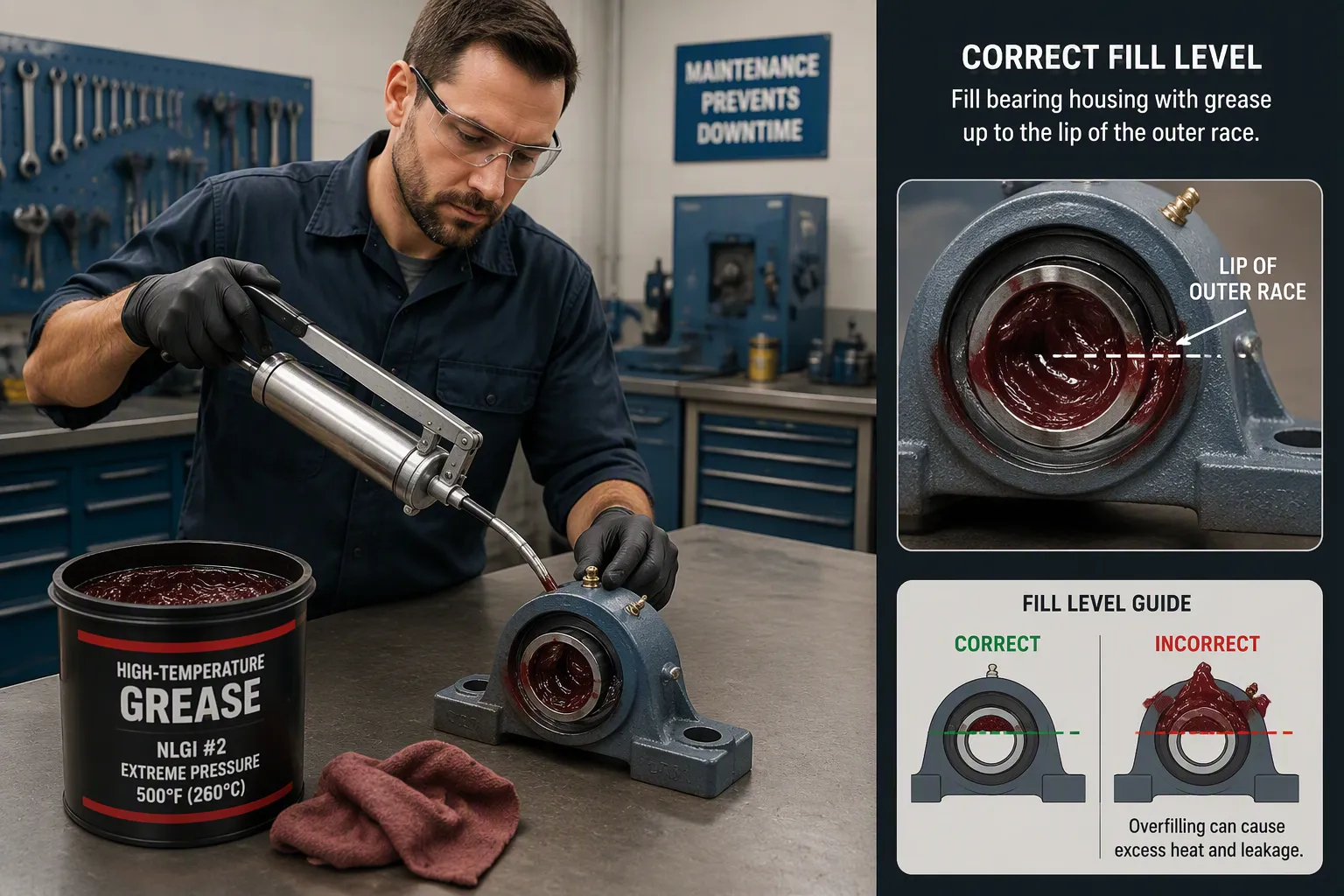
The fill volume matters just as much as the grease itself. The balls of a bearing act as tiny viscosity pumps that roll on a small oil film. Too much grease volume causes the rolling elements to churn the grease, resulting in parasitic energy losses and high operating temperatures. This overheating increases the risk of bearing failure.
Follow these fill rules to avoid over-greasing:
Fill the housing up to the lip of the outer race of the bearing.
If internal observation is not feasible, use a fill volume equal to 3X the replenishment volume for low-speed bearings, and 1X for high-speed bearings.
For high-speed bearings, use more frequent but lower volume doses to emulate continuous oil lubrication, avoiding heat generation from excess grease.
Overfilling triggers a destructive chain reaction:
Excess grease builds internal pressure inside the bearing housing.
This pressure pushes lubricant past the seals, breaking the protective barrier.
The seal breach allows contamination to enter the bearing.
Simultaneously, grease is forced into motor windings, degrading electrical performance.
These combined effects result in rising operating temperatures, degraded lubrication performance, and ultimately premature bearing failure.
Re-lubrication Scheduling and Monitoring
A fixed calendar interval ignores the most important variable: temperature. The SKF convention halves the re-lubrication interval for every 15°C increase in bearing temperature above 70°C. The temperature correction factor (fT) is calculated as: fT = 2^(-(T-70)/15), where T is the operating temperature in °C.
For temperatures ≤70°C, fT = 1.0 (full baseline interval). At 85°C, fT = 0.5 (interval halved). At 100°C, fT = 0.25 (interval quartered). At 115°C, fT = 0.125 (interval one-eighth). For temperatures above 120°C, consult the manufacturer because standard greases may be at their rated limit.
A field example shows that a motor bearing at 95°C requires an interval of about 28 days instead of a blanket 90-day interval, directly linking temperature correction to failure prevention.
Temperature monitoring provides your earliest warning system. A bearing’s temperature is its most responsive indicator of friction. An abnormal temperature rise signals lack of lubricant or severe surface wear, which directly correlates with bearing grease degradation. A sustained temperature above the established machine baseline is a clear early warning sign that requires immediate investigation.
In one documented case, a No. 2 generator bearing rose from 65°C to over 100°C, triggering a turbine trip. Inspection revealed grease ‘cake-lock’ — the thickener had logjammed inside the bearing, causing lubricant starvation. The temperature spike served as an early telegraph of grease degradation, allowing operators to detect the issue before catastrophic mechanical failure.
Vibration analysis complements temperature monitoring. Unusual vibration patterns often appear before temperature rises, giving you additional lead time. Combine both methods to establish a reliable baseline for each bearing, then investigate any deviation promptly. Adjust your re-lubrication schedule based on what the data tells you, not what the calendar suggests.
High heat destroys standard bearing grease. You can prevent this failure with the right knowledge and products. Understand thermal degradation mechanisms like oxidation, evaporation, and additive depletion. Recognize the costly consequences of friction, wear, and downtime. Select a high-temperature grease with proper base oil, thickener, and temperature ratings. Apply it with correct fill volumes and cleaning techniques.
Now take action. Audit your current lubrication practices. Avoid common mistakes like over-greasing and wrong lubricant selection. Consult a grease supplier to find the right product for your application. Implement a regular monitoring schedule using temperature and vibration data. These steps ensure long-term bearing health and operational reliability.
FAQ
At what temperature does standard grease start to fail?
Standard lithium grease fails at 177°C maximum. You should switch to a high-temperature product when operating temperatures exceed 150°C. At 200°C, the thickener structure melts and collapses. The oil separates from the soap matrix, causing complete lubrication loss and eventual bearing seizure.
Can I mix different types of grease?
No. Mixing incompatible greases creates a chemical reaction that can harden or soften the mixture, destroying its lubricating properties. When switching to a new product, clean the bearings thoroughly with a suitable solvent. Allow the bearing to dry completely before packing fresh grease.
How often should I re-lubricate bearings in high heat?
The SKF convention halves the re-lubrication interval for every 15°C increase above 70°C. At 85°C, you halve the interval. At 100°C, you quarter it. A motor bearing at 95°C requires re-lubrication about every 28 days instead of a blanket 90-day interval.
Why does PFPE grease cost so much?
PFPE grease costs roughly $30,000 for five gallons. This premium price reflects its extreme thermal endurance. Products like Krytox GPL 207 operate up to ~288°C, while Krytox XHT-BD reaches ~360°C continuously. You must weigh whether your application truly demands this level of performance.
How can I detect grease failure before bearing damage?
Temperature monitoring provides your earliest warning system. A sustained temperature above your machine baseline signals lubricant starvation or surface wear. Vibration analysis complements temperature data, often showing unusual patterns before heat rises. Investigate any deviation promptly and adjust your re-lubrication schedule accordingly.
See Also
How Grease Colloidal Stability Affects Performance Outcomes
Key Traits That Define Superior Industrial Grease Performance
Boosting Car Dependability Using FAKKT-GC874K Synthetic Grease
Essential Facts About Lubricants for Harmonic Drive Reducers