


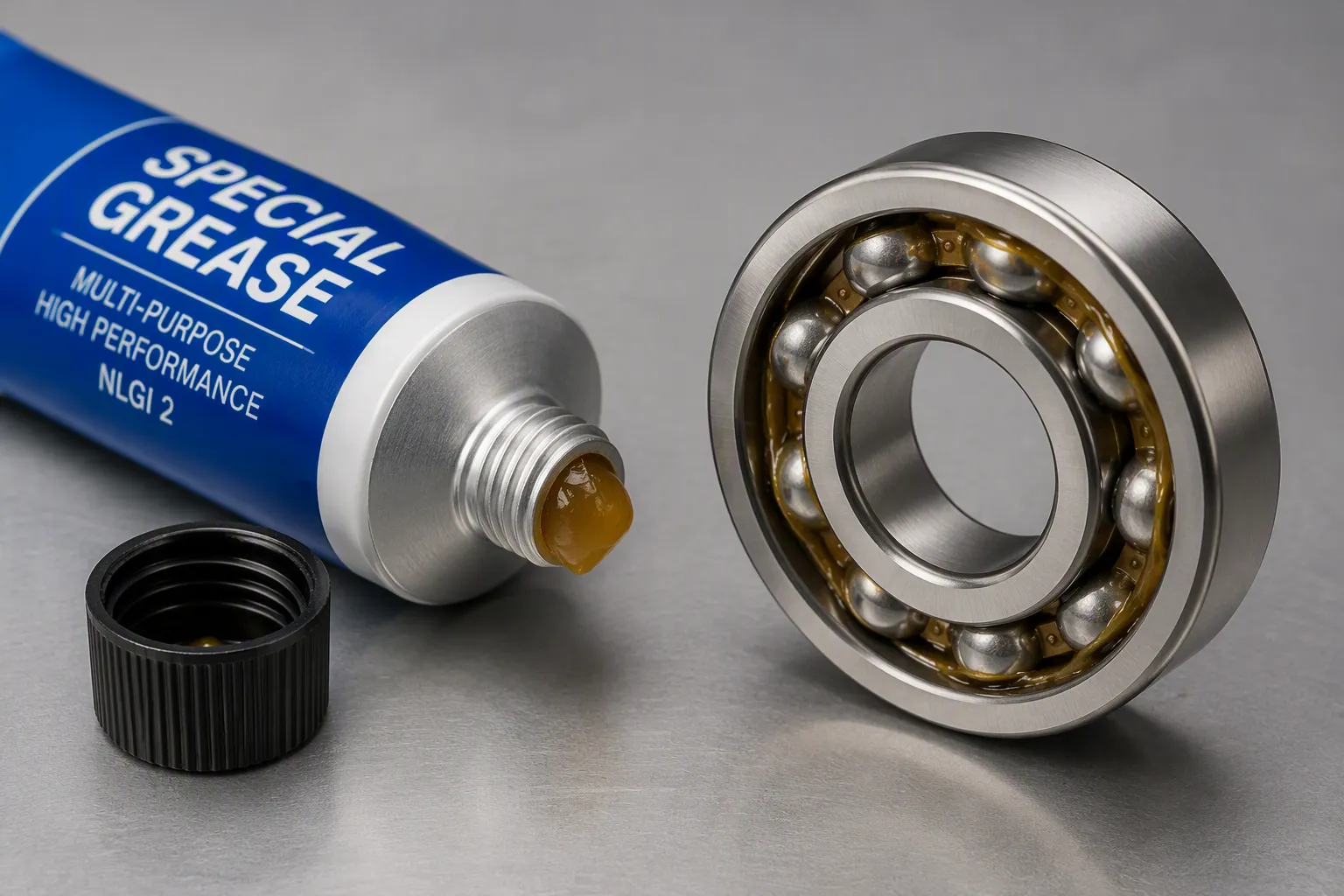
What is the special grease for a deep groove ball bearing? You won’t find a single product on a shelf. The Deep Groove Ball Bearing grease you need is a tailored choice. It is often an NLGI Grade 2 grease. This grade is engineered for specific operating conditions.
Selecting the correct grease is critical. It prevents premature bearing failure. It reduces downtime. It ensures quiet operation. Without the right grease, you risk costly repairs and unexpected stoppages. You must consider temperature, speed, load, and environment. These factors guide your selection. You also need practical application and maintenance tips. This knowledge helps you make the right choice for your machinery. You can extend bearing life significantly.
Key Takeaways
Start with NLGI Grade 2 grease as your base, but adjust the base oil viscosity and additives for your bearing’s temperature, speed, and load.
Use synthetic greases for high heat or low-noise needs; standard lithium greases fail above 121°C.
Fill the bearing with 25-35% grease of the free space; use the SKF formula to get the exact amount.
Never mix greases with different thickeners; flush the bearing completely when switching types.
The Role of Deep Groove Ball Bearing grease
Lubrication and Wear Prevention
Grease performs a critical job inside your bearing. It creates a thin film between the rolling elements and the raceways. This film prevents metal-to-metal contact during operation. Without this separation, you experience rapid wear and premature failure. The grease also reduces friction, which lowers heat generation. Less heat means longer bearing life and better energy efficiency.
The base oil in the grease provides the actual lubrication. The thickener acts as a sponge, holding the oil in place. Under rotation, the bearing releases small amounts of oil to coat the contact surfaces. When the bearing stops, the thickener reabsorbs the oil. This cycle continues throughout the bearing’s service life. You need the right viscosity to maintain this film under your specific load and speed conditions.
Sealing and Contamination Control
Grease serves a second vital purpose beyond lubrication. It acts as a barrier against contaminants. Dust, moisture, and other particles cannot easily penetrate a properly filled bearing. This protection matters most in harsh environments like mining, agriculture, or food processing. The grease fills internal clearances and creates a physical seal around the rolling elements.
For sealed bearings, manufacturers often describe grease life using an L10 rating. This rating represents the time when 90 percent of a bearing group will still function properly. In lubricated-for-life designs, the grease life aligns with the bearing’s fatigue life. You should treat this alignment as a key design consideration. When you select a Deep Groove Ball Bearing grease, you must verify that its expected life matches your application’s requirements. A mismatch means you either replace the bearing too early or risk failure before the rated life expires.
The grease also protects against corrosion. It coats internal surfaces with a protective layer that resists moisture ingress. This protection proves especially valuable in applications with temperature fluctuations that cause condensation. You gain extended bearing reliability when you choose a grease with strong anti-corrosion properties.
Key Factors in Grease Selection
Temperature and Speed Limits
Temperature dictates your grease choice more than any other factor. Standard lithium-based greases perform well in moderate conditions. They lose their protective properties when temperatures climb too high. You must check the operating temperature range of your application before selecting a Deep Groove Ball Bearing grease.
Standard lithium-based grease has a maximum operating temperature of 121°C (250°F). Exceeding this limit causes the thickener to break down and the base oil to oxidize rapidly.
High-speed applications demand special attention. When your bearing rotates quickly, it generates additional heat through friction. You need a grease with low-viscosity base oil that flows easily at operating temperature. This low viscosity reduces drag and prevents overheating. However, the grease must also maintain high film strength. This strength keeps a protective layer between the rolling elements and raceways even at extreme speeds. Without adequate film strength, you risk metal-to-metal contact and rapid bearing failure.
Load and Environmental Conditions
Load requirements shape your grease selection in different ways. Heavy loads compress the grease film between rolling elements. Standard greases may not withstand this pressure. You need extreme pressure (EP) additives for high-load applications. These additives form a protective chemical layer on metal surfaces. This layer prevents welding and scoring when loads become severe.
Standard deep groove ball bearings typically use NLGI Grade 2 grease. This grade offers a balanced consistency for most general-purpose applications. It provides enough structure to stay in place while allowing smooth rotation. You should verify this grade suits your specific operating conditions before committing to a product.
Environmental factors also influence your choice. Dusty environments require grease with strong sealing properties. Humid conditions demand excellent corrosion resistance. Chemical exposure calls for synthetic base oils that resist breakdown. You must evaluate your working environment honestly. A grease that performs perfectly in a clean, dry factory may fail quickly in a dusty quarry or a damp food processing plant. Match your grease to your actual conditions, not to ideal laboratory settings. This careful selection prevents premature failure and extends your bearing’s service life.
Types of Special Greases and Their Properties
High-Temperature and Low-Noise Greases
High-temperature applications require a special Deep Groove Ball Bearing grease. Standard lithium greases fail when temperatures exceed 121°C. You need a synthetic grease designed for hotter conditions. SKF LGHP 2 is one example. It operates from -40°C up to 150°C. This range covers most industrial hot environments. The synthetic base oil resists oxidation at high heat. It does not form hard deposits that damage the bearing. You get reliable lubrication in drying ovens, kilns, or near hot motors.
You must check the temperature limits on any grease you choose. Read the manufacturer’s technical data sheet carefully. Confirm the grease covers both your normal operating temperature and any peak spikes. A grease rated to 150°C gives you a safety margin. It protects the bearing even during temporary temperature surges.
Low-noise greases serve a different need. They use specially filtered base oils and thickeners. These greases contain no large particles that cause vibration. You need them for electric motors, fans, and pumps. Noise and vibration levels drop noticeably with the right choice. Manufacturers design these greases for smooth, quiet rotation. They maintain consistent performance over many hours.
SKF offers high-temperature greases for double-shielded bearings. The SKF 6011-2Z bearing comes pre-filled with such a grease. You can trust these products for extended service life in hot conditions. Chevron Delo EP and Castrol Pyroplex are also well-regarded. They perform well in high-speed, high-load scenarios. These greases combine thermal stability with strong load-carrying ability.
Food-Grade and Chemical-Resistant Greases
Food-grade greases meet strict safety standards. They must comply with NSF H1 requirements. This certification permits incidental food contact. You use these greases in food processing, packaging, and beverage production. The grease cannot contain toxic ingredients. It must not impart odors or flavors to food products. White mineral oil or synthetic hydrocarbons serve as the base oil. Aluminum complex or calcium sulfonate thickeners provide water resistance.
Chemical-resistant greases protect bearings in harsh environments. You need them when acids, alkalis, or solvents are present. Standard greases break down quickly under chemical attack. Synthetic greases with PTFE or fluorinated oils offer superior resistance. Match the grease chemistry to the specific chemicals in your application. Consult the grease manufacturer for compatibility data. A wrong choice leads to rapid grease breakdown and bearing failure.
Choosing the correct Deep Groove Ball Bearing grease for these environments prevents costly downtime. You must verify temperature, chemical exposure, and washdown frequency. Proper grease selection extends bearing life and keeps your equipment running reliably.
How to Choose the Right Grease
NLGI Grade and Base Oil Viscosity
NLGI Grade 2 stands as the industry standard for most deep groove ball bearings. This grade provides a balanced consistency. It stays in place during operation. It also allows smooth rotation without excessive drag. You should verify this grade suits your application before making a final choice.
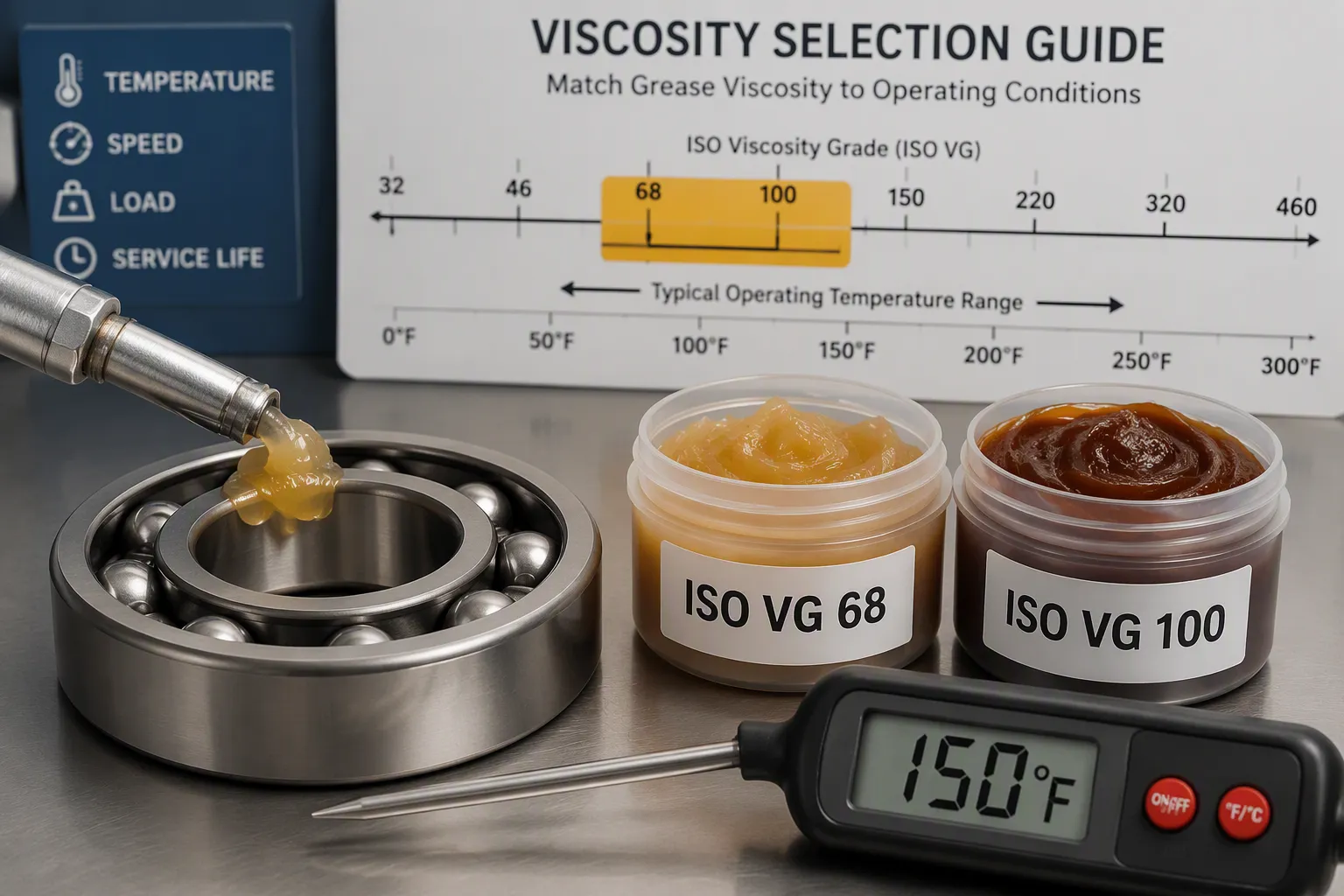
The base oil viscosity matters just as much as the grade. Most general-purpose greases use ISO VG 68-100 base oils. You must match this viscosity to your bearing’s speed and load conditions. The speed factor, known as DN or NDm, guides this decision. You calculate this value by multiplying bearing size by rotational speed. Higher speeds require lower viscosity oils. Slower applications can handle thicker oils.
Consider this practical example. A fan bearing with an NDm value of 293,125 operating at 150°F needs a base oil viscosity near 7 centistokes. This translates to an ISO 22-32 grade. Using a standard multi-purpose grease around 220 cSt would provide roughly 10 times the needed viscosity. That excess thickness generates heat and wastes energy. You must match viscosity to your actual operating speed.
Base Oil Viscosity at 40°C | Selection Guidance |
|---|---|
Below 20 mm²/s | Consider a slight increase to ensure a robust lubrication film |
20 to 250 mm²/s | Standard recommendations generally suffice without alterations |
Above 250 mm²/s | Specialized advice may be warranted to tailor grease selection to specific application demands |
You should also verify the grease consistency through standard test methods. Two ASTM tests define this property:
ASTM D217: Cone Penetration of Lubricating Grease – measures the depth (in tenths of mm) a 150 g cone penetrates worked grease at 25°C in 5 seconds.
ASTM D1403: Cone Penetration using One-Quarter and One-Half Scale Cone – used when only a small grease sample is available.
The worked penetration range for NLGI Grade 2 spans 265–295 tenths of mm. These test methods confirm your grease meets this specification.
Matching Grease to Application Needs
Your application determines which grease chemistry you need. Two thickener types dominate the market: lithium complex and polyurea. Each serves different maintenance strategies.
Decision Factor | Lithium Complex Grease | Polyurea Grease |
|---|---|---|
Typical Service Life | 3,000–5,000 hours before re-greasing is required | 10,000+ hours, often matching the bearing’s entire lifespan |
Relubrication Strategy | Requires scheduled re-greasing (e.g., every 4,000 hours) to offset its shorter individual life | Designed for sealed-for-life applications where re-greasing is impossible or impractical |
Cost-Effectiveness | More cost-effective in re-greaseable systems where maintenance labor is cheap and downtime is not critical | Higher initial cost (1.5–2×), but lower total cost of ownership for sealed, high-downtime-cost applications due to eliminated labor and reduced failure risk |
Selection Criteria | Choose when the bearing has grease fittings and a maintenance schedule is feasible | Choose when the bearing is sealed at the factory and must last without intervention |
Maintenance Requirements: Polyurea greases’ longer service intervals can reduce maintenance frequency, whereas lithium greases may necessitate more regular attention. Cost Constraints: Lithium greases are typically more cost-effective, which may influence their selection in budget-conscious applications.
You must also consider bearing size. Standard greases may not suffice for bearings with a bore diameter exceeding 62 mm. These larger bearings generate more heat and require specialized lubrication. Consult bearing manufacturers such as Schaeffler or SKF for specific recommendations. Their engineers can analyze your operating conditions and suggest the optimal Deep Groove Ball Bearing grease.
Your decision should balance several factors. Operating temperature, rotational speed, applied load, and environmental exposure all matter. The right grease reduces friction, prevents wear, and extends bearing life. The wrong choice leads to premature failure and costly downtime. Take time to evaluate each factor carefully. Your maintenance schedule and budget will thank you.
Application and Re-lubrication Guidelines
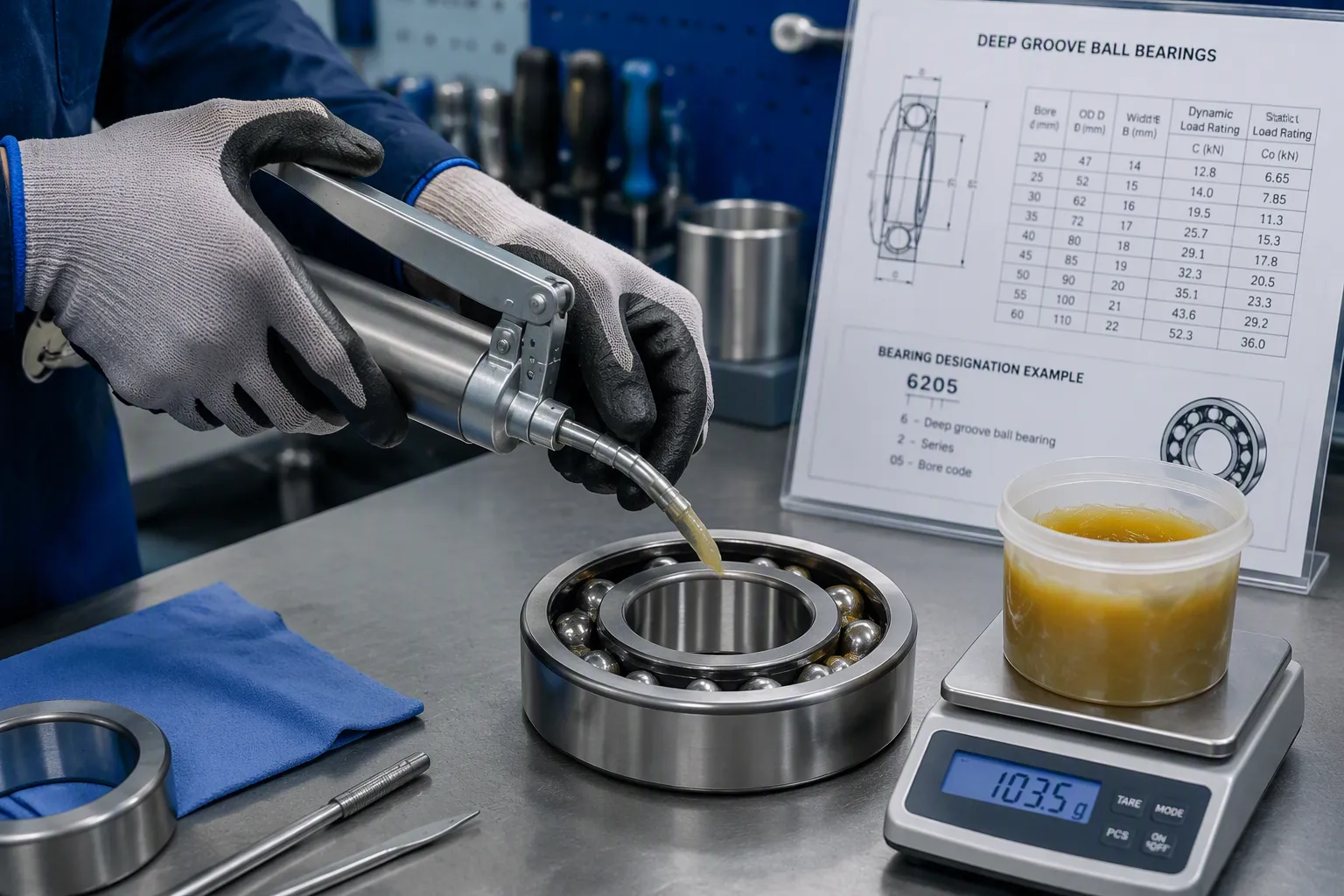
Applying grease correctly matters as much as choosing the right product. You must calculate the proper fill volume and set realistic re-lubrication intervals. These steps protect your bearing investment and prevent unexpected failures.
Calculating Grease Fill Volume
You need the correct amount of grease inside your bearing. Too little grease starves the rolling elements. Too much grease creates heat through churning. The general rule states that deep groove ball bearings need a 25-35% grease fill of the free internal space. This range balances lubrication with heat dissipation.
For precise calculations, you can use the SKF formula. This formula applies to the initial fill of a new bearing or housing.
SKF Formula for Initial Grease Fill Quantity:
G_initial = 0.010 × D × B
Where:
D= Bearing bore diameter (mm)
B= Bearing width (mm)
This formula fills both the bearing and adjacent cavities.
You can translate this percentage into practical weights. Sealed bearings come pre-filled from the factory. If you need to re-pack an open bearing, reference these typical weights:
Bearing Size (2RS) | Grease Weight Range (grams) |
|---|---|
6204-2RS | 0.8 – 1.2 |
6205-2RS | 1.0 – 1.5 |
6206-2RS | 1.5 – 2.2 |
These weights represent the 25-35% fill rule for common sizes. You should weigh your grease when packing bearings manually. This practice prevents over-lubrication, which causes temperature rise and seal damage.
Setting Re-lubrication Intervals
Sealed bearings typically operate as lubricated-for-life components. You do not re-grease them. KML bearings with Chevron SRI#2 grease exemplify this design. Open bearings require periodic re-lubrication. You must schedule this maintenance carefully.
Operating temperature drives your interval more than any other factor. NTN-SNR provides a practical guideline.
NTN-SNR guideline: As operating temperatures increase, the grease interval should be shortened. Generally, for every 10°C increase in bearing temperature above 80°C, the grease interval period is shortened to ‘2/3’. Example: For a 6206 deep groove ball bearing (d=30mm) at 3,600 rpm with a radial load of 2.0 kN, the grease life is approximately 5,500 hours, based on the chart and the speed ratio (no/n = 2.93).
You can also use the SKF model for more detailed calculations. This model defines grease life as a function of operating temperature, speed, and grease quality.
Parameter | Value / Rule |
|---|---|
Speed Factor (nDm) | nDm = n × (d + D) / 2, where n is rpm and Dm is the mean bearing diameter in mm. |
Base Interval (tf) | Read from the SKF diagram for deep groove ball bearings at 70°C. Approximate values: 100,000 nDm → ~15,000 hrs; 200,000 nDm → ~10,000 hrs; 300,000 nDm → ~6,000 hrs; 400,000 nDm → ~3,500 hrs; 500,000 nDm → ~1,500 hrs. |
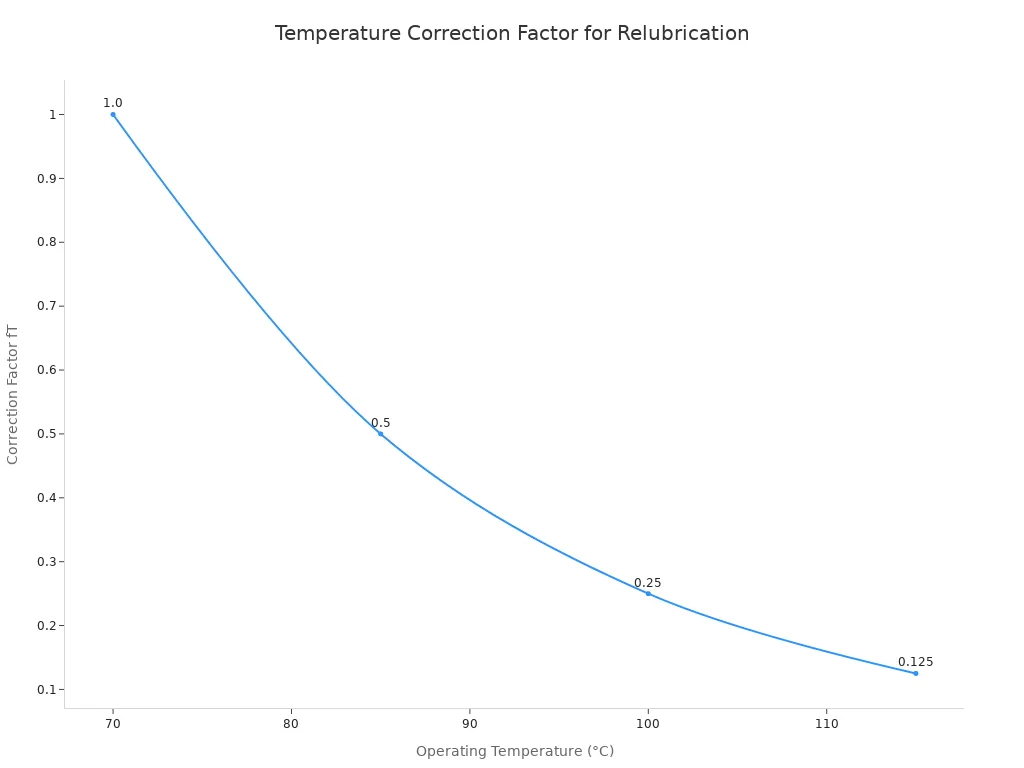
Temperature Correction (fT) | The interval is halved for every 15°C increase above the 70°C baseline. For example: 70°C → fT = 1.0; 85°C → fT = 0.5; 100°C → fT = 0.25; 115°C → fT = 0.125. For intermediate temperatures, use fT = 2^−(T−70)/15. |
Adjusted Interval | t_adj = tf × fT × fC, where fC is the contamination factor (1.0 for clean, 0.5–0.7 for light, 0.2–0.4 for heavy). |
The Grease Performance Factor (GPF) helps you compare products. GPF=1 represents the baseline performance of a good-quality grease. Greases with GPF greater than 1 outperform this baseline. They extend your re-lubrication interval accordingly.
Vibration adds another layer of complexity. Nearby vibration or misalignment shortens the interval beyond contamination reductions. When vibration occurs alongside dust or humidity, you must multiply the correction factors together. Ignoring this stacking effect causes premature bearing failure. Track vibration severity alongside temperature. If vibration increases beyond acceptable thresholds, shorten your existing interval.
Your choice of Deep Groove Ball Bearing grease directly affects these calculations. A high-quality grease with the right thickener and base oil extends intervals. A poor choice forces more frequent maintenance. Follow manufacturer recommendations for your specific bearing and application. This diligence maximizes bearing life and minimizes downtime.
Common Mistakes to Avoid
Mixing Incompatible Greases
You might think topping off a bearing with whatever grease you have on hand saves time. This decision often leads to disaster. Different thickeners do not mix well together. Lithium complex and polyurea greases, for example, can separate when combined. The mixture loses its structure. It stops holding the base oil effectively. You end up with a runny fluid that cannot lubricate properly.
The grease industry uses a specific test to predict compatibility. ASTM D6185 evaluates binary mixtures at three ratios: 50:50, 10:90, and 90:10. Technicians test dropping point, worked penetration after 100,000 strokes, and storage stability at elevated temperatures. A mixture passes only when all three ratios perform acceptably. For critical applications, they add tests for oil separation, roll stability, and water washout. They always compare results against both neat greases as references. A mixture result without this comparison can mislead you completely.
The safest practice: never mix greases with different thickeners. If you must change grease type, flush the bearing completely and refill with the new product.
Over-Lubrication and Under-Lubrication
Over-lubrication seems harmless. You might believe more grease means better protection. The opposite holds true. Excess grease causes churning inside the bearing. The rolling elements must push through the thick grease mass. This resistance generates heat. Manufacturer guidelines show that overfilling beyond the recommended 30-50% of free space raises operating temperature by 10-15°C above normal. That extra heat accelerates oxidation. It shortens grease life. It can even damage seals.
Under-lubrication creates different problems. Too little grease means no continuous film between rolling elements and raceways. Metal touches metal directly. You hear noise and feel vibration. Rapid wear follows quickly. The bearing may seize entirely. You must adhere to the recommended fill volume for your specific bearing size.
The correct approach balances both extremes. Follow the 25-35% fill rule for the free internal space. Use the SKF formula when you need precision. Weigh your grease when packing bearings manually. Track your re-lubrication schedule carefully. A proper Deep Groove Ball Bearing grease application protects your equipment. Careless application destroys it. Your attention to these details determines whether your bearing survives its rated life or fails months early.
Start by identifying your operating conditions correctly. Temperature, speed, and load guide your choice. Select the correct grease type for your specific needs. High-temperature, low-noise, and food-grade options each serve different applications successfully. Confirm the NLGI grade and base oil viscosity match your requirements precisely. The right Deep Groove Ball Bearing grease is a tailored solution, not a generic product. It serves your machinery best when matched to your unique conditions. Follow manufacturer guidelines for fill volume and re-lubrication intervals carefully. This discipline extends your bearing life significantly. It prevents premature failure and reduces unplanned downtime cost. Investing time in proper grease selection and maintenance delivers the most cost-effective outcome. You ensure reliable performance and minimize costly repairs over time.
FAQ
Can I use automotive grease in my bearings?
Automotive grease lacks the proper viscosity and additives for high-speed rotation. It can cause overheating and early failure. Purchase a product designed specifically for your bearing type and operating conditions.
How should I store grease?
Store grease in a cool, dry place. Keep containers sealed to prevent contamination. Check the expiration date before use. Old grease loses its lubricating properties. Follow the manufacturer’s storage recommendations.
What does lubricated for life mean for sealed bearings?
Manufacturers fill sealed bearings with grease at the factory. You cannot re-grease them. The grease matches the bearing’s expected service life. When the grease fails, you replace the entire bearing.
Does grease color indicate quality?
No. Grease color comes from dyes or additives. It does not reflect performance. Red, blue, or green greases can be excellent or poor. Read the technical data sheet instead of judging by color.
How do I know if the grease has failed?
You see excess oil leaking from the bearing. The grease feels hard or crusty. You hear unusual noise or feel vibration. These signs indicate the grease has oxidized. Replace it immediately.
See Also
Key Traits That Define Superior Industrial Grease Performance
Boosting Car Dependability Using FAKKT-GC874K Synthetic Lubricant
How Colloidal Stability Affects Grease Efficiency And Durability
Essential Facts About Lubricants For Harmonic Drive Reducers
Modern Auto Issues Solved With FAKKT Advanced Grease Products