


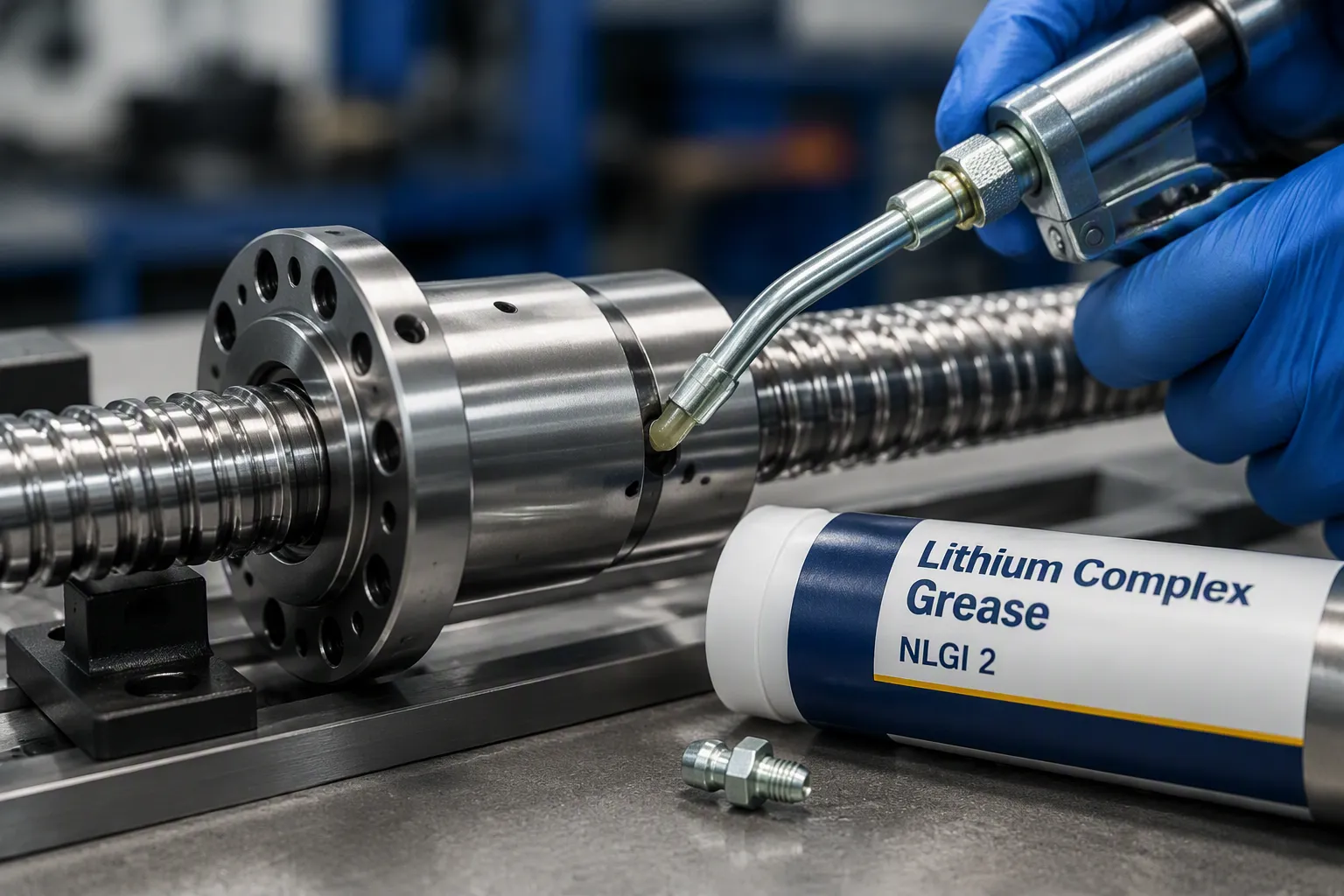
Improper lubrication stands as a leading cause of premature ball screw failure, often resulting in costly downtime and expensive repairs. When you face the critical question of how to select the right grease for ball screw assembly, the sheer number of options on the market can feel overwhelming. The answer lies in understanding four key elements: viscosity, NLGI grade, additives, and your specific operating environment. This guide provides a practical, step-by-step framework to help you make an informed choice, steering you clear of common pitfalls like relying on general-purpose grease. By the end, you will have the confidence to choose a grease that ensures smooth operation, extended service life, and dependable performance for your machinery—every time.
Key Takeaways
Calculate the mean screw speed to find the correct grease viscosity.
Choose a synthetic or mineral base oil with anti-wear additives.
Use NLGI grade 2 grease for most ball screw applications; adjust for extreme conditions.
Fill the ball nut with 20% to 30% of its free volume.
Avoid graphite and molybdenum disulfide in ball screw grease.
Selecting the Right Grease for Ball Screw Assembly: Key Factors
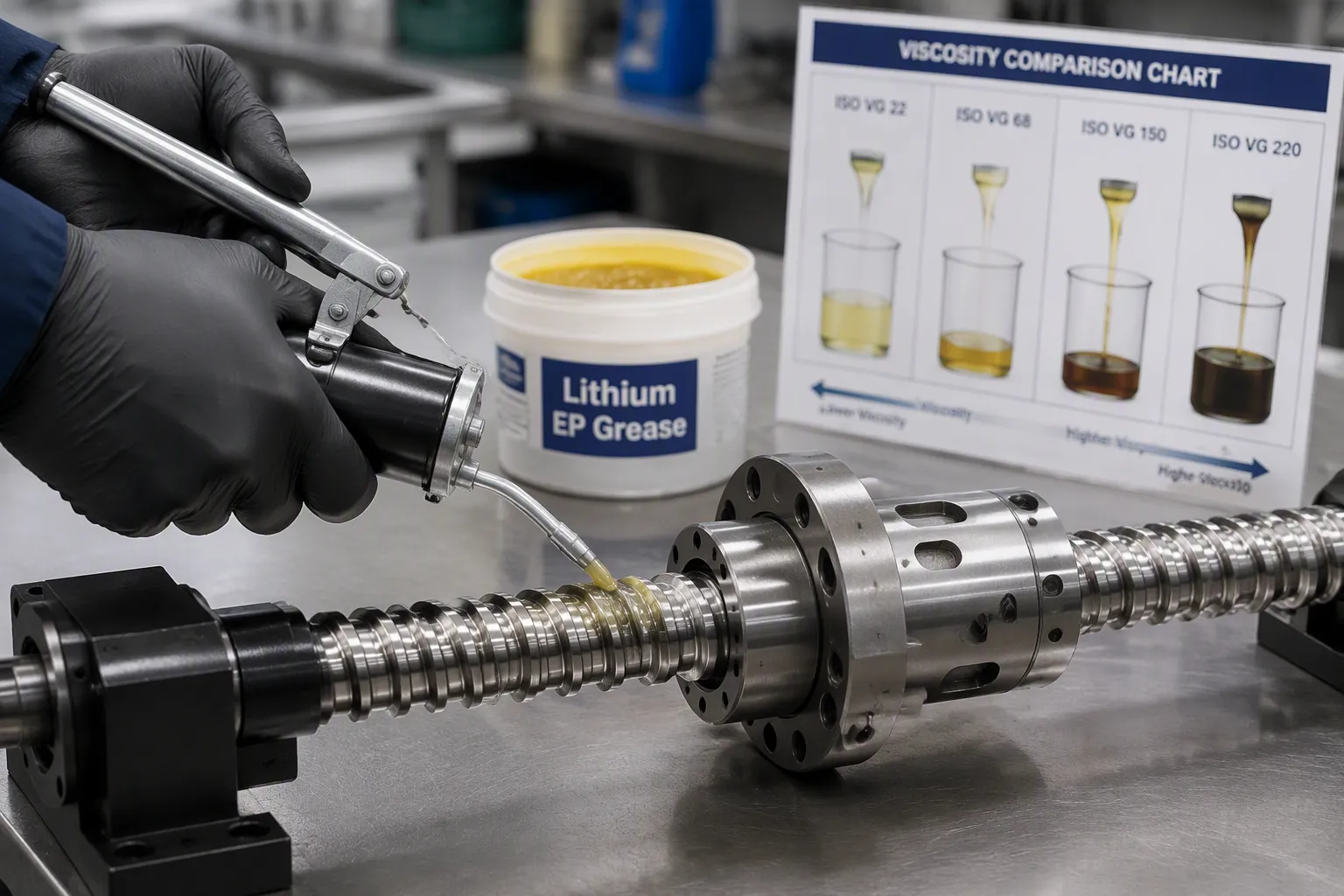
Choosing the correct grease for ball screw assembly starts with understanding two fundamental properties: viscosity and base oil type. These two characteristics determine how well the lubricant performs under your specific operating conditions. Getting them right prevents premature wear, reduces friction, and extends the life of your equipment. Getting them wrong leads to overheating, metal-to-metal contact, and eventual failure. Let’s examine each factor in detail.
Viscosity: Matching Oil Thickness to Load and Speed
Viscosity measures the thickness of the oil within the grease. It stands as the most critical property you must evaluate. The oil film must be thick enough to separate the rolling elements from the raceways. At the same time, it must remain thin enough to avoid excessive drag and heat generation. A grease with too low viscosity cannot protect the metal surfaces. A grease with too high viscosity creates resistance that wastes energy and raises operating temperatures.
To select the right viscosity, you must first calculate the mean screw speed. This value reflects the average rotational speed your ball screw experiences during its duty cycle. The formula accounts for different operating conditions and the time spent at each speed.
The mean screw speed is calculated using the duty cycle formula:
nm = n1(q1/100) + n2(q2/100) + n3(q3/100) + …
Where:
nm = mean speed (rpm)
n1, n2, n3… = speed at each operating condition (rpm)
q1, q2, q3… = time spent at each speed (% of total operating time)
Once you determine the mean speed, you can match it to a grease with the appropriate nominal viscosity. Higher speeds demand lower viscosity oils to minimize drag. Heavier loads require higher viscosity oils to maintain a protective film. You want a grease that balances both demands for your particular application.
Base Oil Type: Synthetic vs. Mineral for Performance
The base oil forms the foundation of any grease. It carries the additives, provides the lubricating film, and determines the temperature range where the grease functions properly. You have two primary choices: synthetic oils and mineral oils.
Mineral oils come from refined crude petroleum. They offer lower cost and adequate performance for moderate operating conditions. If your ball screw runs at normal temperatures with steady speeds, a mineral-based grease may serve you well. However, mineral oils break down faster under extreme heat or heavy loads.
Synthetic oils are engineered in laboratories. They provide a wider temperature range, greater stability, and better viscosity retention under varying speeds and loads. Synthetic greases cost more upfront, but they last longer and protect better in demanding environments. For high-speed operations, extreme temperatures, or continuous duty cycles, synthetic options deliver superior reliability.
The table below summarizes the key performance criteria you should evaluate when comparing grease options.
Evaluation Criterion | Performance Consideration |
|---|---|
Base Oil Type (Synthetic vs. Mineral) | Synthetic greases provide wider temperature range, greater stability, and better viscosity retention under varying speeds and loads. |
Additives | Special additives improve contaminant resistance, reduce wear under load/vibration, lower friction, decrease noise, and increase load capacity. However, graphite or molybdenum disulfide should be avoided as they cause ball skid. |
Specialty Requirements | Vacuum, food-grade, clean-room, and extreme-temperature greases must be matched to specific operational performance needs. |
NLGI Consistency Grade | Grades 000–1 suit low viscous friction; Grades 0–2 suit highly loaded gearing; Grades 1–4 suit rolling contact bearings, with Grade 2 being most common. |
Remember that the base oil determines the grease’s fundamental performance ceiling. No additive package can overcome a poor base oil choice. Take time to match the oil type to your operating environment, and you will avoid many lubrication-related failures.
Why Grease Over Oil? Weighing the Trade-offs
Grease offers distinct advantages over oil for many ball screw applications. It stays in place, provides a sealing barrier, and requires no complex delivery system. You can pre-lubricate components during assembly. Re-lubrication intervals are longer, reducing maintenance demands. However, grease carries real drawbacks you must weigh carefully.
Easy to apply and can be pre-lubricated during assembly
Provides better sealing by staying in place and acting as a barrier against contaminants
Requires less maintenance with defined re-lubrication intervals
Ensures lubrication even in bearings positioned at angles where oil would drain out
Higher friction resistance compared to oil, generating more heat at very high speeds
Poor heat transfer capability, unable to efficiently dissipate heat
Can degrade over time, requiring disassembly for replacement
Difficult to monitor grease quantity
Contamination Risks and the Clean Environment Requirement
Grease traps chips and grit, carrying them directly into the ball nut. This contamination degrades lubricating properties, increasing friction and wear. You may notice loss of accuracy, abnormal noise, or binding as contaminants accumulate. Dust, swarf, oil mist, cutting fluid, water, moisture, and salt spray all threaten your assembly’s performance.
You must use grease only in very clean environments. Prevent these contaminants from contacting the ball screw assembly. Check lubrication every 2–3 months and replace contaminated grease promptly. Clean ball screw components thoroughly before applying new lubricant. Regular inspections help you identify mechanical issues before they cause failure.
When Bearing Grease is the Recommended Choice
General-purpose greases, such as white lithium, are too sticky for ball screw applications. They create excessive drag and fail to provide proper protection. Mixing incompatible greases with different thickening agents or additives can cause chemical reactions, leading to poor lubrication and grease breakdown.
Instead, choose bearing grease for most ball screw applications. For assemblies with balls larger than 3/8 inch, the MIL G 3278 specification provides guidance. This standard ensures the grease meets specific performance requirements for demanding applications.
Grease Type to Avoid | Reason |
|---|---|
High-viscosity grease in high-speed scenarios (speed >5000 rpm) | Increases running resistance, heat generation, and energy consumption |
Mixing different grease types (e.g., lithium-based with polyurea-based) | Damages the colloidal structure, causing grease deterioration and failure |
Selecting the right Grease for Ball Screw Assembly requires careful evaluation of your operating environment and application demands. Bearing grease formulated specifically for rolling elements will serve you better than general-purpose alternatives.
Understanding NLGI Grade and Additives
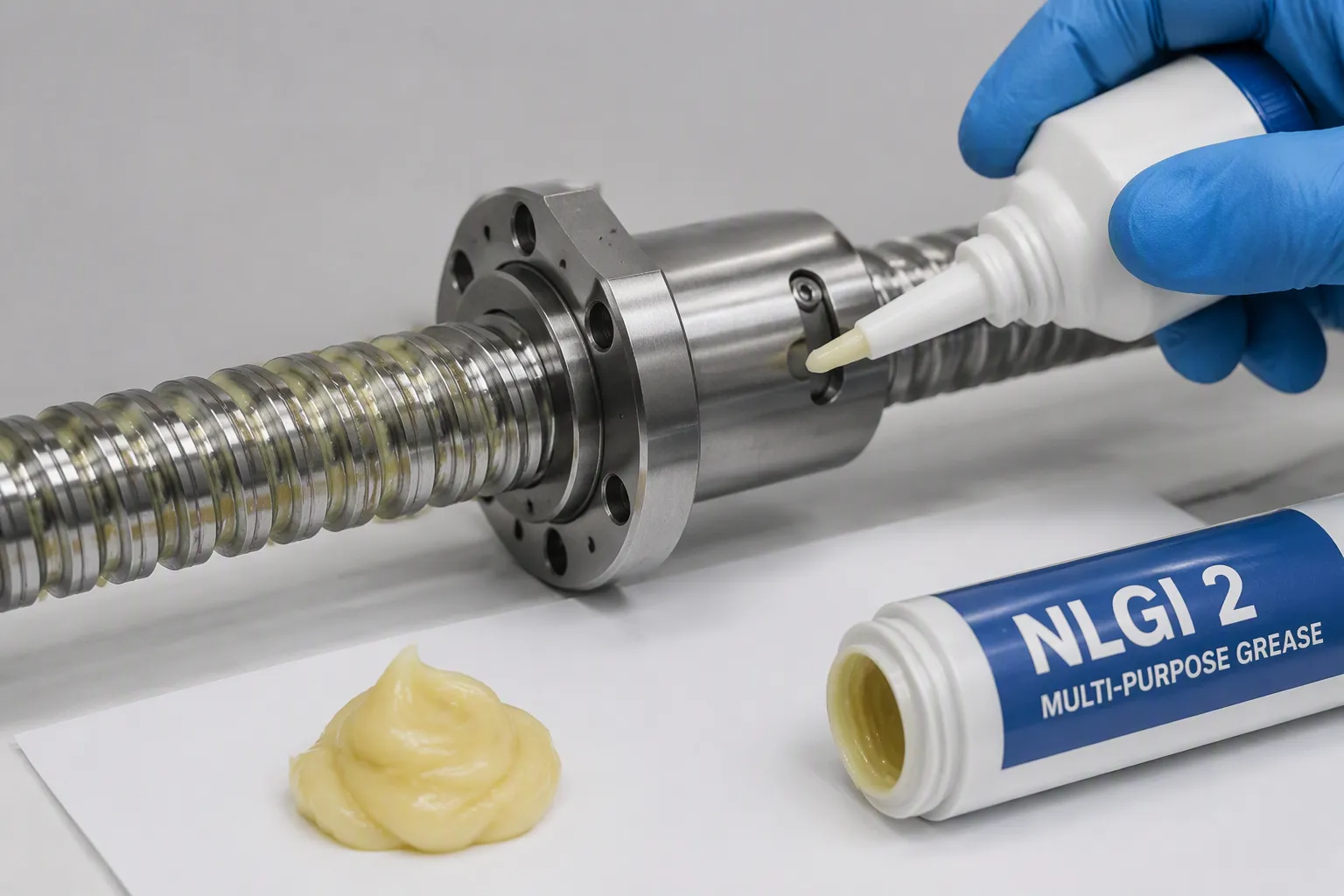
After you select the correct base oil and viscosity, you must consider two more factors. The first is consistency, measured by NLGI grade. The second is the additive package. Both elements determine how well the grease performs in your ball screw assembly. Ignoring either factor can lead to premature wear, increased friction, or contamination that shortens equipment life.
Choosing the Right Consistency (NLGI 2 and Beyond)
The National Lubricating Grease Institute assigns a grade number for grease consistency. Lower numbers mean softer grease that flows more easily. Higher numbers mean stiffer grease that stays firmly in place. NLGI 2 has a consistency similar to butter. For ball screw assemblies, the NLGI grade you choose directly affects how well the grease lubricates and remains inside the ball nut during operation.
NLGI 2 stands as the most common recommendation for ball screws. This grade balances fluidity for easy application with stiffness to stay in place. Ball screws are a type of rolling bearing system, and NLGI 2 is the standard for rolling bearings across many industries. You can rely on NLGI 2 for most standard applications with moderate temperatures and speeds.
An NLGI no. 2 type grease is recommended for ballscrews, though the choice should also consider application-specific requirements such as food-grade or special lubrication needs.
You should adjust the NLGI grade when your operating conditions fall outside the normal range. The table below shows which grade suits different environments.
NLGI Grade | Operating Condition for Selection |
|---|---|
NLGI 1 | Colder environments or applications with limited movement, where a softer grease prevents stiffness and ensures adequate lubrication |
NLGI 2 | General-purpose applications requiring a balance between fluidity for easy application and stiffness to remain in place |
NLGI 3 | High-temperature environments or significant vibrations, where a stiffer grease maintains its protective layer without breaking down |
Selecting the right Grease for Ball Screw Assembly means matching the NLGI grade to your conditions. Cold environments need NLGI 1. This softer consistency prevents the grease from becoming too stiff to flow properly. High heat or strong vibrations need NLGI 3. The stiffer consistency keeps the grease in place and maintains its protective layer. For most standard applications with moderate temperatures and speeds, NLGI 2 delivers the reliable performance you need.
Additives to Avoid: Graphite and MoS2
Additives play a crucial role in grease performance. Anti-wear additives reduce metal-to-metal contact between the balls and raceways. Anti-corrosion additives prevent rust formation when moisture contacts the assembly. Extreme pressure additives handle heavy loads. However, not all additives suit ball screw grease. You must specifically avoid solid additives like graphite and molybdenum disulfide.
Graphite and MoS2 are solid lubricants for high-load, slow-moving applications. They work well in open gears and sliding surfaces. In ball screws, these particles create serious problems. The rolling elements can skid instead of rotating smoothly. The particles accumulate in the raceways, acting like abrasive grit that wears down surfaces over time. This wear reduces positioning accuracy and shortens the assembly life. Never use grease containing these solids in a ball screw assembly.
Instead, choose greases with anti-wear and anti-corrosion additives for rolling bearings. These additives protect your assembly without introducing harmful particles. IMPACT grease is fortified with high-performance polymers and contains exclusive anti-wear additives. It provides protection against rust, corrosion, and wear, and is recommended for use in plain and anti-friction bearings, including ball screws.
Several specialized greases deliver excellent performance for ball screw applications:
FLUOROCARBON GEL 866R-MS: EP-fortified and rust-inhibited, suitable for heavily-loaded low torque applications.
RHEOLUBE 380: EP-fortified, lithium-gelled, synthetic hydrocarbon and ester formulation.
RHEOLUBE 733F: EP- and PTFE-fortified grease for medium-duty precision ball screws, providing smooth, precise motion.
Always check the ingredient list before you buy. Avoid any product with graphite or MoS2. Choose a grease with proven anti-wear and anti-corrosion protection for ball screw assemblies.
Calculating Grease Quantity and Special Operating Conditions
After you select the right grease type, you must determine the correct amount. Special environments like food processing or vacuum chambers also demand different formulations.
Determining the Correct Fill Volume for Your Screw
The grease amount inside the ball nut directly affects performance and temperature. For initial filling, do not exceed 50% of the free nut volume. This prevents overheating at high speeds. Fill between 20% and 30% of the free space. This range provides enough lubrication without excess drag.
Over-greasing causes heat buildup. The grease churns inside the nut and raises temperatures. Under-greasing leads to starvation. The rolling elements run dry, metal contacts metal, and wear accelerates rapidly.
Re-lubrication follows a different rule. The quantity depends on spindle diameter and load.
Lubrication scenario | Key factor | Quantitative rule |
|---|---|---|
Initial filling | Free nut volume | Must not exceed 50% of free nut volume |
Re-lubrication (double nut) | Spindle diameter and load | 0.010 cm³ per 10 mm (high load) or 0.003 cm³ per 10 mm (normal load) |
These values serve as starting points. Adjust them based on your specific conditions.
Food-Grade, Vacuum, and Extreme Temperature Applications
Standard grease will not work in every environment. You must match the lubricant to the conditions.
Food-grade greases must meet NSF standards. These greases use approved ingredients safe for incidental food contact.
Vacuum environments require special attention. Conventional oils and greases evaporate or outgas, ruining sensitive equipment. Solid lubricants like PTFE coatings become necessary.
Extreme temperature applications demand careful selection.
Temperature Range | Recommended Lubrication Approach |
|---|---|
Fluorinated grease | |
200°C – 500°C | Layer-lattice materials (e.g., graphite, molybdenum disulfide) |
Above 500°C | Unlubricated full ceramic bearings or solid lubricants |
For low-temperature operation down to -40°C, you need a specialized Grease for Ball Screw Assembly. These greases use synthetic base oils like polyalphaolefin (PAO) or synthetic esters. They combine with lithium complex or polyurea thickeners. Anti-wear additives and corrosion inhibitors remain effective even at these temperatures.
For high-temperature operation up to 250°C, greases with oxidation stability and high dropping points are essential. These properties maintain chemical stability under thermal stress.
Remember that standard applications still require clean environments. The contamination risks discussed earlier apply regardless of the grease type you choose.
Selecting the right grease for ball screw assembly follows a clear five-step process:
Assess your environment. Check cleanliness, temperature, load, and speed.
Calculate viscosity. Use the mean screw speed formula to find the correct oil thickness.
Choose your base oil. Pick synthetic or mineral oil with anti-wear additives. Avoid MoS2 and graphite.
Select NLGI grade. Choose NLGI 2 for most applications. Adjust for extreme conditions.
Determine fill volume. Fill 20-30% of free space inside the ball nut.
The right grease protects your investment in machine reliability. Consult grease manufacturers or ball screw suppliers for application-specific validation. Their expertise ensures long-term performance and minimal maintenance.
FAQ
How often should I re-lubricate my ball screw assembly?
You should inspect lubrication every 2–3 months. Replace contaminated grease immediately. Re-lubrication frequency depends on duty cycle, speed, and operating environment. High-speed or dirty applications demand more frequent attention. Monitor temperature and noise as early indicators of lubrication breakdown.
Can I mix different grease types in my ball screw?
No. Mixing greases with different thickeners or additives damages the colloidal structure. This causes grease deterioration and premature failure. Always clean the ball nut thoroughly before switching to a new grease. Check compatibility with your supplier when changing formulations.
What happens if I over-grease the ball nut?
Over-greasing causes heat buildup. The excess grease churns inside the nut, raising operating temperatures and increasing drag. This accelerates wear and shortens grease life. Fill only 20–30% of free space inside the ball nut. Never exceed 50% during initial filling.
How do I know when the grease has failed?
Watch for increased operating temperature, abnormal noise, or loss of positioning accuracy. Discolored or hardened grease indicates oxidation. Metal particles in the grease signal active wear. If you notice any of these signs, clean the assembly completely and apply fresh grease immediately.
See Also
Essential Facts About Lubricants for Harmonic Drive Reducers
Key Traits That Define Superior Industrial Grease Performance
Boosting Car Dependability Using FAKKT-GC874K Synthetic Grease