


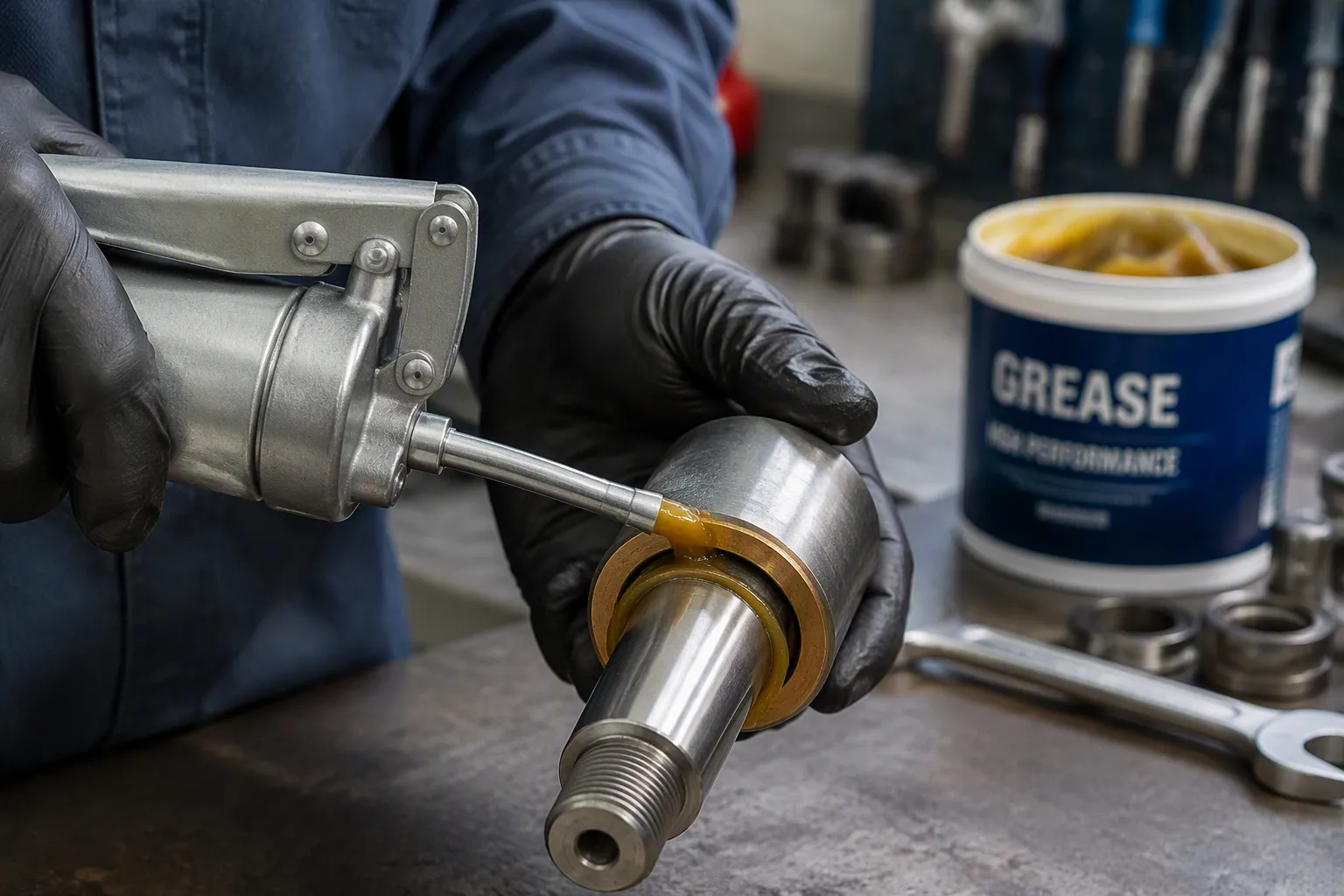
Improper lubrication causes 54 percent of bearing failures. That fact alone shows how critical your grease choice is. Choosing the wrong grease leads to premature wear and downtime. For journal bearings and bushings, lithium complex (moly fortified) and polyurea greases rank as best all-around options. They provide high load capacity, wide temperature range, good water resistance, and long service life. Your ideal Journal Bearing Bushing grease depends on load, speed, temperature, and environment. You need a grease that matches your operating conditions. This guide offers clear selection criteria, specific product picks, and application tips to help you avoid failure and maximize bearing life.
Key Takeaways
Use NLGI #2 grease with a base oil viscosity of 150–220 cSt for most journal bearings.
Pick moly-fortified lithium complex grease for high loads.
Choose silicone grease for temperatures above 80°C.
Select calcium sulfonate complex grease for wet environments.
Do not mix polyurea grease with lithium grease.
Why the Right Journal Bearing Bushing Grease Matters
Cost of the Wrong Grease
The wrong grease punishes your equipment in several ways. It causes premature wear on the shaft and bushing surfaces. It lets heat build up inside the housing. It washes out in wet conditions and leaves metal rubbing on metal. In severe cases, the shaft seizes and your line stops. Unplanned downtime then costs you production hours and repair labor.
Journal bearings and bushings depend on boundary and hydrodynamic lubrication. A rolling-element bearing carries load through point contact, so extreme pressure additives do much of the work. A plain bearing spreads load across a film of oil. Grease film strength and base oil viscosity therefore matter more than EP additives alone. The oil film must stay thick enough to separate the surfaces. Minimum film thickness in the load zone runs from 1.0 to 300 microns during operation. Midsized industrial equipment commonly sees 5 to 75 microns. A larger shaft diameter increases film thickness. Choose a Journal Bearing Bushing grease that maintains that film under your real load.
One common mistake deserves a direct warning. Vaseline is not a bearing lubricant. It melts at low temperatures, carries almost no load, and washes away quickly. Never use it in a journal bearing or bushing.
Plain Bearings vs. Rolling Bearings
These two bearing families need different grease thinking. A rolling bearing tolerates a wide range of greases because its geometry controls the contact. A plain bearing relies on the lubricant itself to build and hold the film. Base oil viscosity drives film formation here. If the oil is too thin, the film collapses under load. If it is too thick, the bearing runs hot and wastes energy.
Speed changes the picture as well. A slow-turning bushing under heavy load needs a stiff, fortified grease. A moderate-speed sleeve needs a general-purpose grease that flows back into the contact. Water exposure adds another demand, because washout strips the film and leaves the bearing dry. Match the grease to the lubrication regime first, then to the environment.
Key Criteria for the Best Grease
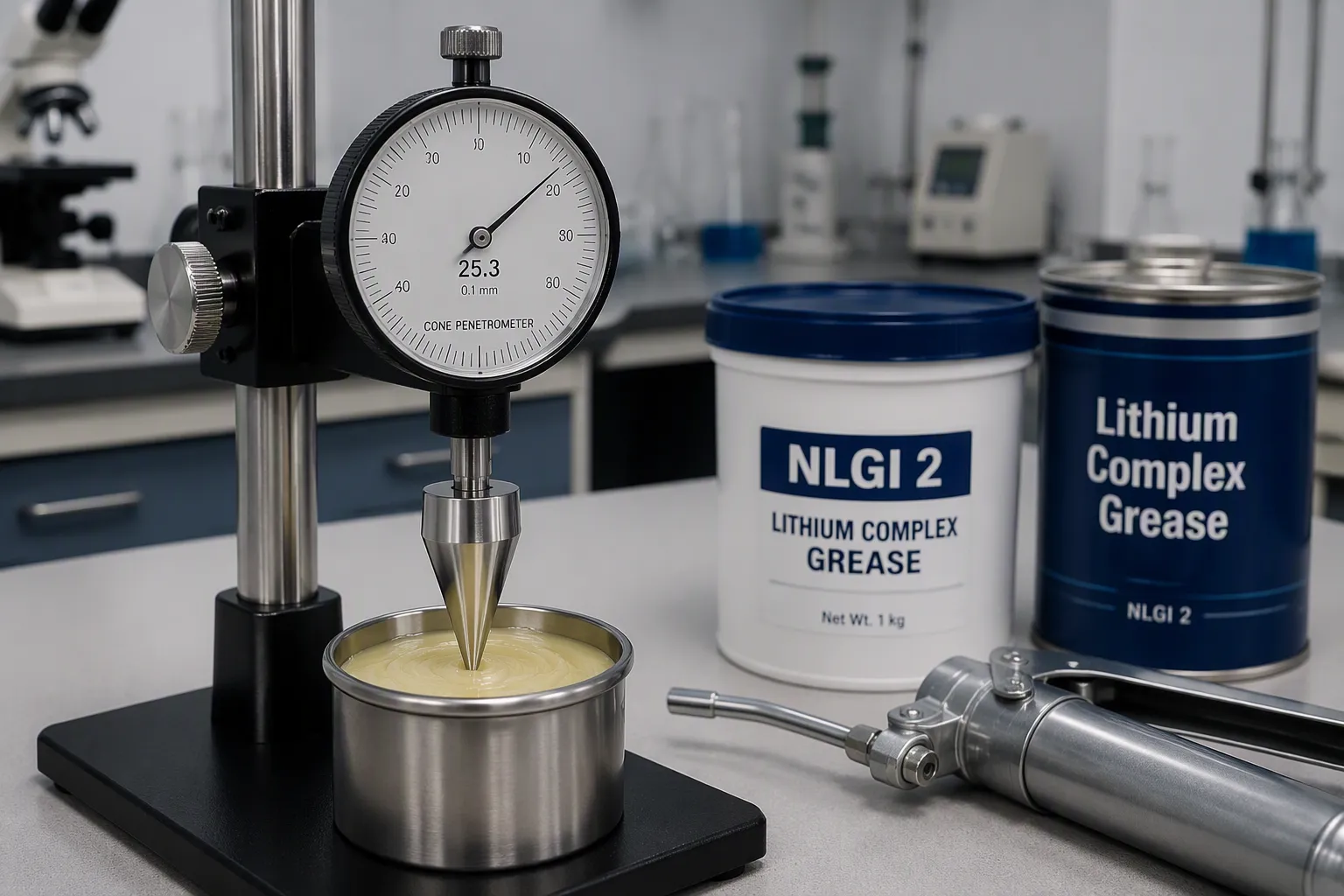
You need a starting point before you compare specific products. For most journal bearings and bushings, the standard recommendation is an NLGI #2 grade grease with a base oil viscosity around 150–220 cSt at 40°C. The NLGI consistency number, also called the NLGI grade, measures the relative hardness of a lubricating grease. The National Lubricating Grease Institute defines this scale, and ASTM D4950, SAE J310, and ISO 6743-9 all reproduce it. The classification defines nine grades, each linked to a range of ASTM worked penetration values. Technicians measure these values using ASTM D217, in which grease is worked 60 strokes at 25 °C and then tested with a standard cone to measure penetration depth.
The NLGI scale ranges from 000 to 6, based on worked penetration after 60 strokes. NLGI 000–0 greases are fluid to semi-fluid and suit enclosed or centralized applications. NLGI 1–3 greases range from tomato-paste-like to butter-like consistency. NLGI 2 is the most commonly used grade, with peanut-butter-like stiffness. NLGI 4–6 greases are stiffer, like ice cream, fudge, or cheddar cheese, and you use them where higher stiffness or channeling is needed.
NLGI 2 is a consistency grade defined by the National Lubricating Grease Institute. The number 2 corresponds to a worked penetration of 265–295 tenths of a millimetre (dmm) per ASTM D217, placing it in the middle of the NLGI scale. Its firm butter-like consistency makes it suitable for the majority of rolling element bearings, electric motor bearings, automotive chassis, and general industrial grease points at moderate speeds and temperatures. NLGI 2 is the global default grade — it is used when no specific grade is called out by the equipment manufacturer’s documentation.
Load, Temperature, and Speed
Load drives your thickener and additive choice. Low-speed, high-load applications favor lithium-complex moly fortified grease. The moly additive provides solid-film protection when the oil film thins under heavy pressure. Temperature sets your base oil and thickener limits. Age-resistant lithium base greases work up to about 80°C. Silicone greases are preferred above that threshold. The maximum operating temperature for lithium complex grease is 170 to 180°C. This is the practical upper temperature limit before oxidation and other degradation accelerate. Speed affects how the grease flows back into the contact. Moderate-speed horizontal bronze or brass oil-groove sleeves do well with general-purpose NLGI 2 grease. A slow-turning bushing under heavy load needs a stiffer, fortified product instead.
Water Resistance and Compatibility
Water exposure strips the oil film and leaves metal rubbing on metal. Calcium sulfonate and polyurea greases offer strong water resistance. According to the ASTM D1264 water washout test, calcium sulfonate complex greases exhibit mass losses below 2%, indicating excellent water washout resistance. Compatibility matters just as much when you switch products. Check the thickener type before you mix greases. Polyurea is the most broadly incompatible common thickener, showing incompatibility with lithium, lithium complex, calcium complex, calcium sulfonate, and bentone. When polyurea contacts lithium grease, the mixture can soften dramatically and lose its ability to retain base oil. The result looks like sudden starvation in a bearing that was recently regreased. Polyurea is the standard factory fill for sealed electric motor bearings, so it is frequently present in a bearing without anyone having specified it.
Thickener | Generally compatible with | Generally incompatible or borderline with |
|---|---|---|
Lithium / lithium complex | Other lithium, lithium complex, simple calcium | Polyurea (case by case), clay, barium complex |
Polyurea | Some polyurea-to-polyurea blends; a few specific soap blends validated by the manufacturer | Most soap-based greases (lithium, calcium, sodium) |
Note that “polyurea” describes a chemical class, not one fixed formulation. Some polyurea thickeners are fully compatible with lithium and lithium complex, while others are flatly incompatible. A compatibility chart is a starting filter, not a final answer. For critical equipment or any transition involving polyurea, skip the purge and disassemble, clean with solvent, and repack. That is the only method that guarantees no mixing. Field cases show the cost of ignoring this rule. One technician replaced a reducer after mixing lithium grease with the OEM’s polyurea fill. Another saw grease thin and leak out of a bearing after a polyurea and lithium complex mix. In one plant, electric motors with OEM polyurea grease were relubricated with aluminum complex grease, which caused softening, running, and poor lubrication. Some cases required extensive purging procedures. Others required a machine shutdown to remove bearings for complete grease removal. Grease thickeners most often mixed were polyurea and lithium or lithium complex. Choose your Journal Bearing Bushing grease with these compatibility rules in mind, and you avoid a failure that looks like sudden starvation.
Top Journal Bearing Bushing Grease Picks
Best Journal Bearing Bushing Grease for General Use
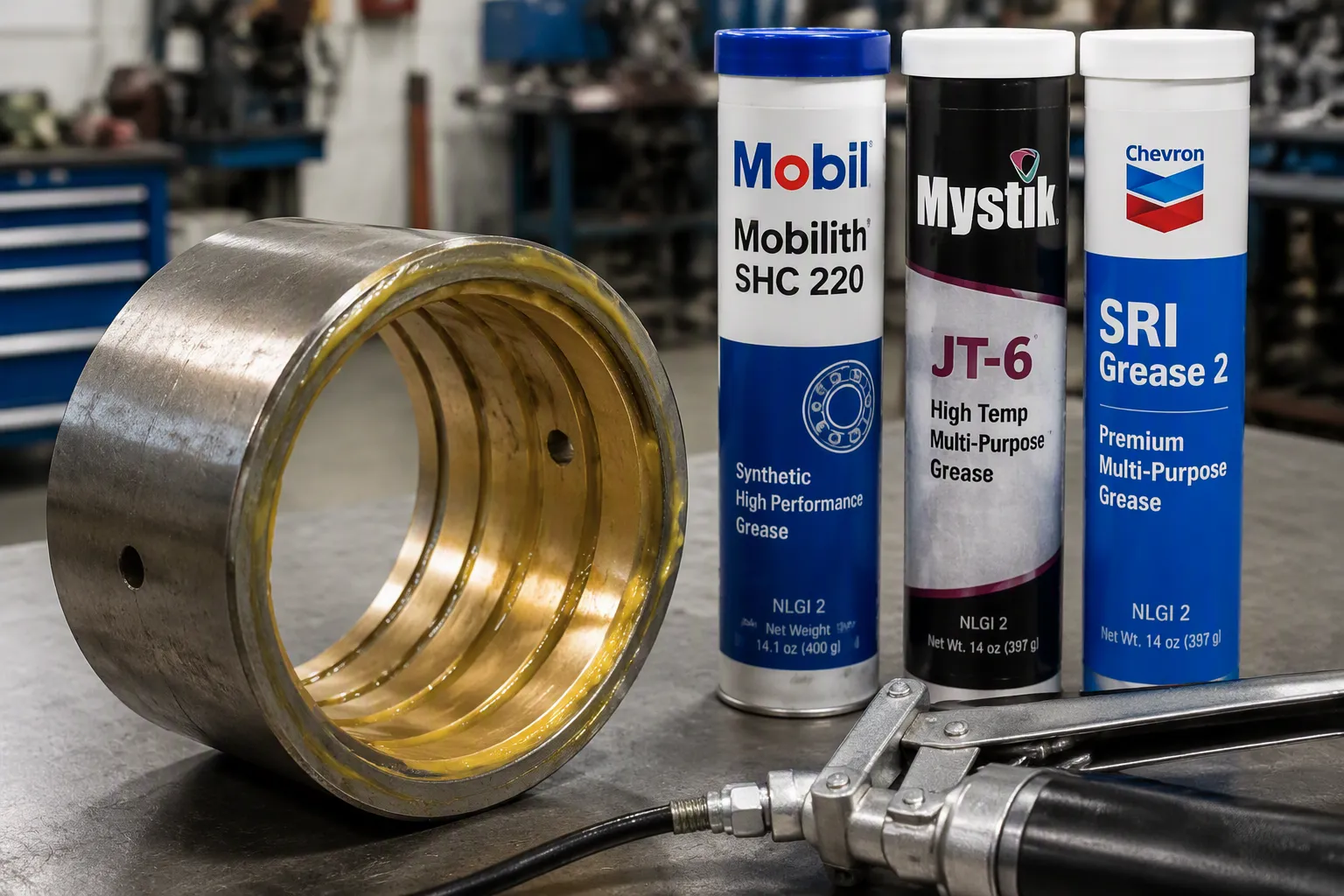
For most applications, an effective Journal Bearing Bushing grease uses a lithium-complex NLGI #2 formulation. This type balances load capacity, temperature range, and water resistance effectively. Three products stand out as reliable workhorses for general service.
Mobilith SHC 220 leads this list. It uses an ISO VG 220 synthetic base fluid. This gives you a base oil viscosity of 220 cSt at 40°C. That value matches the recommended 150–220 cSt range perfectly. You get the film thickness your bearing needs without excessive drag. The synthetic formulation resists oxidation and extends relubrication intervals significantly. The product also carries a Timken OK Load rating of 20 lb. This confirms strong load-carrying ability for typical journal bearing applications. It handles moderate speeds well and maintains consistency across a wide temperature range.
Mystik JT-6 High Temp grease offers another solid choice. It uses a lithium-complex thickener with proven high-temperature stability. This grease handles continuous service in many industrial environments. It resists breakdown and maintains its structure under moderate loads. Chevron SRI Grease 2 also performs well across moderate speeds and temperatures. Both products use NLGI #2 consistency. Their base oil viscosities stay near the recommended sweet spot.
You can use any of these three for general-purpose journal bearing lubrication. They work well on moderate-speed horizontal sleeves with oil grooves. They resist water reasonably well for indoor environments. They provide reliable service life when you follow a consistent relubrication schedule. For most industrial applications, these greases deliver the performance you need without overspending on specialized products.
Best Picks for High-Load, High-Temp, and Wet Conditions
Your operating conditions may push beyond what general-purpose greases can handle. Three distinct scenarios demand specialized products. You need to match the grease chemistry to the specific challenge.
For high-load conditions, reach for a moly-fortified lithium-complex grease. Molybdenum disulfide adds solid-film protection when boundary lubrication dominates the contact. Timken Premium All-Purpose Lithium Complex Grease fits this role well. The moly additive forms a sacrificial layer on the bearing surfaces. This layer protects the shaft and bushing when the oil film thins under heavy pressure. Use this grease for slow-turning bushings, press fits, and heavily loaded pivots. The solid lubricant particles fill surface irregularities and reduce metal-to-metal contact.
For high-temperature service above 80°C, switch to a silicone-based grease. Standard lithium greases degrade and oxidize quickly at elevated temperatures. Dow Corning Molykote 44 High Temperature Bearing Grease solves this problem effectively. Consider these verified specifications:
MOLYKOTE® 44 High Temperature Bearing Grease, Medium is an NLGI Grade 2, silicone-based bearing grease with a lithium thickener, rated for continuous operation from -40°C to 204°C (-40°F to 400°F).
This temperature range covers most high-heat industrial applications. The silicone base oil resists oxidation and does not form hard carbon deposits. The NLGI #2 consistency keeps the grease in place inside the bearing housing. You gain reliable lubrication even near ovens, dryers, kilns, and other heat sources. The wide low-temperature range also allows operation in cold environments.
For wet environments and washdown areas, choose a calcium sulfonate complex grease. Water washout strips ordinary greases quickly and leaves the bearing dry. Shell Gadus S3 V220C 2 offers excellent water resistance for these conditions. Calcium sulfonate thickeners naturally repel water. They also provide strong rust protection and mechanical stability. Use this grease for outdoor equipment, marine applications, food processing areas, and any location with regular water exposure.
One final note applies to plain bearings and bushings with unique demands. Heavily fortified solid-lubricant greases or low-viscosity oils may work better depending on your operating conditions. Choose your Journal Bearing Bushing grease based on your specific conditions. Always verify the manufacturer recommendation for your specific equipment before making a final choice.
How to Apply and Maintain Grease
Frequency, Amount, and Methods
You set your relubrication schedule based on three factors: operating hours, temperature, and contamination. Bearings in wet or dirty environments need more frequent service. High temperatures also shorten the grease’s useful life. Check your equipment manual for the manufacturer’s recommended interval. Then adjust that interval based on your actual conditions. A bearing running in a clean, cool, indoor setting may last months between services. The same bearing exposed to washdown or grit may need weekly attention.
You must avoid over-greasing. Excess grease churns inside the housing, generates heat, and can blow past seals. For journal bearings, follow the 1/3 to 1/2 cavity rule. Fill only one-third to one-half of the free space inside the bearing. This amount leaves room for the grease to flow and release heat. You have three application methods to choose from. Hand packing works well during assembly or for small jobs. A grease gun with a metered stroke gives you control over the volume you inject. Automatic lubricators deliver small, consistent amounts over time. Always clean the fitting before you apply new grease. Dirt pushed into the bearing causes more damage than the grease prevents.
Common Mistakes to Avoid
Mixing incompatible thickeners ranks as the most damaging mistake. Polyurea and lithium greases often fail when combined. The mixture softens, loses its ability to hold base oil, and starves the bearing. However, not all thickener combinations cause problems. Lithium complex and calcium sulfonate greases are compatible with each other. When mixed in a bearing, they do not undergo the separation of soap and oil that leads to oil leakage. This compatibility means you will not see adverse effects such as oil weeping from the bearing pack. Even so, verify compatibility before you switch products.
Never use Vaseline as a bearing lubricant. It melts at low temperatures and carries almost no load. Ignoring base oil viscosity is another common error. A grease with the wrong viscosity cannot maintain the oil film your Journal Bearing Bushing grease needs. Finally, skipping relubrication schedules destroys bearings slowly. Set a reminder, follow it, and record each service. Consistent maintenance extends bearing life far beyond any single product choice.
Use lithium-complex moly fortified NLGI #2 grease for general and high-load applications. Choose silicone grease for high-temperature service above 80°C. Select calcium sulfonate complex for wet environments. These three options cover most situations you face with a Journal Bearing Bushing grease.
Match your grease to your load, temperature, speed, and environment. Brand matters less than these factors. Check the base oil viscosity first. The 150–220 cSt at 40°C range delivers the best film formation for your bearing.
Verify compatibility before you switch thickener types. Mixed greases can soften and starve the bearing. Follow a consistent relubrication schedule. This simple habit protects your equipment much longer than any single product choice alone.
FAQ
What grease works best for most journal bearings and bushings?
A lithium-complex NLGI #2 grease with moly fortification handles most general and high-load jobs. It gives you strong film strength, a wide temperature range, and decent water resistance. Check that the base oil viscosity falls near 150–220 cSt at 40°C. That range builds the oil film your bearing needs.
Can I mix polyurea grease with lithium grease?
No. Polyurea is the most broadly incompatible common thickener. Mixing it with lithium or lithium complex grease can soften the blend and starve the bearing. For critical equipment, disassemble, clean with solvent, and repack instead of purging. That is the only method that guarantees no mixing.
Is Vaseline safe for lubricating a journal bearing?
Vaseline is not a bearing lubricant. It melts at low temperatures, carries almost no load, and washes away quickly. Never use it in a journal bearing or bushing.
How much grease should I put in a journal bearing?
Follow the 1/3 to 1/2 cavity rule. Fill only one-third to one-half of the free space inside the bearing. Excess grease churns, generates heat, and can blow past seals. Always clean the fitting before you apply new grease.
When should I choose silicone grease over lithium grease?
Switch to silicone grease when service temperatures climb above 80°C. Standard lithium greases oxidize and degrade quickly at elevated temperatures. A silicone-based NLGI #2 grease such as Molykote 44 handles continuous operation up to 204°C. It resists oxidation and avoids hard carbon deposits.
See Also
Boosting Automotive Dependability Using FAKKT-GC874K Synthetic Grease Technical Report
Key Factors That Define An Exceptional High-Performance Industrial Grease
FAKKT Grease Answers For Today’s Automotive Industry Challenges
Essential Facts About Grease For Harmonic Drive Reducers
How Colloidal Stability Of Grease Affects Its Overall Performance