


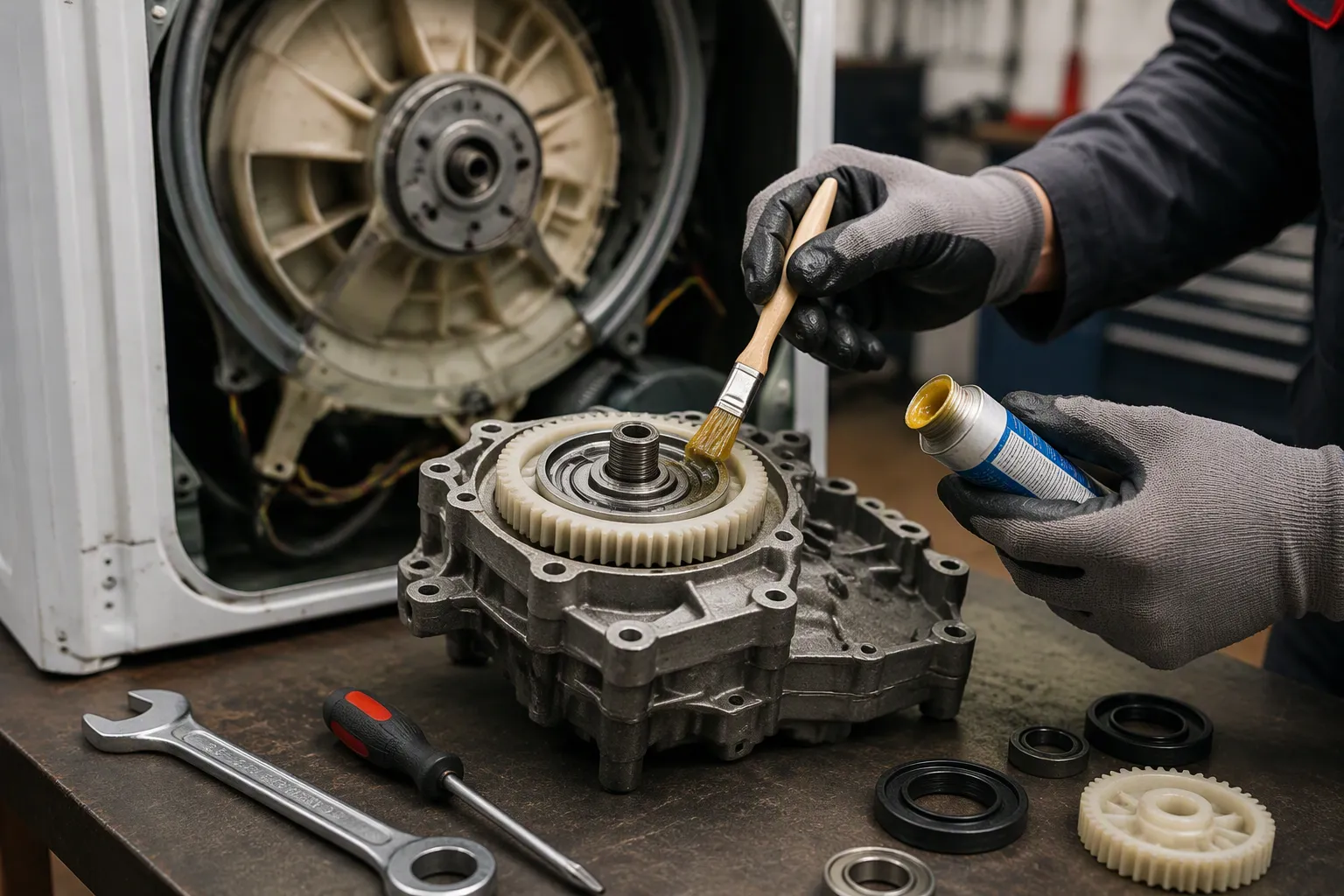
1. Fundamental Tribology & Operating Dynamics
A top-loading washing machine clutch gearbox operates in a harsh, multi-phase environment. During typical washing and spinning cycles, internal components endure high dynamic torque, continuous vibrational resonance, localized temperature spikes, and steady exposure to water, high-alkalinity detergents, and fabric softeners.
The primary role of the transmission lubricant is to manage tribological stress across mixed-material interfaces—typically hardened alloy steel, sintered bronze bushings, and engineering thermoplastics like Acetal/POM (Polyoxymethylene) or Glass-Filled Nylon 66.
Boundary & Mixed Lubrication: During high-torque acceleration and cycle direction changes, the fluid film thins significantly (h / σ < 1), forcing surface asperities into contact. The lubricant must maintain high film strength to mitigate micro-spalling, adhesive wear, and fretting corrosion.
Sealing and Hydrolytic Defense: Lubricants in open or non-hermetic gearcases must resist water washout and hydrolytic breakdown. Detergent-laden water ingress degrades inferior grease thickener matrices, causing rapid emulsification and corrosion.
2. Physical & Chemical Lubricant Classification
Different transmission architectures require specific lubricant physical states and chemical structures. Applying the incorrect rheological phase (e.g., substituting grease for gear oil) alters boundary mechanics, starves high-speed needle bearings, and risks catastrophic drive failure.
A. Semi-Solid Greases (Open and Semi-Sealed Clutch Assemblies)
Lithium-Complex Hydrocarbon Greases: Formulated with mineral oil or Polyalphaolefin (PAO) synthetic bases bound by a lithium-complex soap thickener. Recommended for high-load, metal-on-metal gearing due to high dropping points (>260℃ per ASTM D2265) and strong mechanical shear stability (ASTM D217).
Silicone Greases (Polydimethylsiloxane / PDMS): Suspended in inorganic thickeners such as fumed silica. Silicone options provide exceptional thermal stability and complete chemical inertness around delicate elastomeric lip seals (e.g., NBR, EPDM) and structural plastics. However, under high boundary loads, silicone fluids exhibit lower load-carrying capacity than PAO or mineral-based formulations.
B. Liquid Gear Oils (Hermetically Sealed Sumps)
Certain OEM transmissions (such as classic Whirlpool direct-drive units and heavy-duty commercial gearcases) utilize a fully enclosed oil bath. These sumps call for heavy industrial gear oils (ISO VG 150–220) or extreme-pressure automotive gear oils (SAE 80W-90, API GL-5 certified). These oils continuously circulate via splash-feed mechanisms to cool high-speed planetary gearing.
Comparative Physicochemical Benchmarks
Specification / Property | Testing Standard | Lithium-Complex Grease (PAO Base) | Silicone-Based Grease (PDMS) | ISO VG 150 Gear Oil |
NLGI Consistency Grade | ASTM D217 | Grade 1.5 to 2 | Grade 2 | N/A (Fluid) |
Kinematic Viscosity @ 40°C | ASTM D445 | 100 to 220 cSt | 350 to 500 cSt | 135 to 165 cSt |
Dropping Point (°C) | ASTM D2265 | ≥ 260℃ | Non-melting (>300℃) | N/A |
Water Washout Loss (%) | ASTM D1264 | < 5.0% at 38°C | < 1.5% at 38°C | N/A (Emulsifies) |
Four-Ball Wear Scar (mm) | ASTM D2266 | 0.40 to 0.50 mm | 0.80 to 1.20 mm | 0.35 to 0.45 mm |
4-Ball Weld Load (kgf) | ASTM D2596 | ≥ 315 kgf | ≈ 126 kgf | ≥ 250 kgf |
Polymer / Elastomer Safety | Internal Testing | Moderate (Verify base oil) | Exceptional (Inert) | Moderate to Poor |
Data Source: Compiled from standardized ASTM lab tests, industrial lubricant manufacturer datasheets (e.g., Mobil, NLGI Lubricating Grease Guide), and independent tribology evaluation reports.
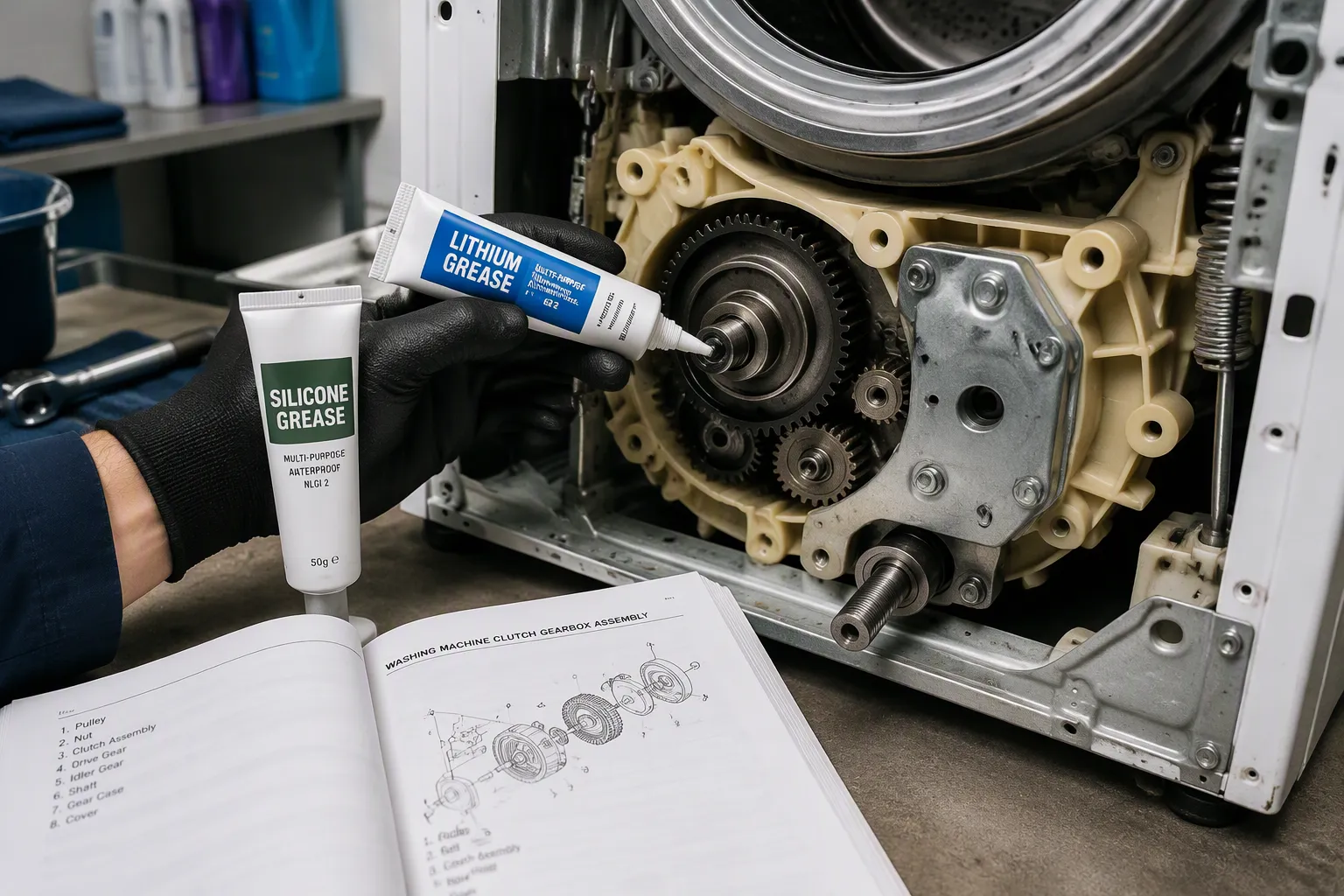
3. Incompatibility Risks & Operational Pitfalls
A. Thickener Matrix Collapse & Syneresis
Mixing incompatible grease formulations disrupts their chemical thickener matrices. Combining a conventional lithium-soap grease with a silicone or aluminum-complex grease often alters micellar structure, causing severe phase separation.
When phase separation occurs, low-viscosity base oil bleeds out rapidly, leaving a dry, caked soap matrix inside the gear cavity. This residue increases mechanical drag and causes premature abrasive gear tooth wear.
B. Over-Lubrication & Hydrodynamic Drag
Applying excessive grease is a frequent mistake during transmission overhauls:
Friction Lining Contamination: Clutch assemblies rely on precise dynamic friction coefficients ($mu approx 0.35text{–}0.45$) to engage drum rotation during spin cycles. Excess grease migrated onto clutch linings or brake bands causes hydroplaning, extended slip cycles, thermal glazing of friction pads, and incomplete spin speeds.
Fluid Churning Losses: Packing a gear cavity beyond 30–40% of its free volumetric capacity causes heavy fluid churning. This increases internal operating temperatures, accelerates lubricant oxidation, and increases current draw on the drive motor, risking thermal overload trips.
Field Diagnostic & Technical Troubleshooting Guide
Before replacing or re-lubricating a clutch gearbox assembly, use the following field diagnostic table to identify root causes based on real-world symptom analysis.
Step-by-Step Step Maintenance & Re-Lubrication Protocol
Required Safety Equipment & Tools
PPE: Nitrile chemical-resistant gloves, ANSI-approved safety eyewear.
Solvents & Cleaners: Non-chlorinated brake cleaner or pure Isopropyl Alcohol (IPA, $ge 99%$). Avoid acetone or chlorinated solvents on plastic gears.
Instruments: Calibrated torque wrench, dial caliper, plastic applicator brush.
Step 1: Safety & Decontamination
Isolate Power and Water: Disconnect main AC power supply. Shut off water inlet valves and drain supply hoses completely.
Disassembly: Access the clutch assembly beneath the outer tub according to OEM service documentation.
Old Grease Removal: Thoroughly wipe away all oxidized, contaminated grease using a lint-free rag. Clean metal gear teeth and plastic components using Isopropyl Alcohol ($ge 99%$). Allow parts to air-dry completely; residual solvent degrades fresh lubricant thickeners.
Step 2: Inspection & Surface Preparation
Substrate Check: Inspect gear teeth under bright light for pitting, micro-cracking, or abnormal wear patterns. Replace broken plastic gears or spalled steel pinions.
Seal Condition: Inspect rubber lip seals. If the seal elastomeric material feels brittle, cracked, or gummy, replace it immediately to prevent water ingress.
Step 3: Targeted Application
Application Thickness: Using a stiff nylon brush, apply a thin, uniform film—targeting a film thickness between $0.2text{ mm}$ and $0.5text{ mm}$—to gear teeth, sliding yoke channels, and drive shaft splines.
Friction Material Exclusion: DO NOT apply grease to dry clutch friction linings, brake shoes, or drive belt contact surfaces. Keep these areas entirely dry and clean.
6. Environmental Responsibility & Waste Management
Used transmission lubricants and flushing solvents contain micro-metallic wear particles, degraded hydrocarbons, and synthetic additives. Uncontrolled disposal poses environmental hazards.
Drain and Water Systems: Never flush degraded grease or solvent residues down household drains or municipal sewer systems.
Containment: Store spent lubricant and solvent-soaked wipes in a sealed, oil-resistant container.
Disposal Facilities: Transport used oil and contaminated grease to a certified automotive waste recycling facility or a local hazardous waste collection site in accordance with regional environmental regulations (e.g., EPA Resource Conservation and Recovery Act guidelines in the US, or EU Waste Framework Directive 2008/98/EC).
FAQ
Can I use automotive grease in my washing machine clutch gearbox?
No. Automotive grease can damage seals and plastic parts inside your washer. Stick with an appliance-grade lithium or silicone product instead. Your owner’s manual will point you to the right one.
How do I know if my machine needs oil instead of grease?
Check your manual first. Some Whirlpool transmissions call for 80W90 oil, not grease. If the old lubricant looks like clear synthetic oil, replace it with a similar product. Never guess.
What happens if I mix lithium and silicone grease together?
The mixture can clump, soften, or harden. Either way, it stops protecting the gears. Clean out the old layer completely before you apply a new product. Pick one type and stay with it.
How much grease should I apply to the clutch gear?
A thin film is enough. Too much causes drag, attracts dirt, and strains the motor. Remember, the clutch needs some friction to grip. Over-lubricating makes it slip.
Can I fix a leaking gear case with new grease?
No. If oil or grease seeps from the case, the seals have failed. A seal repair often costs more than the washer is worth. In that case, replacing the machine makes more sense.
See Also
Essential Guide to Grease for Harmonic Drive Reducers
Boosting Automotive Reliability Using FAKKT-GC874K Synthetic Grease: Technical Bulletin
How Colloidal Stability of Grease Affects Its Performance
FAKKT Grease Solutions Addressing Today’s Automotive Challenges
Key Factors That Make High-Performance Industrial Grease Exceptional