


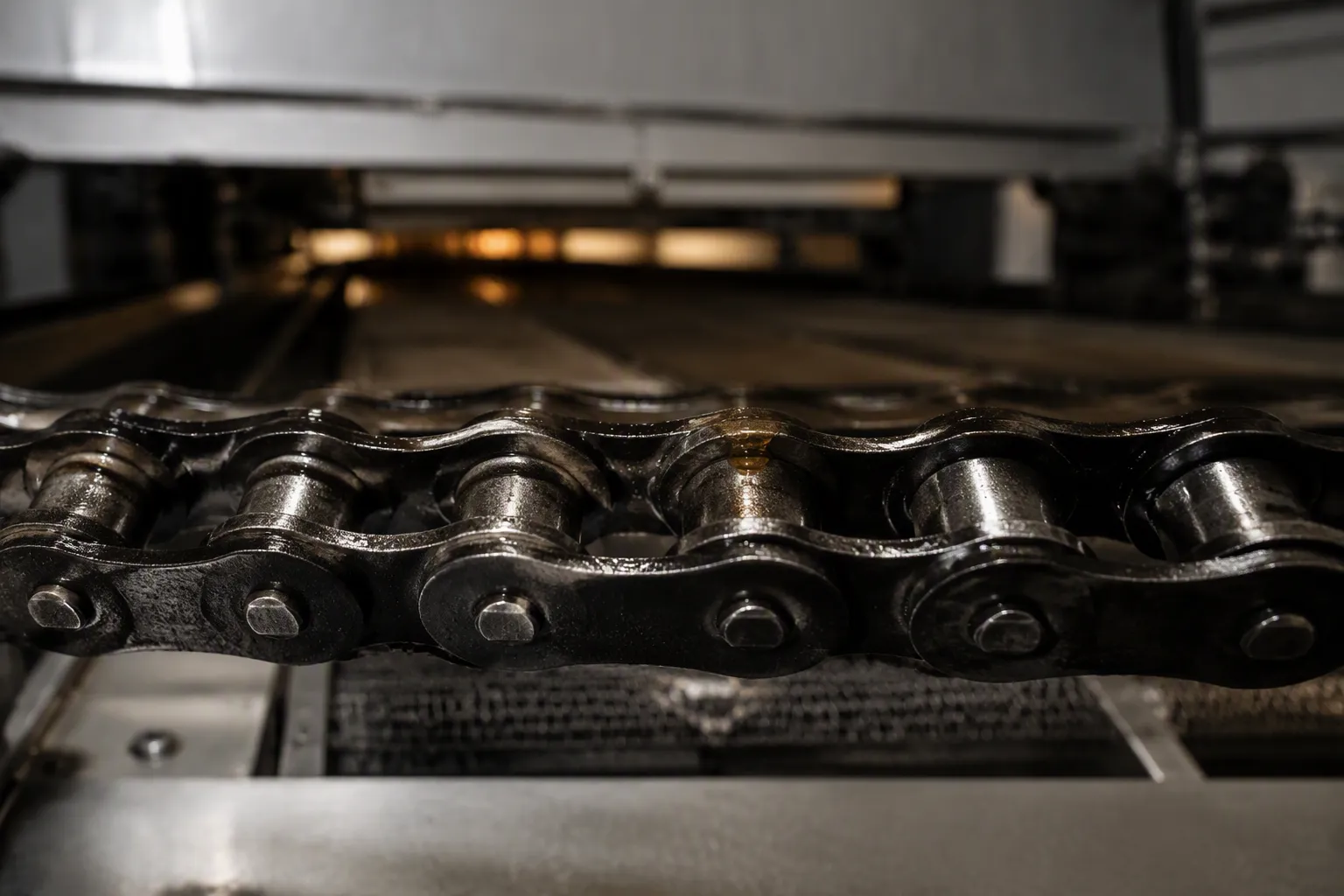
Food-grade synthetic high-temperature grease is the best choice for food baking tunnel oven chains. It resists extreme heat, meets food safety rules, and fights oxidation far better than ordinary lubricants. Bakery operators and maintenance teams depend on these three strengths to keep production clean and running.
This article explains why synthetic food-grade grease wins, compares it against mineral and aluminum-based options, and shows how to select, apply, and maintain it. Readers will learn the key selection criteria, including temperature ratings and H1 certification, plus practical steps that protect both baked goods and oven chain equipment.
Key Takeaways
Synthetic food-grade grease handles extreme heat better than mineral grease.
NSF H1 certification ensures the grease is safe for incidental food contact.
Choose grease based on your oven’s peak temperature and chain speed.
Apply grease correctly and maintain a regular schedule to prevent wear.
Using the right grease saves money and extends chain life.
Why Synthetic Food-Grade Grease Wins
High-Temperature Performance
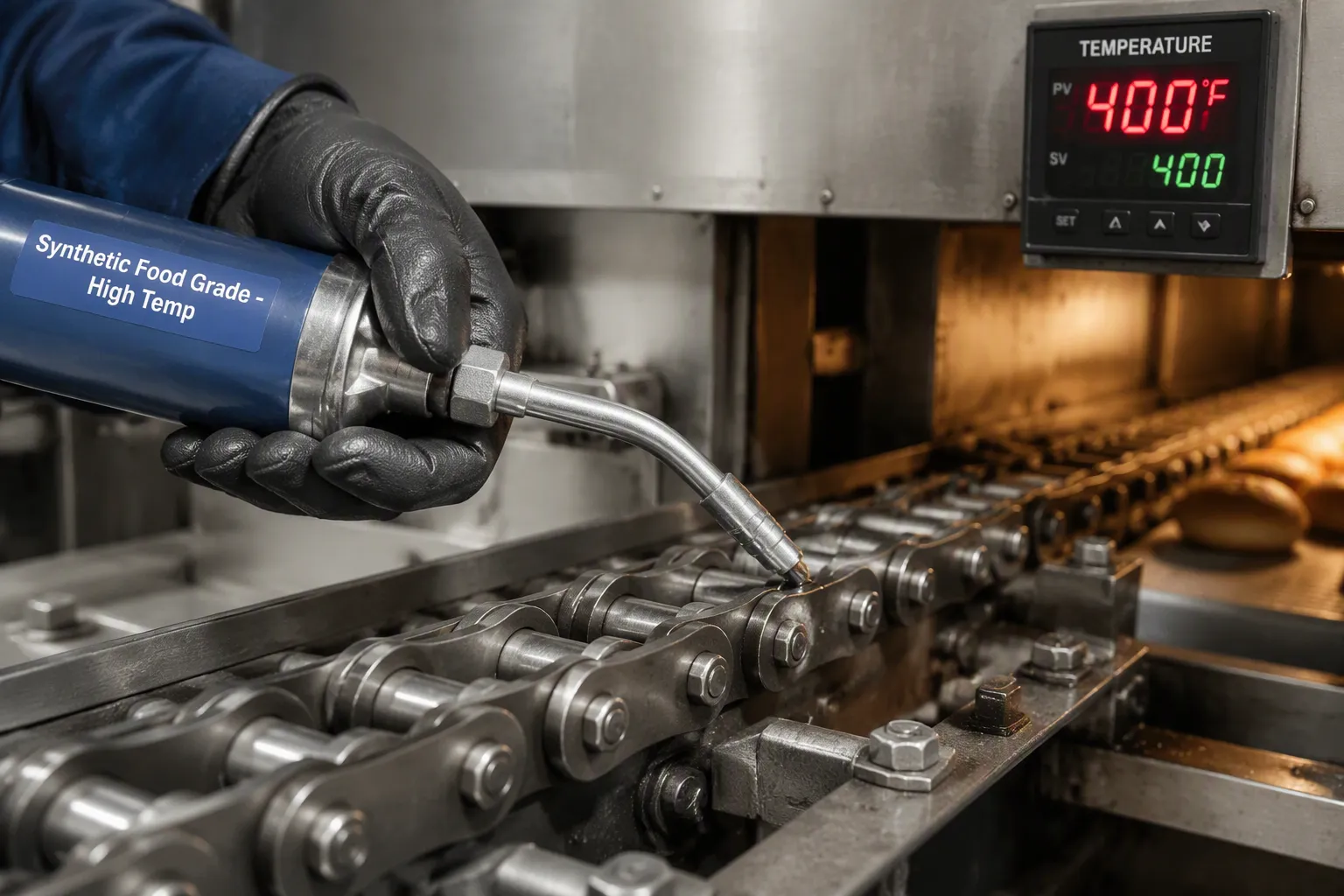
Tunnel ovens push chain lubricants to their limits. A standard food-grade lubricant degrades around 280°C, which forces frequent relubrication and creates smoke contamination risks. Most conventional lubricants break down, carbonize, and form harmful deposits above 300°C. Food-grade lubricants should remain stable up to at least 315°C. Synthetic grease meets this demand.
Synthetic lubricants use esters or olefins instead of crude oil. This chemical base delivers greater oxidation stability than mineral oils. Mineral oil-based grease oxidizes and creates carbon deposits when temperatures exceed 150°F. Synthetic food-grade grease functions across both high and low temperature ranges.
Synthetic lubricants are based on chemicals other than crude oil which are most often esters or olefins. When compared to mineral oils, they have a greater oxidation stability and are commonly used in high temperature applications.
Lab tests confirm this advantage. A synthetic ester grease kept perfect structure after 20 hours at 400°F, with weight loss under 1% and no cover residue. Nine of 17 commercial mineral, PAO, or vegetable greases lost their structure under the same conditions. Evaporation loss for those products ranged from 4% to 44%. At 450°F, the synthetic ester showed excellent structure with only 2% evaporation and 0.1 mg deposits. Five of eight commercial samples developed skin layers. At 500°F, all seven remaining commercial samples showed heavy skin and significant oil bleed. The synthetic ester maintained good structure with no skin and deposits under 4 mg.
Test Condition | Synthetic Ester Grease | Commercial Mineral/PAO/Vegetable Greases |
|---|---|---|
20 h at 400°F (204°C) | Structure perfect; weight loss <1%; no cover residue | 9 of 17 lost grease structure; evaporation loss 4%–44% |
20 h at 450°F (232°C) | Structure excellent; evaporation 2%; deposits 0.1 mg | 5 of 8 had skin layers; evaporation 5%–55% |
20 h at 500°F (260°C) | Good structure with some oil bleeding; no skin; deposits <4 mg | All 7 showed heavy skin and significant oil bleed; deposits 4–27 mg |
4 h at 550°F (288°C) | Good structure with some bleeding; no skin; deposits 2.2 mg | All commercial samples had heavy skin; deposits 8–53 mg |
Food Safety Compliance
Food-grade oven-safe lubricants fall into three NSF categories. NSF H1 products are registered for use where incidental food contact may occur, acceptable up to 10 ppm by weight of finished food under FDA 21 CFR 178.3570. NSF H2 products are registered only for use where no food contact is possible. NSF H3 soluble oils serve hooks and trolleys where occasional contact is acceptable because the oil washes away before food handling.
NSF Category | Definition | Contact Condition |
|---|---|---|
NSF H1 | Registered for incidental food contact; acceptable up to 10 ppm under FDA 21 CFR 178.3570 | Incidental contact permitted |
NSF H2 | Registered only where no food contact is possible | No contact permitted |
NSF H3 (soluble oils) | For hooks and trolleys where occasional contact is acceptable | Occasional contact acceptable |
Tortilla oven chains pass through the cooking zone where incidental food contact is possible. NSF H1 is required. The certification process is rigorous. Manufacturers submit the complete formulation to NSF International. NSF reviews every ingredient against the FDA’s approved list under 21 CFR 178.3570. The lubricant must contain no heavy metals, carcinogens, or mutagens. Products receive an NSF registration number and appear in the NSF Nonfood Compounds database. Registration requires annual reviews, and formula changes demand resubmission.
Most category H1 food-safe lubricants melt at high oven temperatures. The best choice is a high-temperature H1 grease specifically formulated for oven chains. The top oven chain lubricants are also smokeless and odorless. This prevents any effect on the taste and smell of baked goods.
Comparing Grease Types for Tunnel Ovens
Mineral Grease Risks
Mineral-based lubricants carry real dangers in tunnel oven service. A low flash point chain lubricant containing aluminum may not suit high-temperature oven chains. These products can leave hard residues on chain pins and fail when temperatures climb. Aluminum thickeners separate from the base oil under sustained heat. The residue then carbonizes into abrasive grit that accelerates chain wear.
Flash point data reveals the gap between mineral and synthetic products. Mineral-based Molub-Alloy CH 22 reaches only 360°F. Synthetic options perform far better. Tribol CH 290 hits 536°F, KLK 28 reaches 500°F, and Viscogen G achieves 475°F. The LubeCon Series spans a wide range: Series 525 at 250°F, Series 735 at 410–565°F, Series KCL 46 at 445°F, Series SYN HT 160X at 482°F, and Series SYN HT 200 at 594°F. Higher flash points mean the lubricant stays in place instead of burning off.
Synthetic vs. Food-Grade
Synthetic grease outperforms mineral products on every critical measure. Synthetic base oils resist oxidation, shed heat faster, and hold their structure longer. Food-grade certification adds another layer of protection. An H1 rating confirms the product is safe for incidental contact. Buyers should look for products that combine both traits.
Several commercial products illustrate what good looks like. Klüberfood NH1 CH 6-120 SUPREME, Monolec High Temperature Oven Chain Lubricant (9965-9966), and Ovenworx H1 Syn Chain Lubricant (4061) all target this exact application. Each one pairs a synthetic base with H1 registration.
At TEFLUBE, we recommend our EsterChain 150 or 220, specially formulated for high-temperature chain applications in paint shops. These lubricants offer: High flash points (>275°C), Low residue formulation, Extended lubrication cycles, Cleaner chain performance.
That combination of high flash point and low residue defines the right choice for tunnel oven chains.
How to Choose the Right Grease
Temperature and Chain Speed
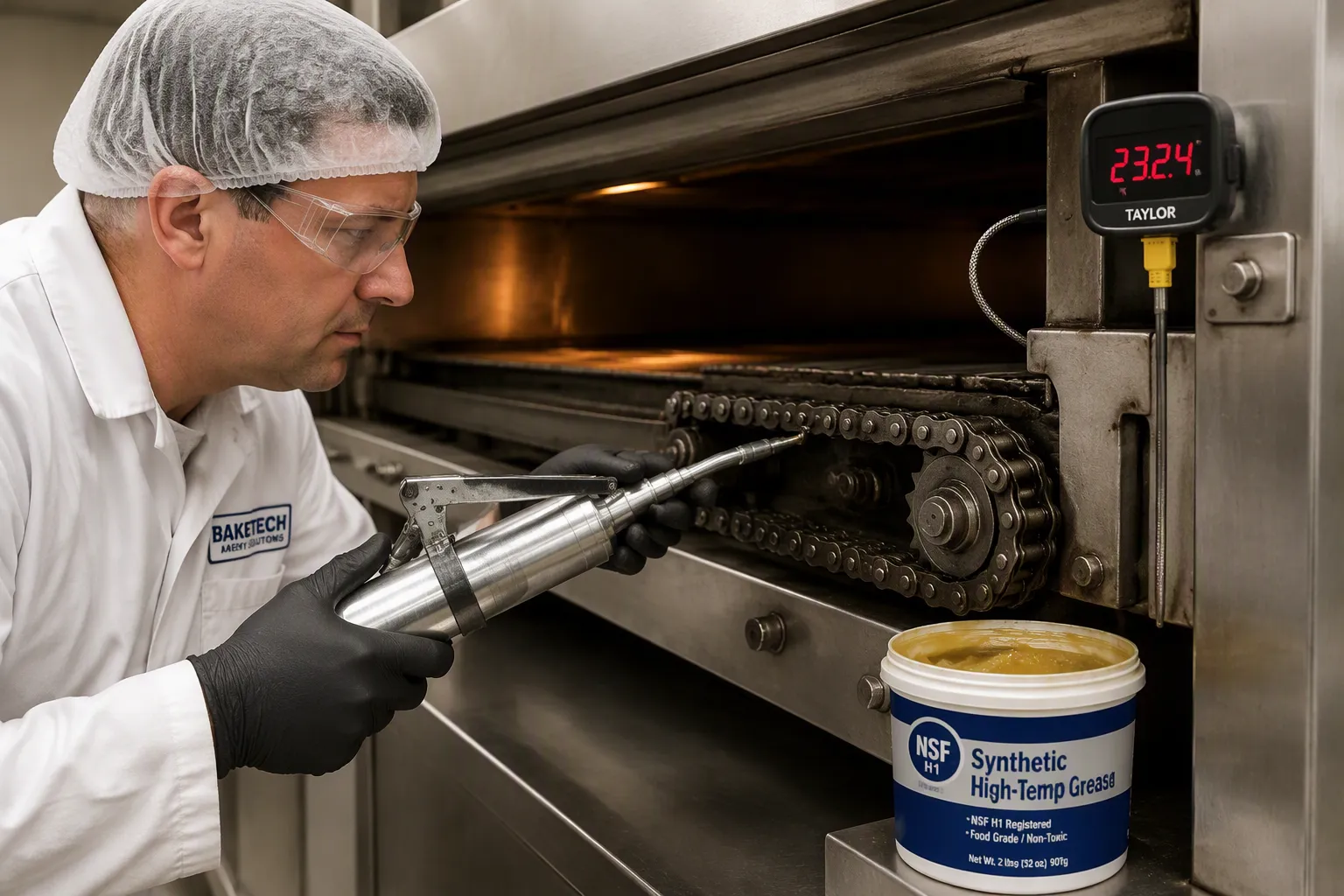
The maximum operating temperature of the tunnel oven drives every other decision. A lubricant must stay stable at the hottest point the chain reaches, not the average oven temperature. Bakery operators should measure the peak temperature at the chain return path and the baking zone exit. A product rated for 400°F will fail quickly in an oven that peaks at 500°F. The synthetic ester grease tested earlier held its structure at 500°F with deposits under 4 mg, while all commercial mineral samples showed heavy skin and significant oil bleed at that same temperature.
Chain speed adds another layer of stress. Faster chains generate more friction and throw lubricant off the pins before it can penetrate. High-speed lines need a grease with strong adhesion and a high flash point. The LubeCon Series SYN HT 200 reaches a flash point of 594°F, which keeps the product in place on fast-moving chains. A low flash point chain lubricant containing aluminum may not suit these conditions because it can leave residues or fail when temperatures climb.
Operators should match the grease to both the peak temperature and the chain speed. A slow chain in a moderate oven tolerates a wider range of products. A fast chain in a high-temperature zone demands a synthetic base with proven oxidation stability. This single choice extends oven life and lowers operational and maintenance costs over time.
Certifications and Base Oil
Certification separates a truly safe product from a general-purpose lubricant. NSF H1 registration confirms the product is acceptable for incidental food contact up to 10 ppm under FDA 21 CFR 178.3570. Buyers in the United States, and those serving USDA, FDA, SQF, BRC, or FSSC 22000 audited facilities, should treat H1 as the minimum standard.
ISO 21469 goes further. This international hygiene standard covers the entire manufacturing process: formulation, manufacture, packaging, and handling. It requires annual auditing of the production site and regular testing of the lubricants. The pharmaceutical, cosmetics, and animal feed industries recognize this certification. Some markets, such as Brazil, require it by law. Many leading food producers specify it as a condition of supply.
Certification | What It Covers | Who Accepts It |
|---|---|---|
NSF H1 | Ingredient approval for incidental food contact | USDA, FDA, SQF, BRC, FSSC 22000 |
ISO 21469 | Full manufacturing process and hygiene standards | GFSI frameworks, premium food manufacturers |
A newer standard adds another layer of assurance. NSF 537 verifies the absence of intentionally added PFAS and compliance with NSF’s PFAS assessment criteria. This certification complements existing NSF H1 or 3H registrations. Bakery chains in kneading and proofer areas may contact food, so H1 remains essential. NSF 3H covers release agents for baking pans, not chains, but it forms part of a complete food-grade range. ISO 9001 confirms the manufacturer’s quality management system.
The base oil determines long-term performance. Synthetic esters and olefins resist oxidation far better than mineral oils. Mineral oil-based grease oxidizes and creates carbon deposits when temperatures exceed 150°F. A synthetic base holds its structure, sheds heat faster, and resists melting. Buyers should look for a product that pairs a synthetic base with H1 registration and, where possible, ISO 21469 certification. This combination protects both product safety and equipment uptime.
Applying and Maintaining the Grease
Proper Application Methods
Proper lubrication of oven chains keeps bakery tunnel ovens running smoothly. It prevents wear on pins, rollers, and bushings. The right application method depends on chain speed and load. Manual and drip lubrication suit low-speed and low-load chains. Automatic systems handle high-speed and high-load applications.
Manual application requires a worker to apply lubricant every 8 to 10 hours using hand tools. The equipment must be powered off during this process. This method is time-consuming and potentially dangerous because workers must access moving parts. Drip systems offer a semi-automatic alternative. A controlled drip rate of 5 to 20 drops per minute provides continuous, uniform lubrication without stopping equipment. Operators must check periodically for clogs or leaks.
System | Operation | Maintenance Needs | Best For |
|---|---|---|---|
Manual | Applied every 8–10 hours; equipment off | Time-consuming; safety risk | Low-speed chains; small production |
Drip | 5–20 drops/min; continuous | Check for clogs and leaks | Conveyor systems running continuously |
Automatic | Timed, metered spray or bath | Minimal daily inspection | High-speed or high-load applications |
Automatic systems deliver timed, metered oil through force-feed or oil-ring methods. They reduce manual labor and unplanned downtime. High-speed tunnel ovens benefit most from this approach.
Maintenance Schedule and Warning Signs
Bakery operators should follow the manufacturer’s lubrication schedule without exception. They must monitor chain condition regularly. Warning signs include unusual noise, visible residue buildup, and stiff chain movement. Reapplication should happen before breakdown occurs, not after.
A consistent maintenance routine extends oven life and lowers operational costs. Teams should record each application and note any changes in chain behavior. This practice catches problems early. The right grease protects both product safety and equipment uptime.
Food-grade synthetic high-temperature grease remains the top choice for baking tunnel oven chains. Operators should prioritize temperature rating, H1 certification, oxidation stability, and long-term cost-effectiveness. The investment pays off through extended chain life and reduced lubricant consumption. One manufacturer reduced lubricant usage by 66 percent after making the switch. Chain replacement costs also drop by half or more. Maintenance demands consistent attention: follow the manufacturer’s schedule, monitor chain condition, and reapply before breakdown occurs. This practice protects product safety and equipment uptime equally, making the right choice critical for every bakery operation.
FAQ
What is the difference between NSF H1 and H2 lubricants?
NSF H1 lubricants accept incidental food contact up to 10 ppm under FDA regulations. NSF H2 products cannot contact food at all. Bakery tunnel ovens require H1 certification for chain lubricants that may touch food products during operation.
How does mineral grease harm tunnel oven chains?
Mineral grease carbonizes at high temperatures. It leaves hard residues on chain pins. These residues turn into abrasive grit. The grit accelerates chain wear significantly. It also requires more frequent lubrication than synthetic alternatives.
How often should operators lubricate oven chains?
Manual application requires lubricant every 8 to 10 hours. Operators must power off equipment during manual lubrication. Automatic systems deliver continuous metered oil without stopping production. High-speed ovens benefit most from automatic lubrication systems.
What certifications should buyers look for?
NSF H1 certification confirms safety for incidental food contact. ISO 21469 certifies the full manufacturing process. Synthetic base oils with these certifications provide the best protection for tunnel oven chains and finished bakery products.
See Also
What Sets High-Performance Industrial Grease Apart From Others
How Colloidal Stability Affects Grease Performance And Longevity
Key Considerations When Selecting Grease For Harmonic Drive Reducers
Modern Automotive Challenges Solved With FAKKT Grease Solutions
How FAKKT-GC874K Synthetic Grease Boosts Automotive Reliability