


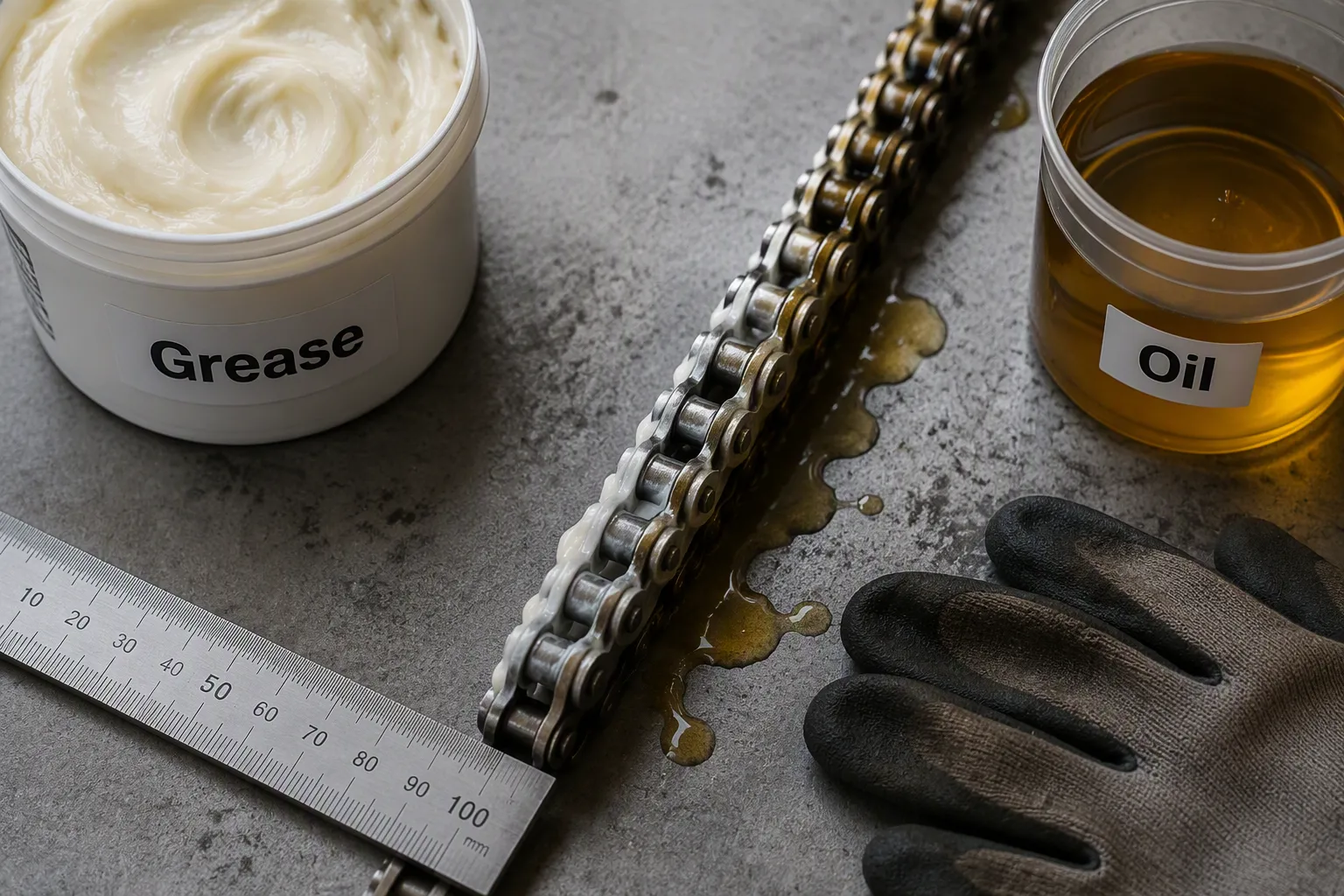
When choosing between grease or oil, oil is generally the better choice for most roller chain applications, but grease for roller chain has its place in specific scenarios. Your decision depends on factors like speed, load, and environment. The primary trade-off is straightforward: oil penetrates deep into pins and bushings, while grease resists fling-off and water exclusion.
Consider what happens without lubrication. Wear rates jump roughly 50 times higher than baseline. Proper lubrication delivers 15,000–20,000 hours of service life.
A chain run dry for as little as 30 minutes can lose 0.5% of its life span — repeat that across a few shifts and you’ve burned through the bushings.
This guide walks you through the decision-making process. You will start with the critical pre-lubrication step of cleaning. From there, you will evaluate whether oil or grease fits your specific application.
Key Takeaways
Oil is the best choice for most roller chains because it reaches internal pins and bushings.
Grease works well for slow, heavy, or wet applications where oil washes away.
Always clean the chain before applying any lubricant to prevent abrasive paste.
Proper lubrication can extend chain life to 15,000–20,000 hours.
Match your lubricant to your chain’s speed, load, and environment for best results.
Why Roller Chain Lubrication Is Non-Negotiable
The High Cost of Friction and Wear
A roller chain functions as a series of precision bearings. Each link contains pins, bushings, and rollers that articulate every time the chain wraps around a sprocket. Without proper chain lubrication, these components grind against each other in direct metal-on-metal contact. That friction destroys material rapidly.
The damage concentrates at the internal pin-bushing joint. This area experiences the most articulation as the chain enters and exits each sprocket. Friction wears away pin material, which produces chain elongation. Many operators mislabel this condition as “stretch,” but the metal does not stretch. It simply wears away. As the pin loses material, the chain’s fatigue strength drops considerably.
You should measure elongation regularly. When it reaches 1.5% across at least six pitches, replacement becomes necessary. This threshold applies to drives with fewer than 60 sprocket teeth. Operating beyond this point invites serious consequences: sprocket damage, chain-jumping, unexpected loading, and increased vibration. A lubricant prevents this scenario by forming a slippery film between moving surfaces. That film minimizes direct contact and extends component lifespan dramatically.
The Critical First Step: Cleaning Before Lubricating
Applying fresh lubricant to a dirty chain wastes your effort. You must clean the chain thoroughly before any lubrication step. Dirt, dust, and old lubricant residue accumulate on chain surfaces during normal operation. These contaminants mix with new oil or grease and create an abrasive paste. That paste grinds away at pins and bushings faster than no lubricant at all.
Dust and other impurities are easily mixed into the lubricant and become abrasive particles, which aggravate the wear of the roller chain. Additionally, impurities may mix with the lubricant to form an abrasive mixture, accelerating the wear of the chain.
This contamination problem explains why proper chain lubricant application requires a clean surface. You should wipe down the chain exterior, use a suitable degreaser for heavy buildup, and allow the chain to dry completely. Only then should you apply your chosen lubricant. This cleaning discipline matters regardless of whether you select oil or grease. Skipping this step turns your maintenance routine into a damage routine. Remember that lubricating a chain properly means lubricating a clean chain. The extra minutes you spend cleaning will save you hours of downtime later.
Oil vs. Grease: The Penetration Problem
Why Oil Reaches the Pins and Bushings
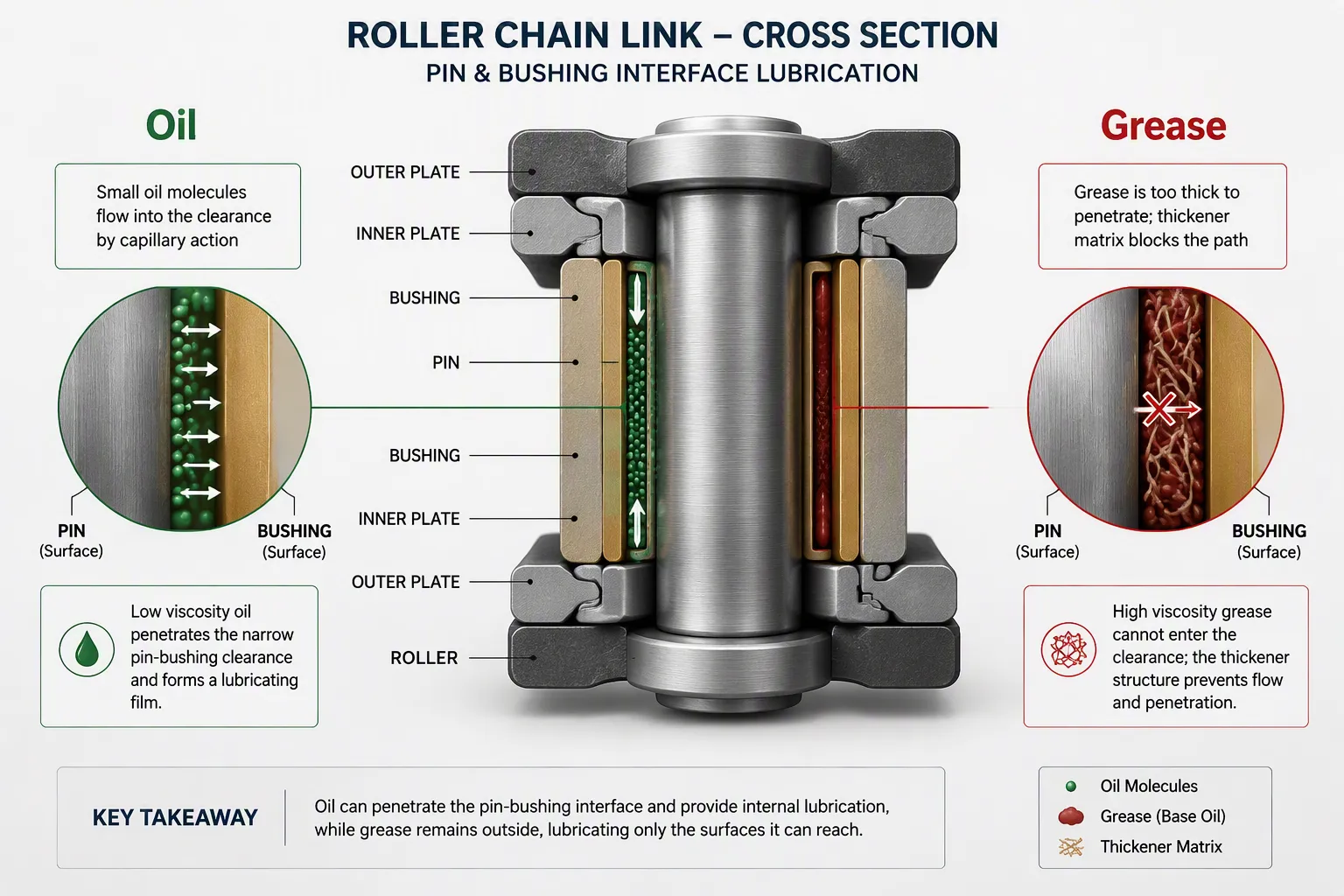
A roller chain’s internal geometry explains why lubricant choice matters so much. The pin and bushing form a bearing pair with an extremely tight clearance. You typically measure this gap in ten-thousandths of an inch. Oil molecules remain small enough to flow freely into this microscopic space. Their low viscosity allows them to migrate through capillary action, creeping along the pin surface until they reach the load-bearing zone.
Think about what happens when you apply oil to a chain. You drip it onto the side plates and let gravity and motion do the work. As the chain flexes around sprockets, the oil works deeper between the pin and bushing. Each articulation cycle pumps fresh lubricant into the wear zone. This continuous replenishment creates a durable hydrodynamic film that separates metal surfaces during operation.
The numbers reinforce this point. A properly oiled chain can achieve 15,000 to 20,000 hours of service life. That longevity depends entirely on maintaining that internal oil film. You need a lubricant that can reach the friction point and stay there. Oil accomplishes this task because it behaves as a liquid under operating conditions. It responds to pressure by flowing rather than resisting, which means it always finds a path to the surfaces that need protection.
Temperature also favors oil in most applications. The lubricant absorbs heat generated by friction and carries it away from the pin-bushing interface. This cooling effect prevents accelerated wear that occurs when components run hot. Grease cannot provide this same thermal management because it lacks the fluidity to circulate and dissipate heat effectively.
The Thickness Barrier: Why Grease Falls Short
Grease presents a fundamental problem for chain lubrication. You should understand that grease consists of oil held in place by a thickener — typically soap, clay, or synthetic compounds. This thickener gives grease its semi-solid consistency. That same consistency prevents it from flowing into the tight clearances where your chain actually wears.
Consider the physical barrier you face. The thickener molecules aggregate into a sponge-like structure that traps oil within its matrix. When you apply grease to a chain, it coats the exterior surfaces thoroughly. The rollers and side plates look well-lubricated. But the critical pin-bushing joint remains dry because the grease cannot squeeze through the microscopic gap. You end up with a chain that appears protected while its most vulnerable components grind together unprotected.
The consequences become evident over time. You might notice that a grease-lubricated chain wears faster than expected despite your diligent maintenance schedule. The exterior remains coated and rust-free, yet elongation progresses steadily. This pattern occurs because the internal bearing surfaces never receive adequate lubrication. The grease simply cannot penetrate to where it matters.
Some operators attempt to overcome this limitation by heating grease before application. The heat temporarily thins the thickener, allowing partial penetration. This technique works for intermittent maintenance, but the effect fades as the grease cools and re-thickens. You must repeat the process frequently to maintain any internal lubrication benefit. Meanwhile, the grease coating on the exterior attracts dust and grit, creating an abrasive layer that accelerates wear on the rollers and sprocket teeth.
The fundamental trade-off becomes clear. Grease excels at staying in place and excluding contaminants. Oil excels at reaching internal wear points and providing continuous lubrication. For most roller chain applications, you need that internal protection far more than you need external persistence. Proper chain lubrication demands a product that can access the bearing surfaces where wear actually occurs.
Performance in the Real World: Speed, Load, and Dirt
High-Speed Chains: The Case for Oil
Speed changes everything about your lubrication strategy. A chain moving at high RPM generates significant heat at every pin-bushing interface. Oil handles this heat effectively. It absorbs thermal energy and carries it away from friction points. Grease cannot manage this task. Its thick consistency creates drag as the chain articulates around sprockets. That drag generates additional heat instead of removing it.
You also need to consider contamination at speed. Fast-moving chains fling off excess lubricant. Oil that flings away carries dirt and wear particles with it. This self-cleaning action keeps the chain internals relatively clean. Grease behaves differently. It stays on the chain exterior, collecting dust and grit. At high speeds, this accumulation creates an abrasive layer that grinds against rollers and sprocket teeth.
The viscosity question matters here too. You want a lubricant thin enough to flow into tight clearances at operating temperature. Oil maintains this property consistently. Grease requires higher temperatures just to begin flowing. Your chain runs dry during startup and low-speed operation as a result.
Slow-Speed and Heavy-Load Chains: When Grease Works
Slow-speed applications present a different set of challenges. When your chain operates at slow speeds under heavy loads, the lubrication dynamics shift. Oil drains away from bearing surfaces before the next articulation cycle brings fresh lubricant. Grease for roller chain applications becomes viable in this regime because it stays where you put it.
You can also use a heavy-bodied oil, such as an SAE 140 gear oil, for these conditions. The high viscosity keeps the lubricant film intact under extreme pressure. Some maintenance teams use a technique called “boiling grease” for intermittent relubrication. You heat the grease until it thins, apply it to the chain while hot, and let it penetrate before it cools and re-thickens. This method delivers partial internal lubrication that standard cold application cannot achieve.
Environmental exposure should guide your final choice. Grease excels at excluding water in wet conditions. Rain and washdowns cannot easily rinse it away. However, that same persistence means grease captures and holds abrasive dust. In a dusty environment, a grease-coated chain becomes a grinding belt. You must weigh these trade-offs carefully. Match your lubricant to your operating reality, not to habit.
When to Choose Oil for Your Chain
Ideal Scenarios for Oil Lubrication
You should select oil for most general-purpose roller chain applications. The decision between grease or oil becomes clear when you examine your operating conditions. Oil suits high-speed drives where centrifugal force would fling grease away from the chain. It also works well for indoor equipment where cleanliness and appearance matter.
Consider your chain speed first. When your drive operates above approximately 500 feet per minute, oil provides the cooling that grease cannot deliver. The oil circulates through the pin-bushing interface and carries heat away from friction points. This thermal management prevents premature wear and extends component life considerably.
Indoor environments favor oil for another reason. Oil attracts less dust than grease because it does not create a sticky surface layer. A lightly oiled chain picks up minimal contamination. This characteristic keeps your maintenance intervals predictable and your wear rates low.
Precision applications also demand oil. If your equipment requires accurate positioning or consistent tension, oil maintains uniform lubrication across every pin and bushing. Grease tends to channel and separate under continuous operation, leaving some joints dry. Oil flows continuously and reaches every articulation point with each revolution.
Temperature variations matter in your selection too. Oil performs consistently across a broad temperature range. You can select a viscosity grade that matches your operating environment. Grease, by contrast, thickens at low temperatures and thins at high temperatures, creating inconsistent lubrication.
You should also choose oil when your chain operates in a clean, controlled environment. Food processing facilities, packaging lines, and textile machinery all benefit from oil’s clean application. You can apply precise amounts without overspray or residue buildup.
Best Types of Oil to Use
Your oil selection should match your chain speed and load conditions. For standard industrial applications, choose a high-quality SAE non-detergent petroleum-based oil. The non-detergent formulation prevents additives from reacting with wear particles and forming sludge. SAE 30 or SAE 40 weights work well for most moderate-speed drives operating at normal temperatures.
For heavily loaded chains running at slower speeds, consider a medium gear oil. An SAE 90 gear oil provides a thicker film that withstands higher pressures without squeezing out of the bearing zone. This viscosity protects against metal-to-metal contact during startup and under shock loads.
You should avoid detergent oils designed for internal combustion engines. These products contain dispersants that hold contaminants in suspension. In a chain application, those suspended particles circulate through the pin-bushing clearance and accelerate wear. A clean, simple oil performs better.
Application method matters as much as oil selection. You should apply oil slowly and continuously rather than in large batches. A drip applicator or brush delivers a steady supply that penetrates the chain internals. Manual application works well for smaller drives. You should oil the chain while it runs slowly, allowing each link to pass through the application point.
The best chain lubricant reaches the internal bearing surfaces and maintains its film under operating pressure. Oil accomplishes this task consistently when you select the correct viscosity and apply it regularly.
Your maintenance schedule should include frequent, small oil applications rather than occasional heavy doses. This approach maintains a fresh lubricant film and flushes away wear particles before they cause damage. Most manufacturers recommend oiling every eight hours of operation for continuous-duty applications.
When to Choose Grease for Roller Chain Applications
Ideal Scenarios for Grease Lubrication
You face specific operating conditions where grease for roller chain applications becomes the practical choice. Wet environments top that list. Rain, pressure washing, or constant condensation will wash away oil within hours. Grease resists water intrusion effectively. Its thick consistency creates a barrier that moisture cannot easily penetrate. This protection prevents rust formation on rollers and side plates, which matters greatly for outdoor equipment like conveyor systems in aggregate plants or agricultural machinery exposed to the elements.
Dirty and dusty environments also favor grease. Think about a chain operating near a grinding operation or inside a foundry. Airborne particles constantly bombard the chain surface. Oil provides no defense against this assault. The oil film picks up every particle it contacts, creating a grinding compound that destroys pins and bushings. Grease, however, traps contaminants on its outer surface where you can wipe them away during maintenance. The internal bearing surfaces remain protected beneath the grease layer.
Slow-speed operation represents the third scenario where grease makes sense. When your chain moves slower than approximately 100 feet per minute, oil drainage becomes a problem. The lubricant runs off the chain between articulation cycles. Grease stays in place for extended periods. This persistence proves valuable for chains that operate intermittently, such as overhead door mechanisms or positioning drives that cycle only occasionally.
Heavy-load applications also benefit from grease’s film strength. The thickener provides a cushioning effect that helps distribute extreme pressure across the bearing surface. You might use grease for roller chain drives on heavy machinery like presses or elevators where shock loads are common. The grease film resists squeezing out under these demanding conditions.
You must understand the trade-off clearly. Grease will not penetrate the internal pin-bushing clearance effectively. The thickener prevents deep migration. You compensate for this limitation through generous application and frequent maintenance. The grease that works its way between rollers and bushings through mechanical action provides the lubrication you need. This process takes time, so you cannot expect immediate protection after a single application.
How to Apply Grease Effectively
You need a deliberate application strategy when using grease. Start with a thoroughly cleaned chain. Remove all old lubricant and accumulated dirt using a suitable degreaser. Allow the chain to dry completely before proceeding. This preparation ensures the fresh grease adheres properly and does not mix with abrasive contaminants.
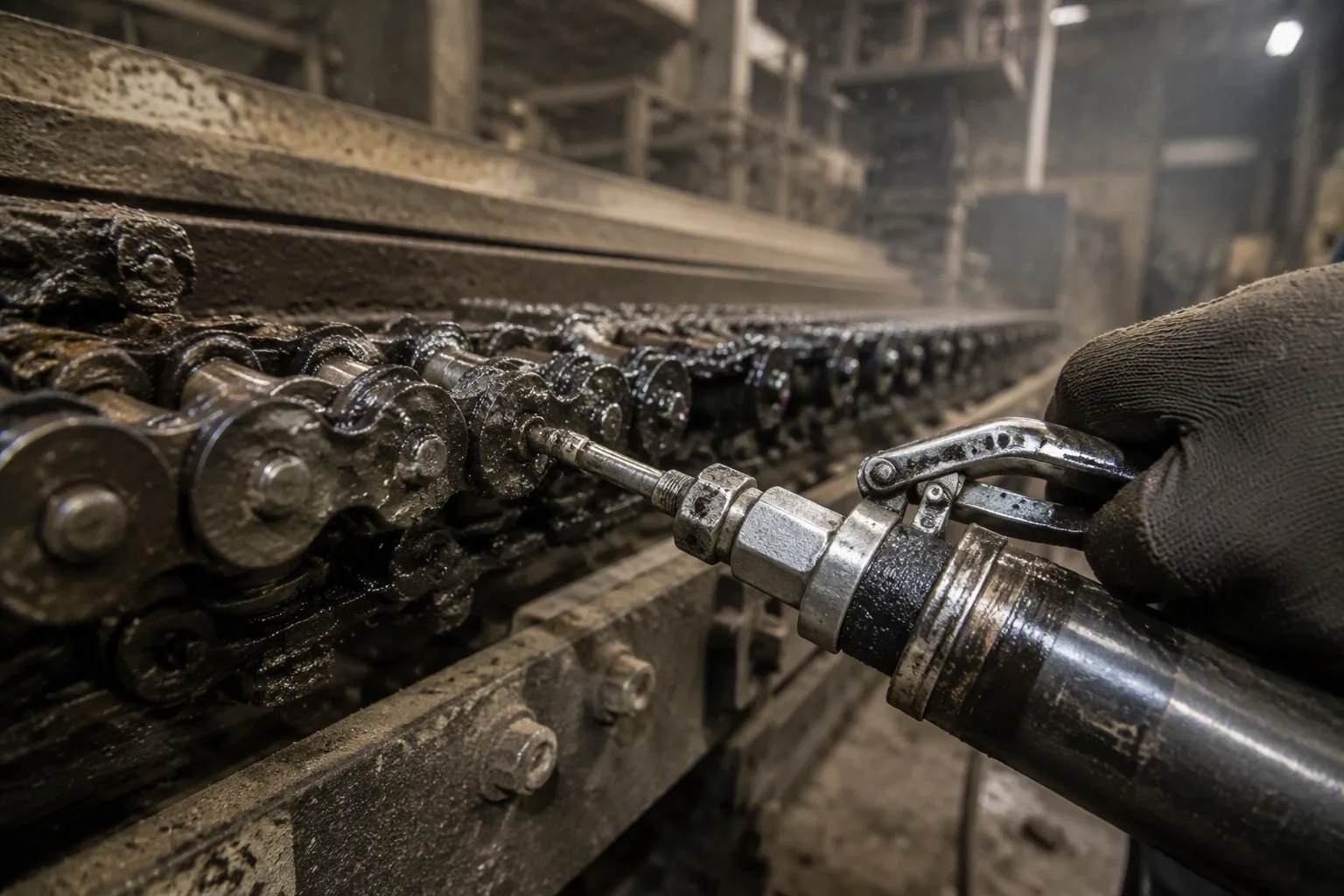
Apply grease generously to the chain’s interior surfaces. Focus on the area where rollers meet side plates, as this location allows the grease to work inward during operation. Use a brush or a grease gun with a chain applicator nozzle for even coverage. You want a visible coating on every link, not just a thin smear.
Run the chain slowly for several minutes after application. This motion helps work the grease into the joint clearances through mechanical action. You might need to apply additional grease after this initial run-in period. The goal is to force some grease into the pin-bushing interface where it can provide actual protection.
For chains that require deeper penetration, consider the “boiling grease” technique. Heat the grease until it becomes fluid, then apply it to the chain while hot. The thinned grease flows into internal clearances before cooling and re-thickening. This method delivers partial internal lubrication that standard cold application cannot achieve. You should repeat this process regularly, as the effect diminishes over time.
Your maintenance schedule must be more frequent with grease than with oil. Plan to clean and reapply grease every 100 to 200 operating hours for continuous-duty applications. Inspect the chain regularly for signs of inadequate lubrication, such as unusual noise or visible wear particles in the grease. Remember that grease for roller chain applications requires this diligent approach to compensate for its inherent penetration limitations. The right chain lubricant for your situation depends on these environmental and operational factors you have assessed.
You now understand the core distinction. For most applications, oil wins because it penetrates pins and bushings while providing cooling. The grease or oil decision ultimately depends on your operating conditions.
Choose grease for roller chain applications only when you face slow speeds, heavy loads, or harsh environments where oil washes away. Assess your speed, load, and exposure first. This evaluation guides your chain lubrication strategy effectively.
If you currently use grease and notice premature wear or elongation, switch to oil. Match viscosity to your speed and load requirements. Regular inspection and proper application will optimize performance and extend equipment life significantly.
FAQ
Can I use WD-40 or engine oil on my roller chain?
No. WD-40 is a solvent, not a lubricant, and will not protect the pin-bushing interface. Engine oil contains detergents that hold wear particles in suspension, creating an abrasive paste. Use a non-detergent SAE 30 or 40 oil instead.
Can I switch from grease to oil without cleaning the chain first?
No. Old grease mixed with fresh oil forms an abrasive paste that accelerates wear. Clean the chain thoroughly with a degreaser, dry it completely, then apply oil. This step protects your investment in the new lubricant.
How often should I lubricate my chain?
Apply oil every eight hours of operation for continuous-duty applications. For grease, clean and reapply every 100 to 200 hours. Frequent small applications work better than occasional heavy doses. Adjust based on your operating conditions.
When does grease actually make sense for a roller chain?
Grease works well for chains operating below 100 feet per minute in wet, dusty, or dirty environments. It resists water washout and stays in place when oil would drain away. Apply it generously and check it frequently.
How do I know my chain needs relubrication?
Listen for squeaking or grinding sounds. Check for visible wear particles on the chain surface. Measure elongation regularly using a chain wear gauge. Replace the chain when elongation reaches 1.5% across six pitches.
See Also
Essential Facts About Lubricants for Harmonic Drive Reducers
How Colloidal Stability in Grease Affects Its Performance
Key Traits That Define Superior Industrial Grease Quality
Modern Automotive Solutions with FAKKT Grease Products
Improving Car Dependability Using FAKKT-GC874K Synthetic Grease