



API CL-4 and FB-4 are the two new diesel oil types from the American Petroleum Institute. First licensing starts January 1, 2027. Here is what matters: API sets oil performance types, your OEM (engine maker) approves what goes in your trucks, and PC-12 is the industry program that developed these types. The “C” prefix marks heavy-duty oils; the “F” prefix marks fuel-efficient ones.
That January date is a first-licensing date, not a required changeover deadline. You plan the switch on your own schedule. Still, 2027 diesel engine oil Canada planning affects inventory, oil change intervals, warranty wording, winter starting, and kilometers between services. This guide gives you a practical path: what changes, how the oils compare, and how to prepare.
Key Takeaways
January 1, 2027 is the first date a license can be issued, not a deadline you must meet to change over. You can make the switch on your own schedule.
CL-4 woCL-4 succeeds. CK-4 with backwardcompatibility, but each engine still needs the correct viscosity and manufacturer specification.is a special oil made only for newer engines. Never use it in older trucks unless the OEM approves it.
Always check your OEM approval list for both the oil category and viscosity grade. This protects your warranty.
Plan for a mixed fleet: keep the oils in separate storage, label them clearly, and budget for two oil types during the transition.
2027 Diesel Engine Oil Canada: What Changes
The January 1 First-Licensing Date
PC-12 is the development name for the two new categories, API CL-4 and FB-4. The American Petroleum Institute (API) sets these heavy-duty diesel oil categories. The timeline follows a fixed plan. Testing requirements were finalized in late 2024. Mid-2025 opened the product qualification phase. Final pass/fail limits were set at the end of 2025. Then 2026 became a required waiting period while suppliers finished testing. First licensing starts January 1, 2027, and PC-12 products should reach stores that month. Both Infineum Insight and Phillips 66 confirm this schedule.
Here is the part many fleets miss. January 1, 2027 is a first-licensing date, not a required changeover deadline. No rule forces every truck onto the new oil that day. You can plan the switch on your own schedule. API makes the service symbols available before the 2027 model year, and that timing lets oil marketers prepare for a smooth transition. Your job is to decide when the change makes sense for your equipment.
New Engines Versus Current Trucks
The new categories exist for a reason. EPA and CARB announced stricter emission limits for the 2027 heavy-duty model year, including a 90% NOx reduction and an emission-control useful life extended from roughly 400,000 to 650,000 miles. OEMs asked the oil industry for better categories, and API gave the go-ahead. Both CL-4 and FB-4 must handle higher operating temperatures, tighter tolerances, and improved oxidation and wear protection.
So what does that mean for your yard? New 2027 engines will arrive designed around these oils. Your current trucks keep running on today’s categories until you choose to switch. CL-4 must stay backward compatible for mixed-age fleets, which helps your 2027 diesel engine oil Canada planning. Map your fleet by model year first. Then you can see which trucks need attention now and which can wait.
CL-4 Vs FB-4 Compared
Versus CK-4 And FA-4
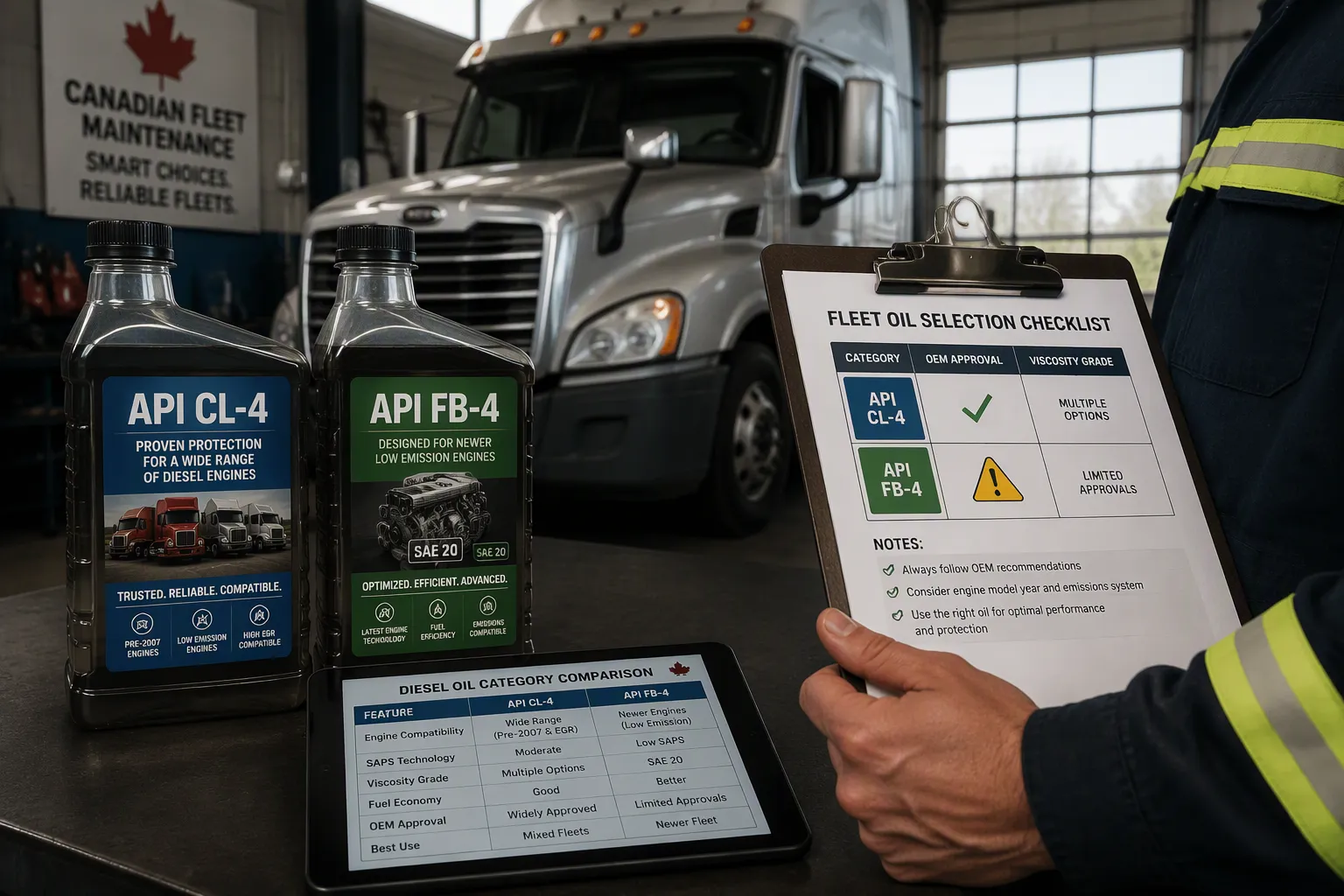
Think of the new categories as a simple swap. CL-4 takes the place of CK-4, and FB-4 takes the place of FA-4. The table below shows them side by side so you can see where each one fits.
Category | Predecessor | Intended engines | Viscosity trend | Backward compatibility |
|---|---|---|---|---|
API CL-4 | CK-4 | A wide range of diesel engines, including many trucks already on the road | Keeps today’s viscosity grades | Made to work with older vehicles |
API FB-4 | FA-4 | Only newer engines approved for it | Lower viscosity, moving toward thinner oils | Not a universal replacement for older engines |
This split matters for your 2027 diesel engine oil Canada planning. CL-4 covers most of your fleet. It handles higher operating temperatures and tighter tolerances, and it should work in older vehicles too. FB-4 goes a different way. It aims at fuel economy in the newer model engines now being built, and the industry is watching SAE 20-weight oils in this category. That is a big step for the industry, as Infineum Insight notes in its PC-12 coverage.
So treat FB-4 as a specialty oil, not a default choice. It fits engines built and approved for it. It does not fit older engines, and you should never pour it into a truck just because it is newer on the shelf.
OEM And Backward Compatibility
Your OEM approval list has the final say here. Check two things for every truck: the oil category and the viscosity grade. A category approval does not automatically cover every viscosity inside it. Engine makers publish their own approval lists, and those lists can differ from truck to truck in the same fleet.
Backward compatibility gives you room to move. CL-4 should serve both your older units and your 2027 arrivals, which makes a mixed fleet simpler. That said, confirm it against each OEM’s published approvals before you commit a bulk tank. Phillips 66 and Infineum both track the PC-12 timeline, and both point fleets back to manufacturer guidance for fitment.
One simple habit pays off here. Build a basic sheet with truck model year, engine make, current oil category, current viscosity, and OEM approval status. Update it as you talk to suppliers. That sheet turns a confusing shelf into a clear plan, and it keeps your warranty language honest when service records get reviewed.
Canadian Winter And Mixed Fleets
Cold Starts And Viscosity
Cold mornings are hard on the wrong oil. The lower the W-rating, the faster the oil flows when cold and the easier the engine starts. That one rule shapes your winter planning more than any label on the pail.
Viscosity Grade | Cold Range (°C) | Cold Cranking Behavior |
|---|---|---|
0W20 | down to -40°C | Flows fastest, easiest turnover |
5W30 | -35°C to +35°C | Faster cold flow than thicker oils |
Higher-viscosity oils | Thickens notably as temperatures drop | Slow circulation, poor cold starts |
At -20°C, a 5W-40 flows much faster than a 15W-40. The regular 15W-40 moves slowly, while the 5W-40 synthetic flows freely. Below -15°C, a 15W-40 means slower oil flow, more strain on the battery and starter, and a longer idle warm-up.
“Temperatures below -10 Celsius heighten the risk, with significant increases in problems at -15C to -20C… During those first 30 to 60 seconds, components may operate with inadequate lubrication.”
So match the W-rating to your coldest mornings, and check the grade against your OEM approval list. Never choose a viscosity on price alone.
Mixed-Fleet Planning
Your yard probably holds three generations of trucks. Match CL-4 to older and broad-range engines, and save FB-4 for newer engines approved for it. That split keeps your 2027 diesel engine oil Canada plan simple and your warranty language clean.
Then plan by distance. Track kilometers between services for each unit, and set your intervals from OEM guidance instead of one fleet-wide number. A truck running short winter routes adds kilometers differently from a long-haul unit, so distance-based planning beats calendar guessing. Review those numbers each season, and adjust as your mix changes.
2027 Diesel Engine Oil Canada: Fleet Checklist
Inventory, Intervals, Budget
You have the background now. Here is where you turn it into action. Work through these steps in order, and keep notes as you go.
Confirm the January 1, 2027 first-licensing date against official API sources and your OEM’s own bulletins. Dates and details can shift, so check the primary source rather than a secondhand summary.
Map which trucks are affected. List each unit by model year, engine make, current oil category, and current viscosity. Flag the 2027 arrivals separately from the older units.
Review your oil change intervals. Pull the OEM guidance for each engine family, and compare it with what your shop actually does. Note any place where your current practice runs ahead of or behind the book.
Read your warranty language closely. Look for wording about required oil categories and approved viscosities. A mismatch here can cost you a claim later.
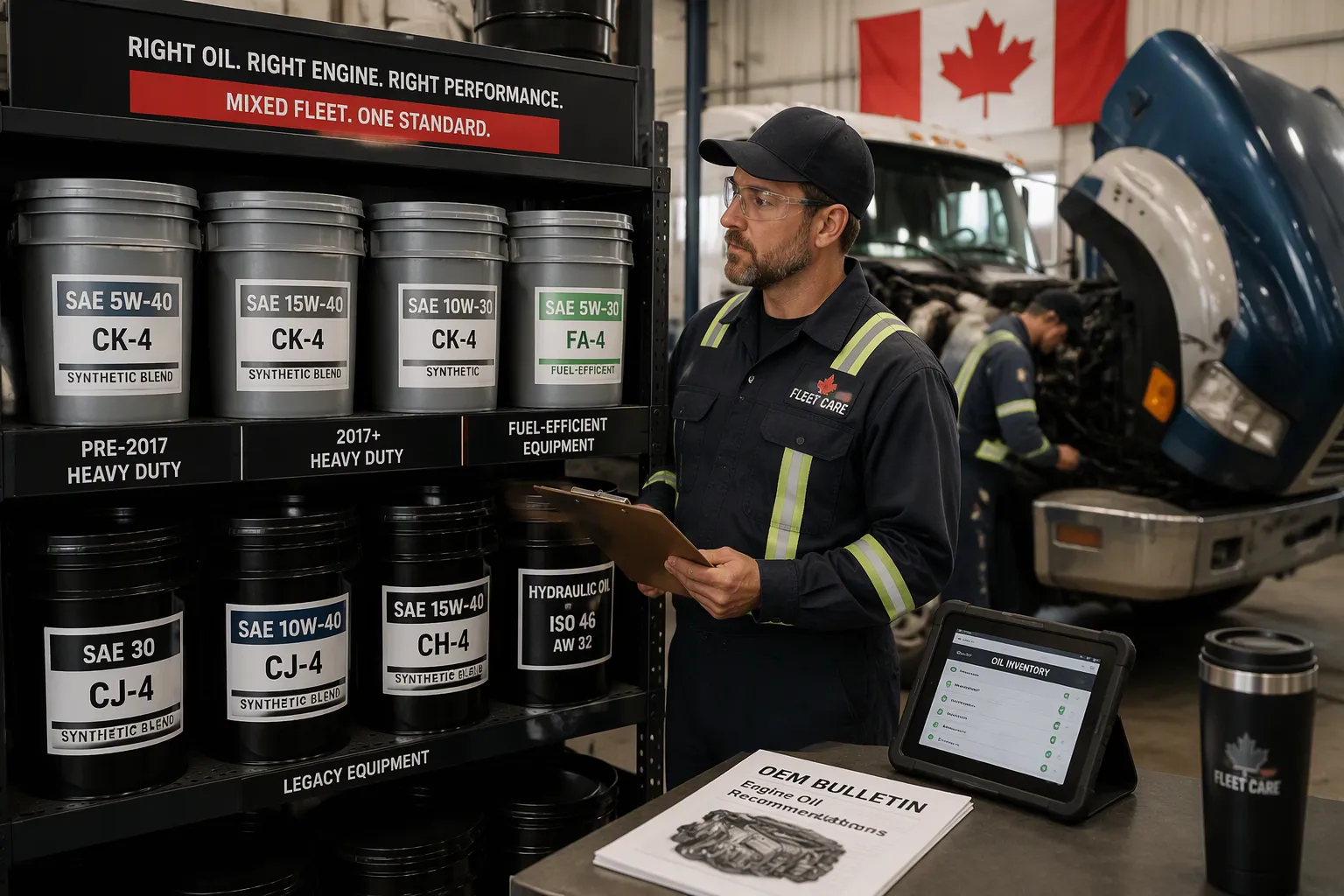
Plan inventory and budget for a mixed-fleet transition. You may run two categories side by side for a season or more. That means separate storage, clear labeling, and a budget line for both.
That last point deserves a second look. A mixed fleet does not switch overnight. Your older units may stay on CK-4 for a while, your 2027 trucks arrive on CL-4, and a few newer engines may call for FB-4. Plan your tank space and your purchasing around that reality. Keep the categories physically separated in the shop so nobody grabs the wrong pail on a cold morning.
Supplier And OEM Talks
Pick up the phone before you pick up a purchase order. Talk with your oil suppliers about your equipment list and your service schedule. Ask them what they recommend for each engine family, and ask for the relevant technical data sheets. Those sheets give you the real numbers on viscosity, approvals, and performance claims.
Do the same with your OEMs. Engine makers publish approval lists, and those lists are the final word on what goes in your trucks. Ask directly which categories and viscosities they approve for each model year you run. Get the answer in writing if you can.
Bring your mapped truck list to both conversations. A supplier who sees your actual mix can give you sharper guidance than one working from a generic pitch. The same goes for your OEM contact. Specific questions get specific answers.
One more habit helps. File every data sheet and approval letter where your shop can find it. When a technician, a warranty auditor, or a new hire needs the answer, nobody should have to guess. That simple filing system keeps your 2027 diesel engine oil Canada plan on track all year.
Check the January 1, 2027 first-licensing date with official API and OEM sources. List which trucks in your fleet are affected. Review your oil change intervals and warranty wording. Then plan inventory and budgets for a mixed-fleet switch. Think about winter as well. Check cold starts in Celsius, train your staff, and set intervals by kilometers.
Your 2027 diesel engine oil Canada plan works best when you build it around your own equipment list. Contact Hecheng Lubricant Material to talk about your equipment needs and ask for the relevant technical data sheets.
FAQ
Do I have to switch my whole fleet on January 1, 2027?
No. That date is a first-licensing date, not a mandatory changeover deadline. You set your own schedule. Plan the switch around your equipment, your service intervals, and your supplier’s stock. Confirm the date against official API and OEM sources before you commit a budget.
Which oil fits my older trucks?
CL-4 is your likely fit. It succeeds CK-4 and should stay backward compatible with older vehicles. Check your OEM’s approval list for both the category and the viscosity grade before you fill a bulk tank. FB-4 is not a universal replacement, so keep it away from older engines.
Can I run FB-4 in any 2027 truck?
Only if the engine maker approves it. FB-4 succeeds FA-4 and targets newer engines built for lower-viscosity oil. A 2027 model year alone does not guarantee approval. Ask your OEM which categories and viscosities they list for each engine family, and get the answer in writing.
Will the new oils change my oil change intervals?
Possibly, but do not assume longer drains. Pull the OEM guidance for each engine family and compare it with your current practice. Set intervals by kilometers and by your actual duty cycle. A blanket drain extension is not a safe default for a mixed fleet.
What should I ask my supplier first?
Bring your mapped truck list. Ask which category and viscosity they recommend for each engine family, and request the relevant technical data sheets. Those sheets give you the real numbers on approvals and performance. File them where your shop can find them later.
See Also
Innovative FAKKT Grease Solutions Addressing Today’s Automotive Industry Challenges
Technical Bulletin: Improving Automotive Reliability Using FAKKT-GC874K Synthetic Grease
Essential Information About Grease for Harmonic Drive Reducers
Understanding the Role of Antioxidants in Lubricants
Underrated Silicone Oils: The Best Friend for Your Plastic Parts