


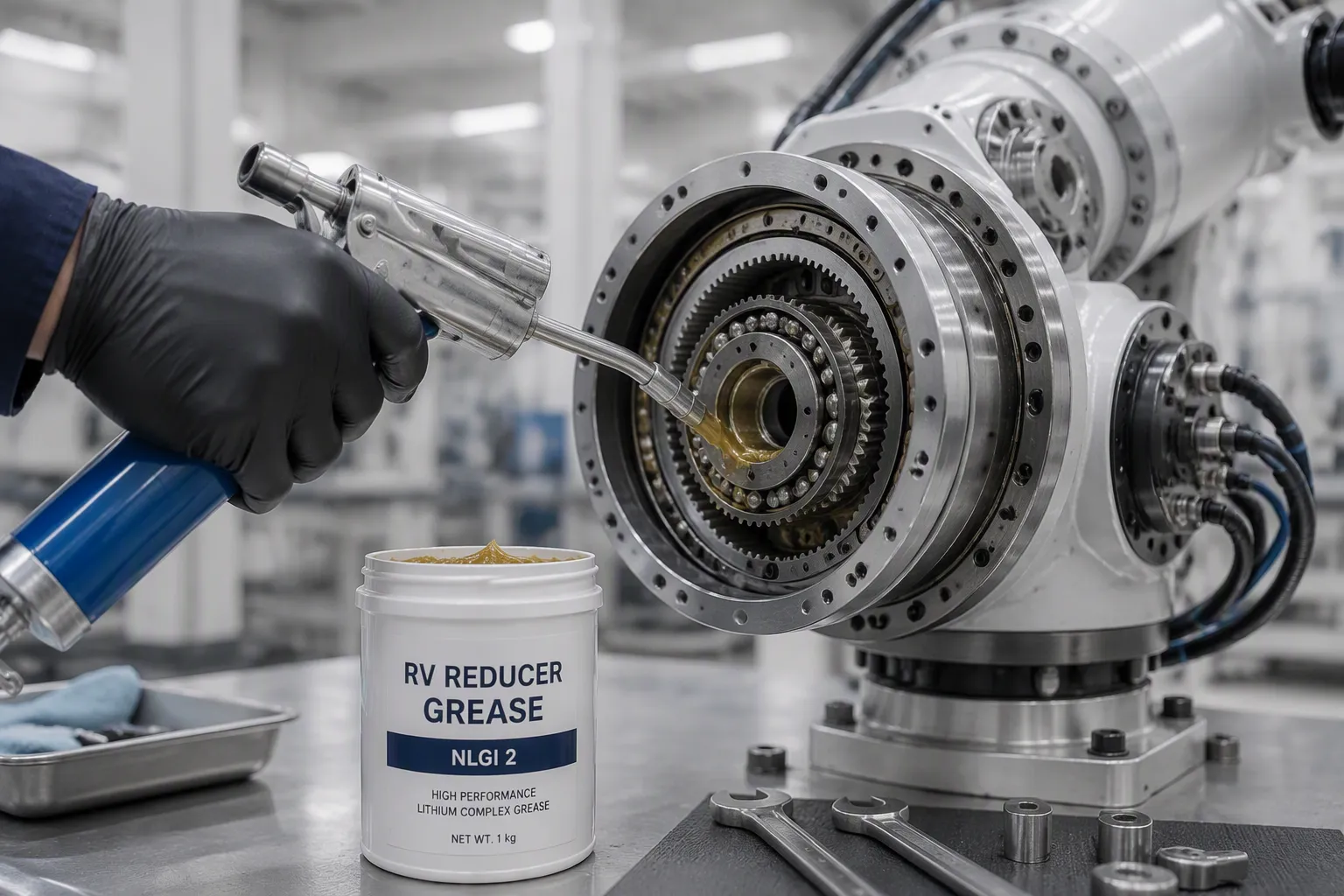
Key Operational Takeaways
Backlash Integrity: Proper grease formulation limits micro-pitting and severe adhesive wear, preserving positional accuracy below the critical threshold over millions of duty cycles.
Elastohydrodynamic Lubrication (EHL): Adequate base oil viscosity and tailored extreme-pressure chemistry prevent boundary lubrication regimes under extreme tooth contact pressures.
Thermal Management: Low-shear, synthetic formulations minimize viscous dissipation, reducing internal heat generation and seal degradation.
Failure Prevention: Improper lubricant selection leads directly to grease channeling, tribo-oxidation (fretting corrosion), and catastrophic surface spalling.
Tribological Dynamics of RV Reducers
RV (Rotary Vector) reducers integrate a dual-stage planetary-cycloidal transmission. The primary stage consists of a spur gear reduction, while the secondary stage utilizes cycloidal discs driven by eccentric shafts engaging fixed pin-gear housings.
Contact Mechanics & Efficiency Comparison
The contact mechanics within the cycloidal stage exhibit combination sliding and rolling contact under line-load geometries. Hertzian contact pressures frequently exceed under nominal peak acceleration conditions.
Reducer Architecture | Kinematic Efficiency | Contact Regime | Primary Wear Mechanism |
RV (Rotary Vector) | >85% | Rolling/Sliding Line Contact | Micro-pitting, Fretting Corrosion |
Harmonic Drive | ~80% | Sliding Surface Flex-Spline Contact | Tooth Flank Scuffing, Fretting |
Standard Planetary | 90~95% | Rolling Line Contact | Fatigue Spalling, Pitting |
The mechanical efficiency of the RV configuration relative to strain-wave (harmonic) gearing reduces structural thermal loading. However, tightly toleranced internal clearances demand lubricants with exceptional shear stability and flowability to guarantee continuous replenishment at the cycloid-pin interface.
Physicochemical Property Requirements
1. Base Oil Selection & Rheology
Synthetics such as Polyalphaolefins (PAO) or synthetic ester blends are strongly preferred over Group I/II mineral oils. Synthetics demonstrate a superior Viscosity Index (VI), low volatility, and elevated thermo-oxidative resistance.
Apparent Viscosity & NLGI Grade: RV greases are formulated at semi-fluid consistencies (NLGI Grade 00 or 000) to ensure rapid slumping back into the mesh zone, preventing channeling (a state where grease is pushed aside, leaving contact surfaces starved of oil).
Speed Factor Limits: Designed for speed factors , balancing dynamic viscous drag against centrifugal fluid separation.
2. Thickener Matrix & Mechanical Shear
Lithium Complex or specialty Organic Polyurea thickener matrices provide robust mechanical shear stability. Under intense shear rates within the roller bearings and pin-mesh zones, the thickener structure must temporarily bleed base oil without undergoing irreversible structural breakdown (softening).
3. Additive Systems Formulation
Extreme Pressure (EP) & Anti-Wear (AW): Ashless or low-ash Sulfur-Phosphorus (S-P) chemistry forms sacrificial boundary films, preventing scuffing under severe impact loading.
Anti-Oxidants (AO): High-temperature aminic and phenolic antioxidants extend grease oxidation life.
Corrosion Inhibitors (CI): Neutralize acidic breakdown products and protect ferrous interfaces against ambient moisture ingress.
Performance Benchmarks: Standard Industrial vs. OEM RV Grease
Performance Metric | Standard Lithium EP2 | Dedicated Synthetic RV Grease (e.g., Nabtesco RV Grease LB00) | Standard Test Method |
NLGI Consistency | Grade 2 | Grade 00 / 000 | ASTM D217 |
Base Oil Viscosity (40℃) | 150~220 cSt | 30~50 cSt | ASTM D445 |
Low-Temp Breakaway Torque (-10℃) | Baseline (100%) | -25% to -40% Torque Reduction | ASTM D1478 |
Four-Ball Weld Load | <250kgf | ≥ 400kgf | ASTM D2596 |
Copper Strip Corrosion | 1b | 1a | ASTM D4048 |
Failure Modes & Tribological Pathology
Adhesive Scuffing & Micro-pitting
Mechanism: Inadequate fluid film thickness () forces contact into the boundary lubrication regime. Asperities weld under instantaneous flash temperatures and shear off.
Consequence: Rapid accumulation of backlash exceeding the threshold, causing spatial positioning drift at the robot end-effector.
Tribo-Oxidation (Fretting Corrosion)
Mechanism: Oscillatory micro-motion between cycloidal pin sleeves and housing bores depletes local lubricant films, generating abrasive iron oxide debris (Fe2O3).
Consequence: Debris acts as a lapping compound, accelerating roller bearing wear and raceway spalling.
Thermal Runaway and Elastomer Degradation
Mechanism: High-viscosity or over-filled grease induces extreme fluid friction (churning loss). Internal temperatures exceed continuous operational thresholds ().
Consequence: Elastomeric dynamic shaft seals undergo thermal hardening/nitridation, leading to lubricant leakage, atmospheric contamination, and gear set seizure.
Lubrication Management & Lifecycle Protocols
Selection and Compatibility Guidelines
OEM Specification Adherence: Always utilize lubricants qualified by the equipment manufacturer. Never substitute standard industrial NLGI 2 greases for semi-fluid precision lubricants.
Chemical Compatibility Guardrails: Never mix different thickener chemistries (e.g., Lithium Complex with Polyurea) or incompatible base oils (e.g., PAG with PAO). Thickener interaction can trigger immediate phase separation, structural collapse, and total oil bleed.
Re-lubrication Intervals
Standard Operating Conditions: Complete lubricant exchange is required every 12,000 to 20,000 operating hours or 3 to 5 calendar years, whichever occurs first.
Severe Operating Conditions: In high-ambient environments (such as foundries or press shops) or continuous high-acceleration duties, apply an environmental derating factor of to (reducing replacement cycles to 3,000–8,000 operating hours).
Frequently Asked Questions
How do field engineers identify grease degradation in an RV reducer prior to mechanical failure?
Analytical sampling combined with vibration monitoring yields early detection. Key physical indicators include severe darkening (thermo-oxidative degradation), base oil separation, a burnt odor, and elevated iron debris concentrations () determined via analytical ferrography or ICP spectroscopy. Operational indicators include unexplained spikes in servo motor current draw and abnormal acoustic signatures.
Is it acceptable to flush an RV reducer housing with solvent during maintenance?
No. Solvents leave residual fluid that dilutes fresh grease and damages internal elastomeric seals. Recommended flushing procedures require purging the unit using the target grease itself under slow rotation until clean grease exits the exhaust port.
Why are higher-consistency greases (NLGI 2) unsuitable for precision RV reducers?
NLGI 2 greases exhibit high yield stress. In compact, high-speed cycloidal gearboxes, high-consistency grease suffers from channeling. The cycloidal disc cuts a permanent trough through the grease mass, preventing fresh lubricant from slumping back into the contact zone. This leads to dry contact, rapid temperature rise, and premature failure.
See Also
Key Traits That Define Superior Industrial Grease Performance
How FAKKT-GC874K Synthetic Grease Boosts Automotive Dependability
Modern Automotive Issues Solved by FAKKT Grease Products
Colloidal Stability In Grease And Its Effect On Performance
FAKKT-UB 45001 Sets Tribological Benchmark For Extreme Conditions